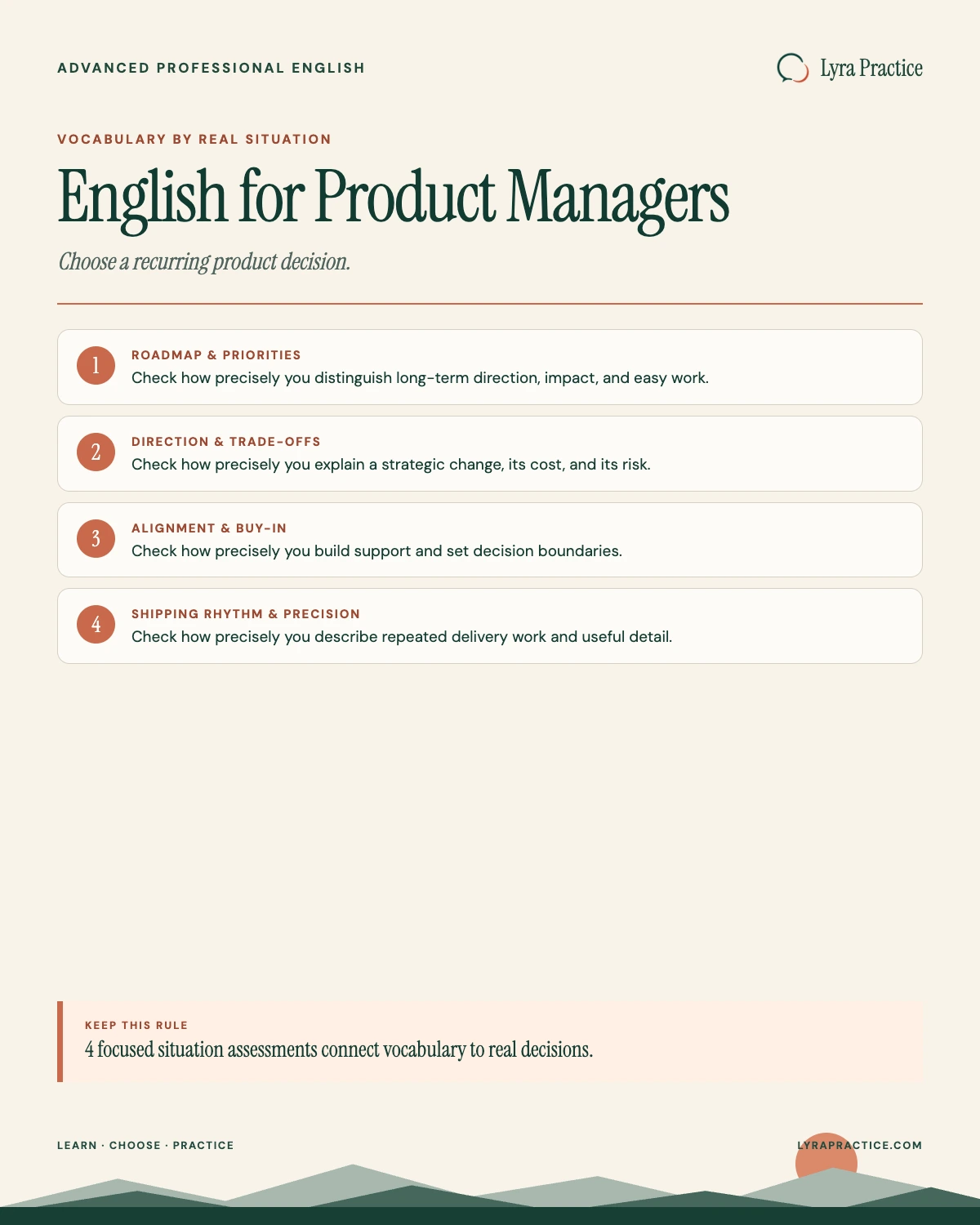
English for product managers

Make product decisions clearacross every function.

Learn the English product managers use to explain priorities, make trade-offs visible, build cross-functional support, and describe delivery precisely—then practice it in realistic product conversations.

For product managers who already work in English and want to communicate product judgment with more precision and confidence.

Product management English visual guide organized around real communication situations
Vocabulary for Product management organized around the situations where precision matters.

Try a real Lyra Practice exercise

Trade-off

Free · No account needed

The team can launch this month with manual account setup, or delay six weeks to automate it. Which update makes the trade-off explicit?

From understood to precise

Sound like the product manager who can make the choice legible.

Strong product communication names the direction, the benefit, the cost, and the decision boundary. Precision helps teams disagree productively and still move.

Roadmap reviewPRJ-01

This work is our top priority.

Blocked
Roadmap reviewPRJ-01

“Our north star is faster time-to-value; this onboarding work is the current priority because it directly shortens it.”

Separates the durable decision guide from the work that matters now.

Unblocked
Launch decisionPRJ-02

Launching now has some downsides.

Blocked
Launch decisionPRJ-02

“The trade-off is speed versus operating effort: we learn from customers sooner, but support handles setup manually for six weeks.”

Names both what the team gains and what it accepts in exchange.

Unblocked
AlignmentPRJ-03

Everyone has seen the proposal.

Blocked
AlignmentPRJ-03

“The proposal is approved, but we still need engineering and support buy-in before the rollout can work.”

Distinguishes awareness and approval from willingness to support execution.

Unblocked

Choose what you want to communicate

Start with the conversation in front of you. We'll surface only the expressions that fit.

Your situation

Roadmap & priorities

Connect near-term work to a durable direction and distinguish easy work from meaningful impact with language that makes your intent and next step clear.

Check your communication in this situation

Expressions for this conversation

How Lyra Practice works

Learn each expression deeply enough to use it naturally.

See how a product decision makes both sides of a choice visible, distinguish a trade-off from a generic downside, then practice communicating a launch decision with feedback.

Example journey · trade-off

Browse the full expression catalogReference material for roadmaps, priorities, product direction, trade-offs, stakeholder alignment, and delivery.36 chosen for product management · 274 expressions in the full library

274 expressions

North Star

Roadmap & Priorities

A north star is the single, durable reference point a team, project, or person uses to decide among competing goals, priorities, or trade-offs — not one goal…

Move the Needle

Roadmap & Priorities

Move the needle means to make a meaningful, roughly measurable difference to an important business result — it separates real impact from effort, activity, or…

Low-Hanging Fruit

Roadmap & Priorities

Low-hanging fruit is a task, opportunity, or improvement that is both easy to achieve and worth doing — not just easy, and not just important or valuable.

Salient

Roadmap & Priorities

Salient describes the point(s) that stand out and deserve attention from within a larger set of facts, risks, or ideas — it's not a fancier word for…

Pivot

Direction & Trade-offs

To pivot is to make a deliberate, decisive change of direction — for a company, product, team, conversation, or career — while carrying forward something real…

Trade-off

Direction & Trade-offs

A trade-off is a situation or decision in which getting more of one thing means accepting less of another. Name both the gain and the cost when you state one.

De-risk

Direction & Trade-offs

To de-risk something means to take a deliberate, concrete action - usually before or during a decision, investment, or commitment - that makes it meaningfully…

Trajectory

Direction & Trade-offs

Trajectory names the direction and shape of a pattern over time — read from multiple points, not a single fact or event — and, by extension, where things are…

Pressure-Test

Direction & Trade-offs

To deliberately challenge or expose an idea, assumption, plan, or system to demanding conditions to find weaknesses.

Defensible

Direction & Trade-offs

Defensible describes a number, assumption, position, or decision that can be justified with the reasons or evidence in hand if someone challenges it; it does…

Reframe

Direction & Trade-offs

To reframe something is to present or consider it through a different perspective, analytic viewpoint, or metaphor.

Socialize

Alignment & Buy-in

In business use, "socialize" means to informally share a not-yet-final idea, plan, or proposal with relevant people before a formal step, so reactions can…

Buy-In

Alignment & Buy-in

The willing commitment of people whose cooperation a plan, decision, or change depends on—not just their formal permission.

Align

Alignment & Buy-in

To bring people, plans, priorities, or work into a consistent arrangement or shared direction.

Stakeholder

Alignment & Buy-in

A person or group with an interest in, influence on, or exposure to the effects of an organization, decision, or project.

Level-Set

Alignment & Buy-in

To level-set is to take a bounded moment, usually at the start of a conversation or a piece of work, to agree the shared baseline everyone will work from: the…

Guardrails

Alignment & Buy-in

"Guardrails" are the boundaries a team, process, or system operates within — clear enough to keep action in an acceptable range, but loose enough to leave real…

Caveat

Alignment & Buy-in

A caveat is a specific limitation that either qualifies an otherwise confident statement or independently flags how far a claim, plan, dataset, or analysis can…

Cadence

Shipping & Delivery

A cadence is a deliberately recurring, established operating pattern — a rhythm a team sets and expects to continue — not a one-time event, a bare frequency…

Streamline

Shipping & Delivery

To streamline a process, workflow, or organization is to make it simpler and more efficient, typically by removing or reorganizing the unnecessary steps,…

Surface (verb)

Shipping & Delivery

To bring a previously hidden, unnoticed, or unspoken issue into view (with an object), or for something hidden to become visible on its own (without an object).

Granular

Shipping & Delivery

Granular describes fine detail or resolution in data, a plan, a discussion, or a setting.

Throughput

Shipping & Delivery

Throughput is the rate at which a team, process, or system actually completes work or processes data over a period — not a one-time total, not a theoretical…

Roll Out

Shipping & Delivery

To introduce something or make it available for the first time to a defined audience; for products and systems, this commonly foregrounds actual access or use.

Keep exploring

Guides by situation

Optional reading for when you want more than the practice path on one situation.

Common questions

Who is this for?

Product managers who already work in English and want more precise language for priorities, strategy, stakeholder alignment, and delivery conversations.

How is this different from English for Project Managers?

This page focuses on product direction, customer impact, roadmap choices, and cross-functional buy-in. English for Project Managers focuses on scope, dependencies, schedules, project risk, and delivery coordination.

Does this teach product strategy?

No. Lyra Practice teaches the language used to communicate product judgment. It does not choose your roadmap, product method, or strategy.

Make the next product decision easier to understand—with more precision.

Practice the language you need to explain priorities, make trade-offs visible, build support, and describe delivery.