
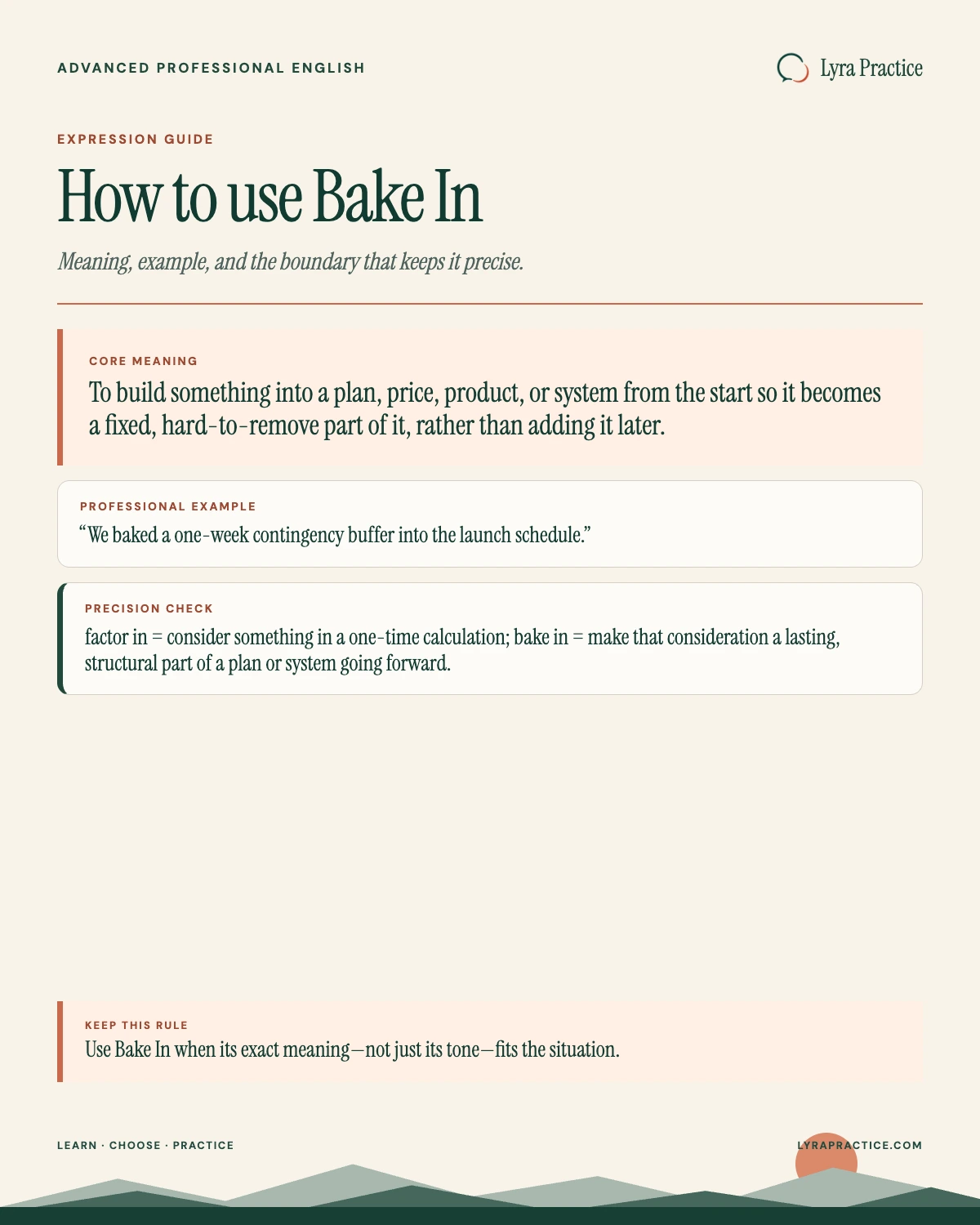
Bake in means to make something part of a plan, price, product, or process. It often suggests that the item was included early and may be hard to change later. The examples below show this idea in four areas of work. They also show common grammar patterns.
Quick check
How well do you know "Bake In"?
You know "Bake In" well.
Keep going with the full learning path — more workplace contexts, related expressions, and practice using it yourself with feedback.
Continue with "Bake In" →There's more to "Bake In" than it seems.
You've got part of it, but the full learning path goes deeper into its nuances, workplace contexts, and when it sounds natural — then gives you practice using it yourself.
Learn "Bake In" in depth →Planning and scheduling
Status update: "We baked a two-week buffer into the delivery date, so a short delay may not move the launch."
Exec note: "The contingency time is already baked in -- if the work stays on plan, we may finish early."
Financial forecasting and pricing
Finance memo: "We baked a 3% inflation assumption into next year's budget."
Client proposal: "The quoted price already has the shipping discount baked into it, so it does not appear as a separate line item."
Product and technical design
Engineering Slack: "Accessibility should be baked in from day one, not added only after the redesign ships."
Design review: "Security was baked into the architecture from the start -- that work helped us prepare for the audit."
Try it yourself
Use "Bake In" yourself
Organizational culture
All-hands comment: "Blameless postmortems are baked into how this team works -- they are a regular practice, not a short project."
Grammar: "into" plus a target
When "bake in" names a target, the usual preposition is "into," written as one word: "bake the discount into the price," not "bake the discount in the price."
When the object is a pronoun, put it between the verb and particle: "The buffer matters -- can you bake it in before we send this out?" Do not use "bake in it" for this meaning.
Grammar: the hyphenated attributive form
Before a noun, "baked-in" is usually hyphenated: "baked-in assumptions," "baked-in costs." After a linking verb, it stays two words: "the assumption is baked in."
Report line: "These are baked-in costs, not new spending -- the number hasn't changed since Q1."
What these examples have in common
Every example asks the same basic question: Is this now an integrated part of the plan, price, design, or routine? The answer may matter in different ways. A built-in buffer may help a team manage risk. An old assumption may create risk if no one checks it. The phrase "bake in" does not say whether the choice is good or bad. The rest of the sentence gives that meaning.
Practice scenarios
Practice using bake in in situations like:
- explaining to a stakeholder why a delivery date already accounts for a risk buffer
- describing an assumption embedded in a forecast or price
- contrasting a feature designed in from the start with one added on later
Useful practice phrases:
- "We baked a buffer into the schedule."
- "That assumption is baked into the model."
- "Security should be baked in, not bolted on."
Want to actually use "Bake In" naturally at work?
Understanding it is one thing. Practice its nuances, see how it works in real workplace situations, and use it yourself with feedback.
Start the "Bake In" learning path →One phrase works in four areas. In each case, it presents the item as integrated rather than separate.