
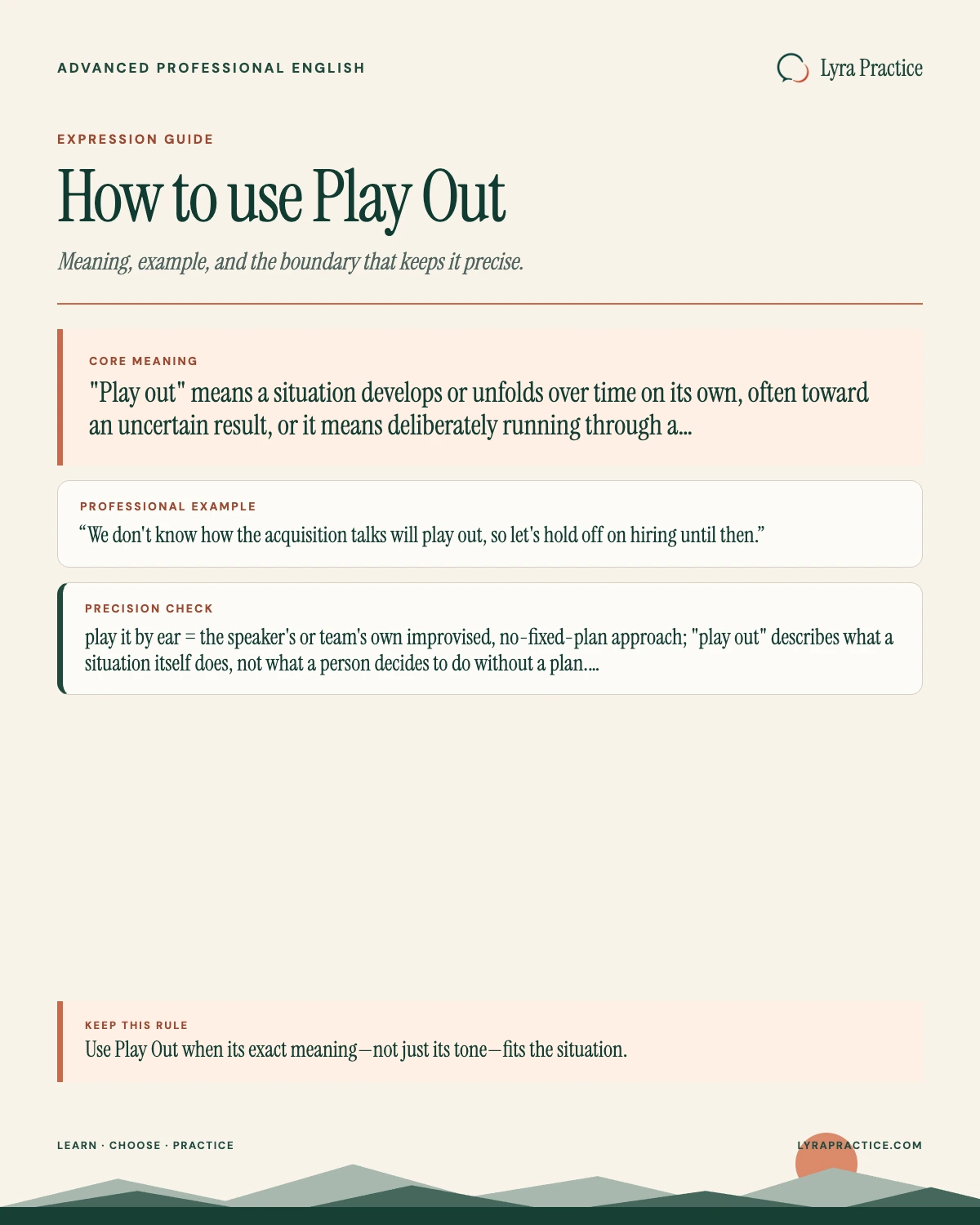
"We'll see how it plays out" marks an outcome as uncertain. It can be professional when the uncertainty is real and clearly bounded.
The phrase avoids a promise such as "this will work." It is shorter than a long account of what remains unknown. Still, it should not hide known risks or needed decisions.
Quick check
Bound the uncertainty
You know "Play Out" well.
Keep going with the full learning path — more workplace contexts, related expressions, and practice using it yourself with feedback.
Continue with "Play Out" →There's more to "Play Out" than it seems.
You've got part of it, but the full learning path goes deeper into its nuances, workplace contexts, and when it sounds natural — then gives you practice using it yourself.
Learn "Play Out" in depth →Use it for genuinely open situations
Use the phrase when the outcome is still open. Say what evidence is missing and what remains within the team's control.
"It's not clear yet how the vendor negotiation will play out -- we'll have more by Friday."
"However this quarter plays out, we're not changing the hiring plan."
Each example adds something firm: a date or an approved decision. The speaker should be able to meet the date and have authority to state the decision.
Try it yourself
Add the next step
Don't leave it as the whole answer
The phrase describes "an unfolding event," not "a plan." Alone, it may sound vague. Add what is known: evidence, a next step, an owner, a date, or a fixed decision.
Thin: "We'll see how it plays out."
Better: "We'll see how the vendor talks play out this week, and we'll have a recommendation for you by Monday either way."
Don't confuse it with executing a plan
"Play out" can describe events unfolding or a scenario being acted through. It does not mean "implementing a plan." "We will play out the rollout plan next quarter" is not natural for execution. Use "execute" or "carry out" if that is the meaning.
The rule
Use "we'll see how it plays out" for a genuinely open outcome. Pair it with evidence, ownership, and the next decision point. Do not use it to avoid action, required disclosure, or accountability.
Practice scenarios
Practice this phrase in situations like:
- updating a stakeholder on a negotiation still in progress
- hedging on a quarter's results without overstating certainty
- pairing the hedge with a concrete next step so it doesn't sound evasive
Useful practice phrases:
- "We'll see how this plays out -- I'll have an update by [date]."
- "It's not clear yet how X will play out."
- "However this plays out, [fixed commitment] doesn't change."
Want to actually use "Play Out" naturally at work?
Understanding it is one thing. Practice its nuances, see how it works in real workplace situations, and use it yourself with feedback.
Start the "Play Out" learning path →State the uncertainty in five words, then add what the team will do next.