
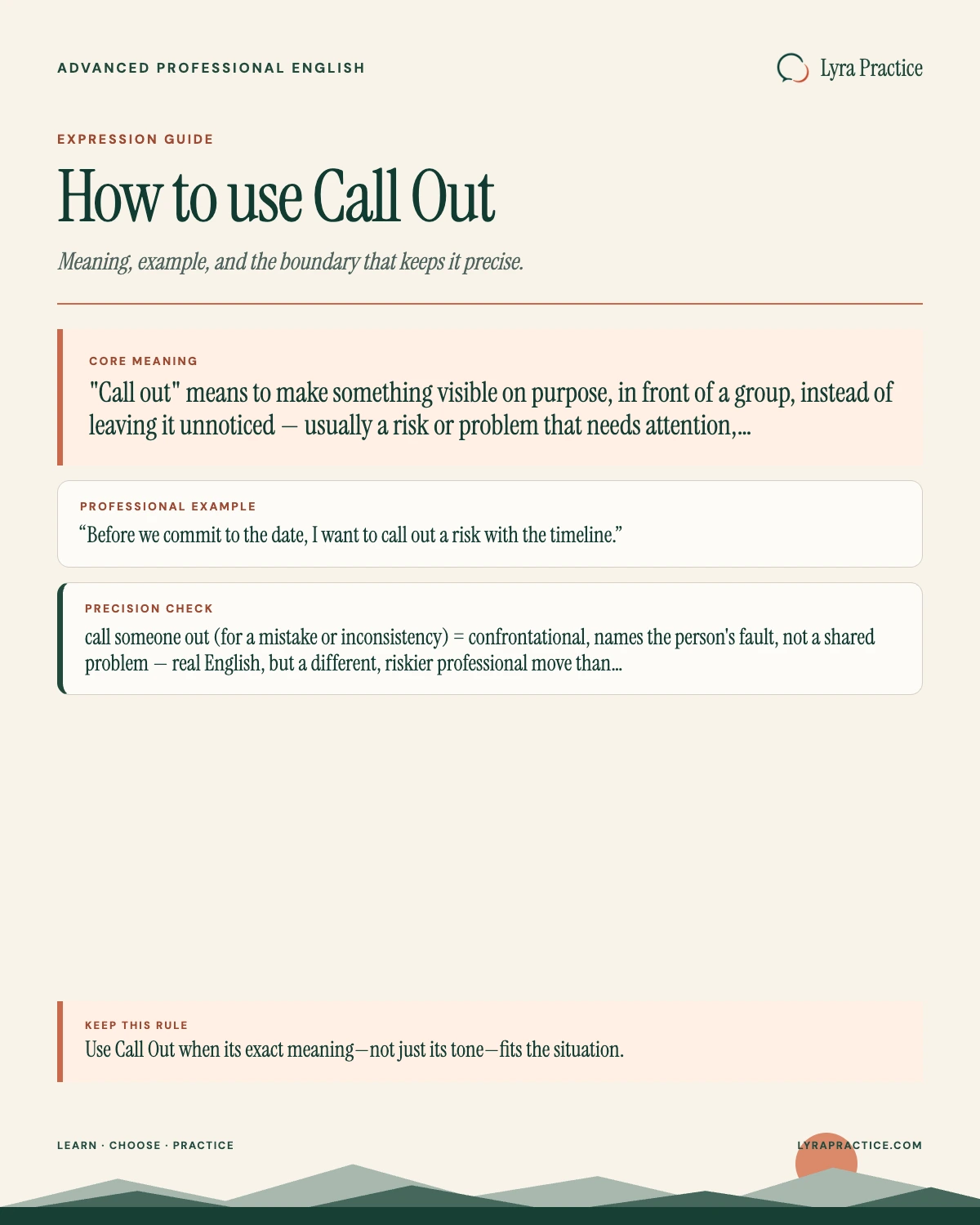
Call out has two useful senses at work: naming a risk or gap, and giving someone public credit. The examples show both senses and explain the rule for a pronoun object.
Quick check
How well do you know "Call Out"?
You know "Call Out" well.
Keep going with the full learning path — more workplace contexts, related expressions, and practice using it yourself with feedback.
Continue with "Call Out" →There's more to "Call Out" than it seems.
You've got part of it, but the full learning path goes deeper into its nuances, workplace contexts, and when it sounds natural — then gives you practice using it yourself.
Learn "Call Out" in depth →Surfacing a risk or gap
Stand-up comment: "I want to call out a risk with this timeline -- the vendor hasn't confirmed the delivery window yet."
Retrospective note: "One thing worth calling out from this sprint: our review process added two days we didn't plan for."
Giving specific public credit
All-hands comment: "I want to call out Priya's work getting this fixed before launch -- she caught it during a routine check, not because anything broke."
Manager 1:1 note: "Just wanted to call out how you handled the client escalation last week -- that was well done."
Calling out a detail inside a document
Deck review comment: "Can you call out the Q3 estimate in the summary slide? It's easy to miss buried in the table."
Try it yourself
Use "Call Out" yourself
The "call out X as Y" pattern
Written review: "I'd call out the current timeline estimate as optimistic, given how the last two milestones went."
Grammar: particle placement with pronouns
With a pronoun object, the particle splits from the verb: "There's a risk in this plan -- can you call it out in the summary?" never "call out it."
What these examples have in common
Each example draws attention to a risk, a gap, or a person's work. The credit examples name a specific action ("caught it during a routine check," "handled the client escalation") instead of offering generic praise. That detail makes the recognition clearer and more credible.
Practice scenarios
Practice using call out in situations like:
- flagging a risk in a status update without sounding like you're blaming anyone
- giving a teammate specific, genuine credit in a recognition moment
- calling out a detail buried in a deck so it doesn't get missed
Useful practice phrases:
- "I want to call out a risk with this timeline."
- "I want to call out [name]'s work on this."
- "Can you call it out in the summary?"
Want to actually use "Call Out" naturally at work?
Understanding it is one thing. Practice its nuances, see how it works in real workplace situations, and use it yourself with feedback.
Start the "Call Out" learning path →The same verb can name a shared problem. It can also give credit for a specific contribution. Calling someone out can also mean criticizing them, so context matters.