
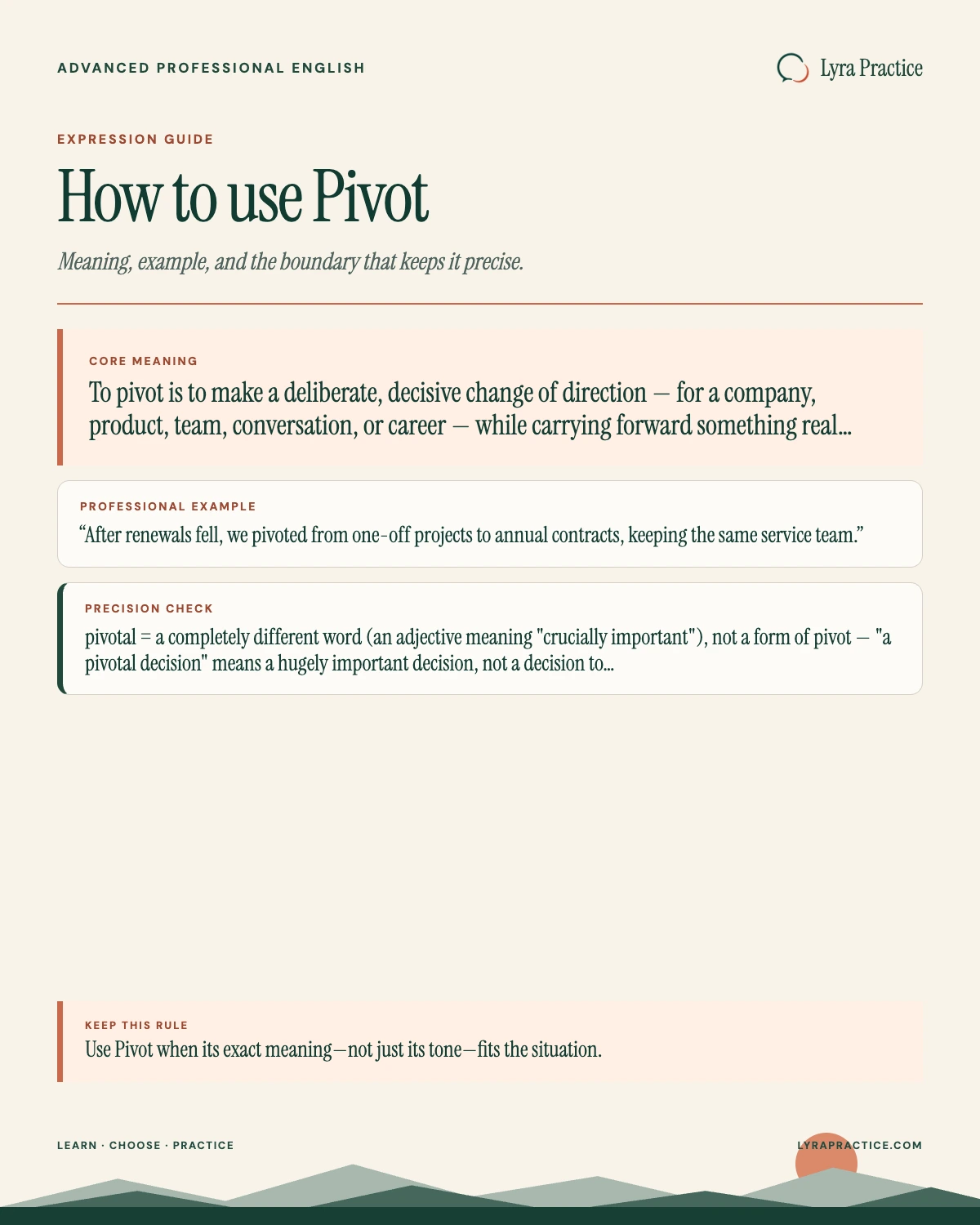
Pivot often appears in strategy updates and status reports, where many people may see and repeat small errors.
Three mistakes appear often. Writers omit "from" after "away" or add an extra consonant to "pivoted" or "pivoting." Readers may also treat "pivots on" as a directional change.
Quick check
Pivot away from or pivot away?
You know "Pivot" well.
Keep going with the full learning path — more workplace contexts, related expressions, and practice using it yourself with feedback.
Continue with "Pivot" →There's more to "Pivot" than it seems.
You've got part of it, but the full learning path goes deeper into its nuances, workplace contexts, and when it sounds natural — then gives you practice using it yourself.
Learn "Pivot" in depth →Mistake 1: "away" needs "from"
"Pivot" often takes a preposition. Common patterns are "pivot to/toward [new focus]," "pivot away from [old focus]," and "pivot from [X] to [Y]." In this pattern, "away" needs "from." Do not omit it.
Wrong: "We're going to pivot away the low-margin accounts." Right: "We're going to pivot away from the low-margin accounts."
To catch this error, read the full sentence aloud and check that "from" follows "away."
Mistake 2: the doubled consonant
Despite this heading, these forms do not double the final consonant. Write "pivoted" and "pivoting" with one t. Adding a second "t" creates a spelling error. This error can appear in announcements and updates that use pivot often.
Wrong: "The team pivotted to a new pricing model last quarter." Right: "The team pivoted to a new pricing model last quarter."
The check is simple: keep the single t before -ed or -ing. Unlike "planned" or "stopped," pivot does not double its final consonant.
Try it yourself
Use "Pivot" yourself
Mistake 3: misreading "pivots on" as directional
This error comes from reading, not spelling or prepositions. "Pivot on" and "pivot around" have a different sense. They mean that an outcome depends heavily on one factor. They do not describe movement toward that factor.
"The launch date pivots on whether legal signs off this week."
Here, the date depends on legal's decision; the launch is not changing direction toward legal. This distinction can be confusing if you know only the directional sense of "pivot."
How to check yourself
The first two checks are simple. Make sure "from" follows "away." Also keep one t in the past and -ing forms. For "pivot on," ask another question. Does the sentence name a dependency? If so, something else must happen first. Or does it name a direction toward a new focus? Only the second meaning describes a strategy change. For a dependency, "pivots on" is correct. It needs no direction preposition.
Catch all three errors before sending an update because announcements, board notes, and status reports often reach many readers.
Practice scenarios
Practice using pivot in these situations.
- writing a status update that redirects strategy away from an old approach
- describing a decision that depends on a single upcoming factor
- proofreading a leadership announcement for spelling and preposition errors
Useful practice phrases to try.
- "We're pivoting away from the low-margin accounts."
- "The team pivoted to a new pricing model last quarter."
- "The launch date pivots on whether legal signs off this week."
Want to actually use "Pivot" naturally at work?
Understanding it is one thing. Practice its nuances, see how it works in real workplace situations, and use it yourself with feedback.
Start the "Pivot" learning path →None of these three mistakes changes what "pivot" means.