
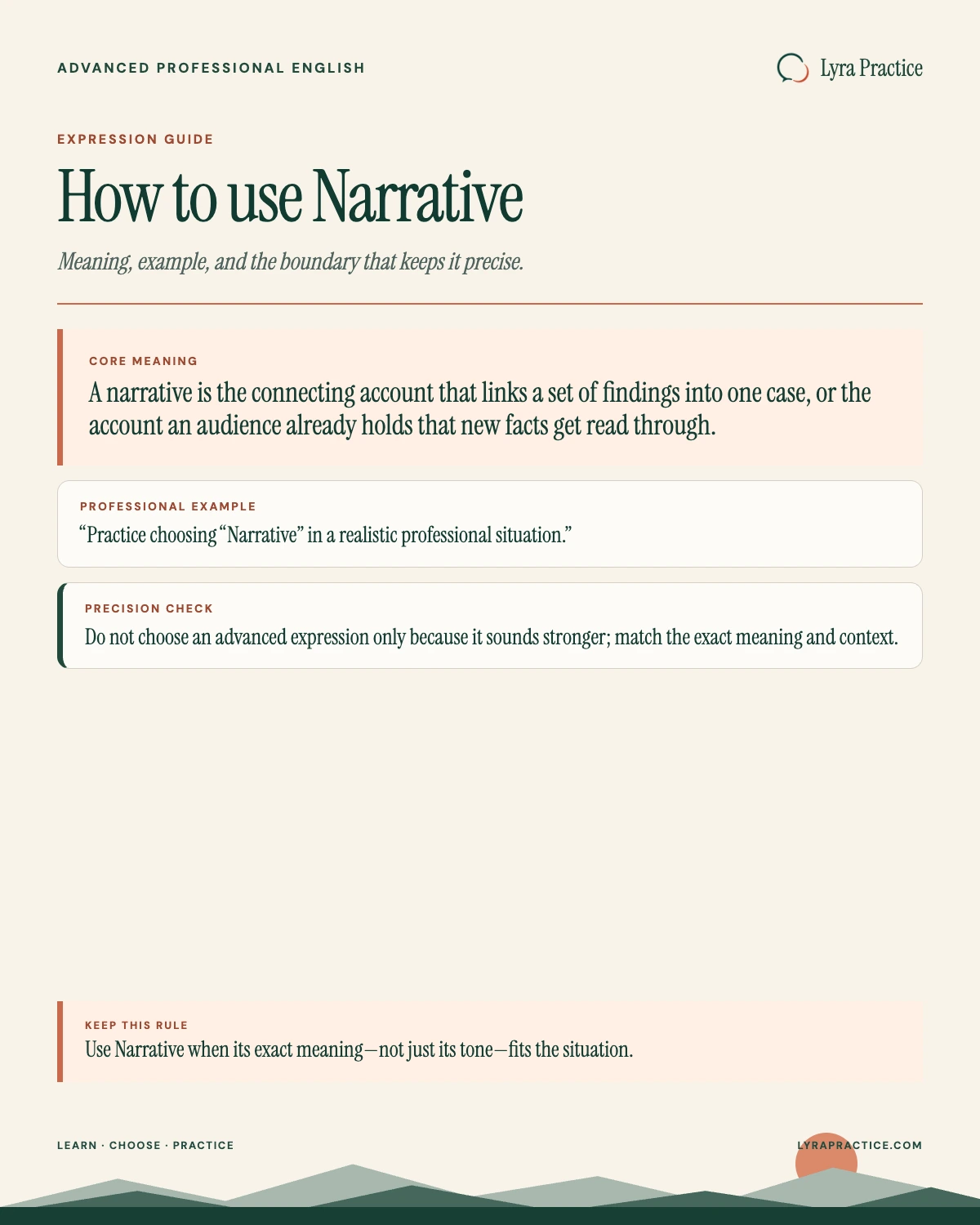
No. This point needs to be clear because "narrative" can cut both ways. Teaching its power without this warning would leave out an important risk. A good narrative organizes real facts into a clear story. It does not replace facts, hide relevant known information, or excuse skipping a required disclosure, review, or correction.
Quick check
How well do you know "Narrative"?
You know "Narrative" well.
Keep going with the full learning path — more workplace contexts, related expressions, and practice using it yourself with feedback.
Continue with "Narrative" →There's more to "Narrative" than it seems.
You've got part of it, but the full learning path goes deeper into its nuances, workplace contexts, and when it sounds natural — then gives you practice using it yourself.
Learn "Narrative" in depth →Framing organizes facts -- it doesn't replace them
The word family includes building, shaping, and controlling a narrative. It also includes getting ahead of one. Each use assumes real facts and honest framing, and that requirement is essential. If a "narrative" omits, downplays, or denies a relevant known fact, the work changes. It becomes an attempt to hide information under a nicer name.
Wrong: "We shaped the narrative by leaving the delay out of the investor update." Right: "The narrative acknowledges the delay directly and explains the corrective steps we're taking."
The difference is not tone or word choice. It is whether the delay appears or stays hidden. Investors may need that fact, so leaving it out does not create a strong narrative. It may create a disclosure failure instead.
Crisis situations: facts first, framing second
In a crisis, a good narrative stays grounded in known facts. It helps people understand those facts, and honesty matters. Name the issue and state what is known. Then build the narrative from that information. Do not choose facts to fit a preferred story.
Crisis: a credible narrative states what's known, what isn't yet known, and what's being done about it -- not whatever version sounds best in the moment.
This gives you a useful test for any crisis draft. Does it state what is known and admit what is still unknown? It should not sound more certain than the facts allow. Does it say what people are doing about the issue? A draft should not fail these tests just to sound better.
Try it yourself
Use "Narrative" yourself
Investor communication: careful, not inflated
In investor communication, a strong narrative links real results to a thesis. It stays careful. A persuasive story cannot replace accurate disclosure.
Investor: a compelling narrative connects real results to the thesis; it doesn't imply momentum the actual numbers don't support.
The same rule applies to investor and pitch narratives. Here, it is a firm limit, not just good practice. A persuasive frame cannot replace accurate disclosure or suggest results that are not real.
The line, stated directly
The serious mistake is treating "shaping the narrative" as permission to hide facts. This includes leaving out, downplaying, or denying a known fact. That is not real communication work; it is hiding information behind a nicer term. Crisis, investor, and compliance work should not reward this behavior. Skillful framing does not change that rule.
Practice scenarios
Practice building an evidence-based narrative in these situations.
- drafting a crisis statement that acknowledges an issue before framing it
- writing an investor update that connects real results to a thesis without overclaiming
- catching a draft that omits a material fact in favor of a better-sounding version
Useful practice phrases to try.
- "The narrative acknowledges [the issue] directly and explains..."
- "Here's what's known, what isn't yet known, and what we're doing about it."
- "This connects the real results to the thesis without implying more than the numbers support."
Want to actually use "Narrative" naturally at work?
Understanding it is one thing. Practice its nuances, see how it works in real workplace situations, and use it yourself with feedback.
Start the "Narrative" learning path →A narrative organizes real facts. It cannot replace them.
This warning is central to the word's proper use. Honest facts make its power legitimate.