
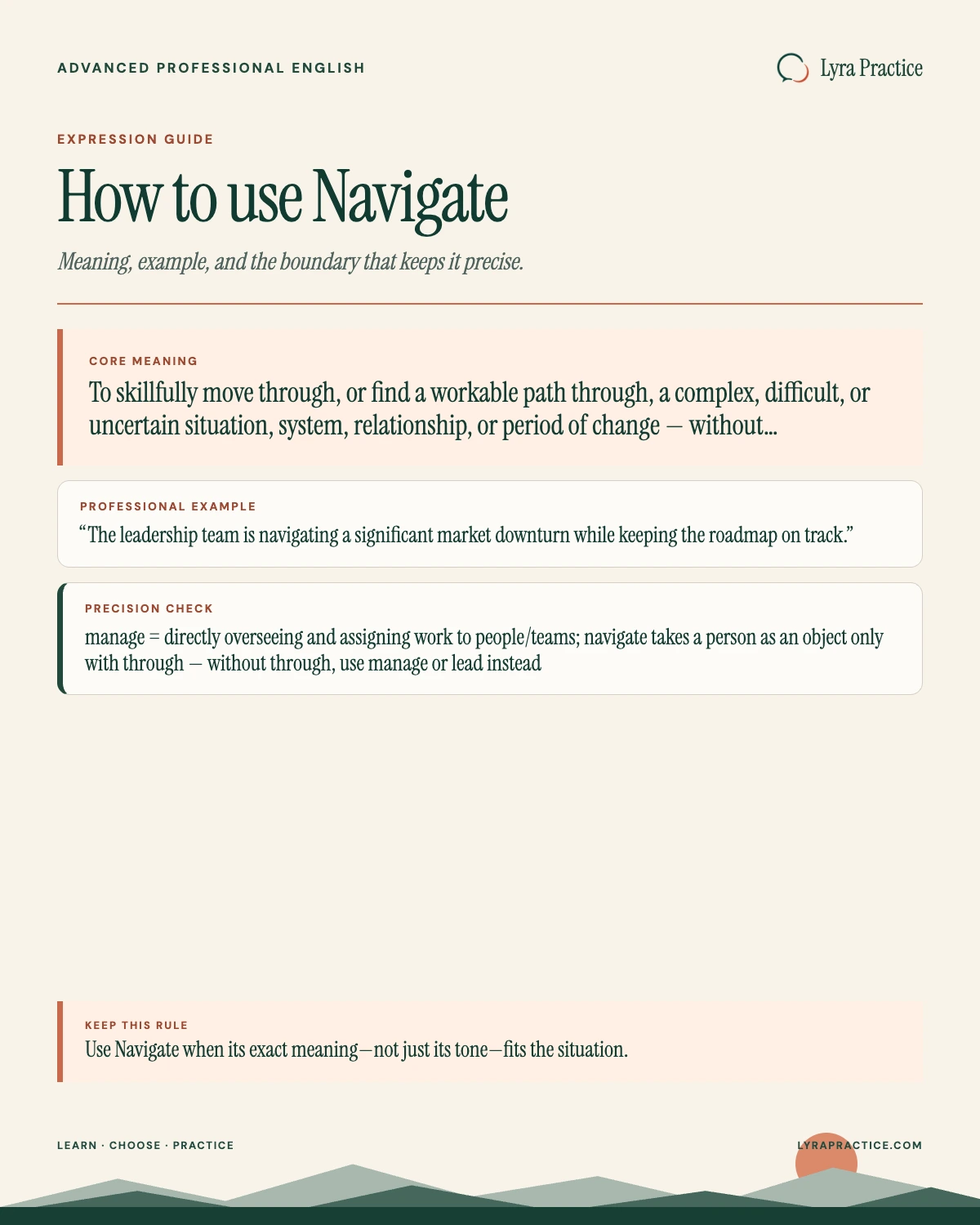
At work, people use navigate for a path through change or hard issues. The verb can show sound judgment without claiming the work is done.
The sentences group the verb by setting. They show how it works across several workplace settings.
Quick check
How well do you know "Navigate"?
You know "Navigate" well.
Keep going with the full learning path — more workplace contexts, related expressions, and practice using it yourself with feedback.
Continue with "Navigate" →There's more to "Navigate" than it seems.
You've got part of it, but the full learning path goes deeper into its nuances, workplace contexts, and when it sounds natural — then gives you practice using it yourself.
Learn "Navigate" in depth →Leadership and change management
Exec update: "We're navigating a significant vendor transition this quarter, and I want to keep the team updated as the timeline firms up."
Internal memo: "The integration team has been navigating two conflicting engineering cultures since the acquisition closed, and we're seeing real progress."
Town hall: "I won't pretend the reorg has been simple. We're navigating it together, and I'll keep sharing what I can as decisions get made."
Self-narrative: interviews and performance reviews
Interview answer: "In my last role, I navigated a period where our biggest client threatened to leave twice in six months -- that taught me more about account management than anything else."
Performance review, self-assessment: "This quarter I navigated a lot of ambiguity around the new reporting structure while still hitting our delivery targets."
LinkedIn post: "Grateful for a team that helped me navigate my first year as a people manager -- still learning, but further along than I expected."
Try it yourself
Use "Navigate" yourself
Client and stakeholder communication
Client email: "We're navigating a supplier delay on our end, and I wanted to flag it before it affects your timeline."
Status update: "The team is navigating some ambiguity in the new compliance requirements -- legal is weighing in this week, and we'll have clarity by Friday."
Difficult conversations and office dynamics
1:1 prep note: "I need to navigate this conversation carefully -- he's not going to like the feedback, but it has to happen before the promotion cycle."
Slack DM to a peer: "Any advice on navigating the politics around this budget request? I don't want to step on toes I don't know are there yet."
What these examples have in common
None of these sentences claims that the problem is fixed. The first phrase does not mean the change is complete. The past-tense phrase shows work through a hard time. It does not promise a good result. The verb can suggest effort and progress without claiming success.
Here, the challenge is unclear, complex, or tied to office politics. The verb can also describe finding a path through a complex system. Still, "I navigated the weekly status report" sounds too strong for a routine task.
Practice scenarios
Practice using navigate in situations like:
- describing a difficult period in an interview without overclaiming the outcome
- flagging an in-progress complication to a client honestly
- narrating a leadership challenge in a performance review
- asking a peer for advice on an ambiguous, politically sensitive situation
Useful practice phrases:
- "We're navigating [situation], and I want to keep you updated as it develops."
- "In my last role, I navigated [difficulty], which taught me..."
- "The team is navigating some ambiguity around [topic]."
- "I need to navigate this conversation carefully because..."
Want to actually use "Navigate" naturally at work?
Understanding it is one thing. Practice its nuances, see how it works in real workplace situations, and use it yourself with feedback.
Start the "Navigate" learning path →Navigate often names work through a hard time, not its end. The setting changes, but that limit remains.