
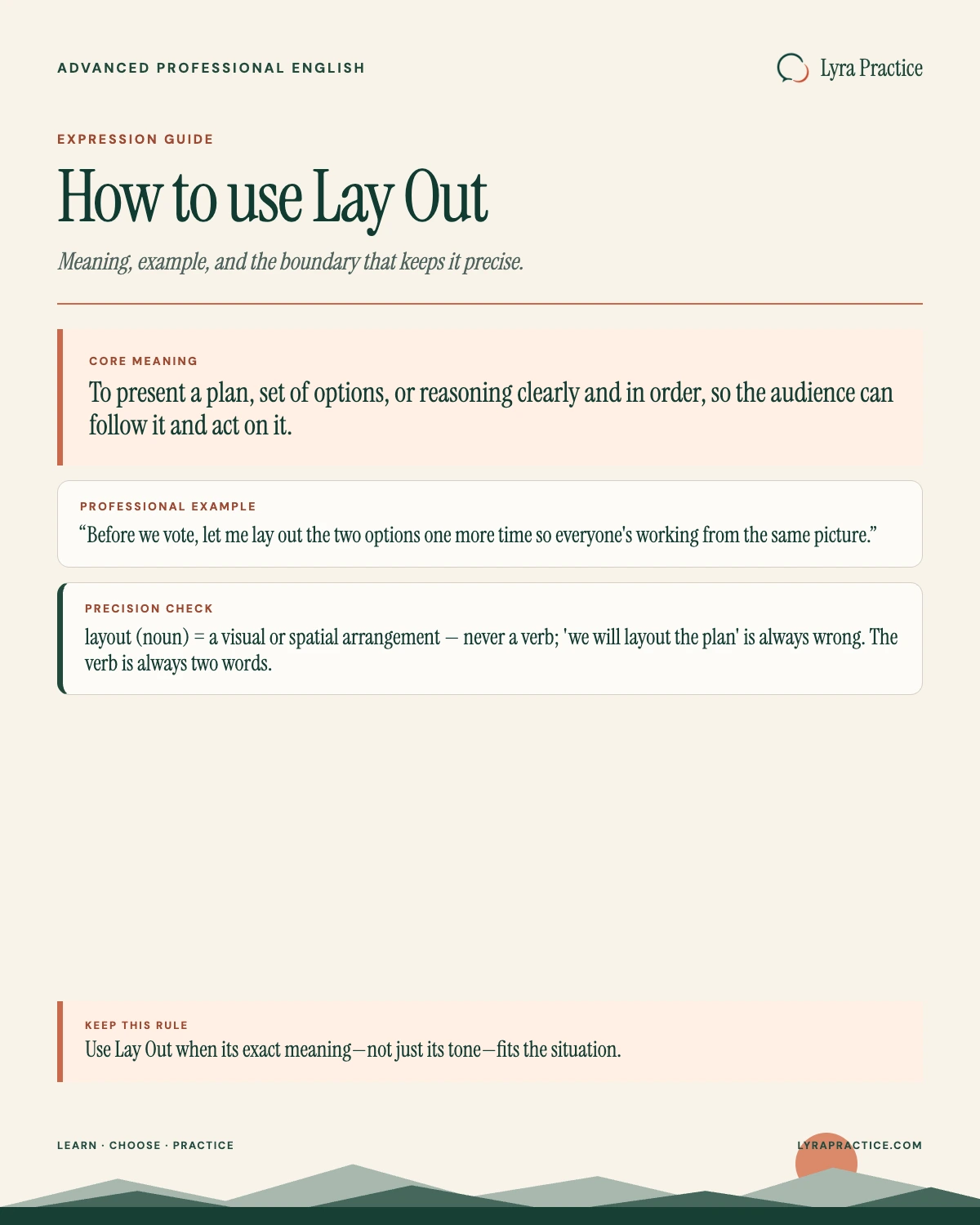
Lay out often means presenting information clearly and in order. You can lay out a plan, options, reasons, or requirements. The verb works in meetings, documents, and everyday messages.
The examples also show its separable grammar and irregular past tense.
Quick check
How well do you know "Lay Out"?
You know "Lay Out" well.
Keep going with the full learning path — more workplace contexts, related expressions, and practice using it yourself with feedback.
Continue with "Lay Out" →There's more to "Lay Out" than it seems.
You've got part of it, but the full learning path goes deeper into its nuances, workplace contexts, and when it sounds natural — then gives you practice using it yourself.
Learn "Lay Out" in depth →Meetings and presentations
Meeting opener: "Let me lay out the plan before we get into questions."
Client call: "I'll lay out the three options we're considering, and then we can talk through trade-offs."
Executive readout: "She laid out the reasoning behind the pricing change in about five minutes, and the room followed every step."
Documents
Contract language: "The agreement lays out each party's obligations in Section 4."
Project plan: "This document lays out the timeline, the budget, and the criteria for success."
Try it yourself
Rewrite it naturally
Separable grammar
Full noun phrase, either order: "Can you lay the options out for the board?" or "Can you lay out the options for the board?"
Pronoun object, split required: "Here's the plan — let me lay it out for you." ("Lay out it" is not correct.)
Irregular past tense
- Status update: "We laid out the requirements last week, so the vendor should have everything they need." (Not "layed out.")
Clause complements
Slack message: "I'll lay out why the timeline shifted before anyone asks."
Team memo: "This section lays out how the new approval process will work."
What these examples have in common
Each sentence presents information for an audience to follow. The information may be a plan, terms, options, or reasoning. A person can lay it out, and a document can do so too.
This sense does not describe events developing or results becoming clear. For those meanings, verbs such as play out or pan out may fit. Lay out focuses on how information is presented.
Practice scenarios
Practice using lay out in situations like:
- opening a meeting by presenting the plan before taking questions
- writing a document section that presents terms or requirements in order
- using the split form correctly with a pronoun object
- getting the irregular past tense right in a status update
Useful practice phrases:
- "Let me lay out the plan before we get into questions."
- "The agreement lays out each party's obligations."
- "We laid out the requirements last week."
Want to actually use "Lay Out" naturally at work?
Understanding it is one thing. Practice its nuances, see how it works in real workplace situations, and use it yourself with feedback.
Start the "Lay Out" learning path →Use lay out when someone presents information clearly and in order.