
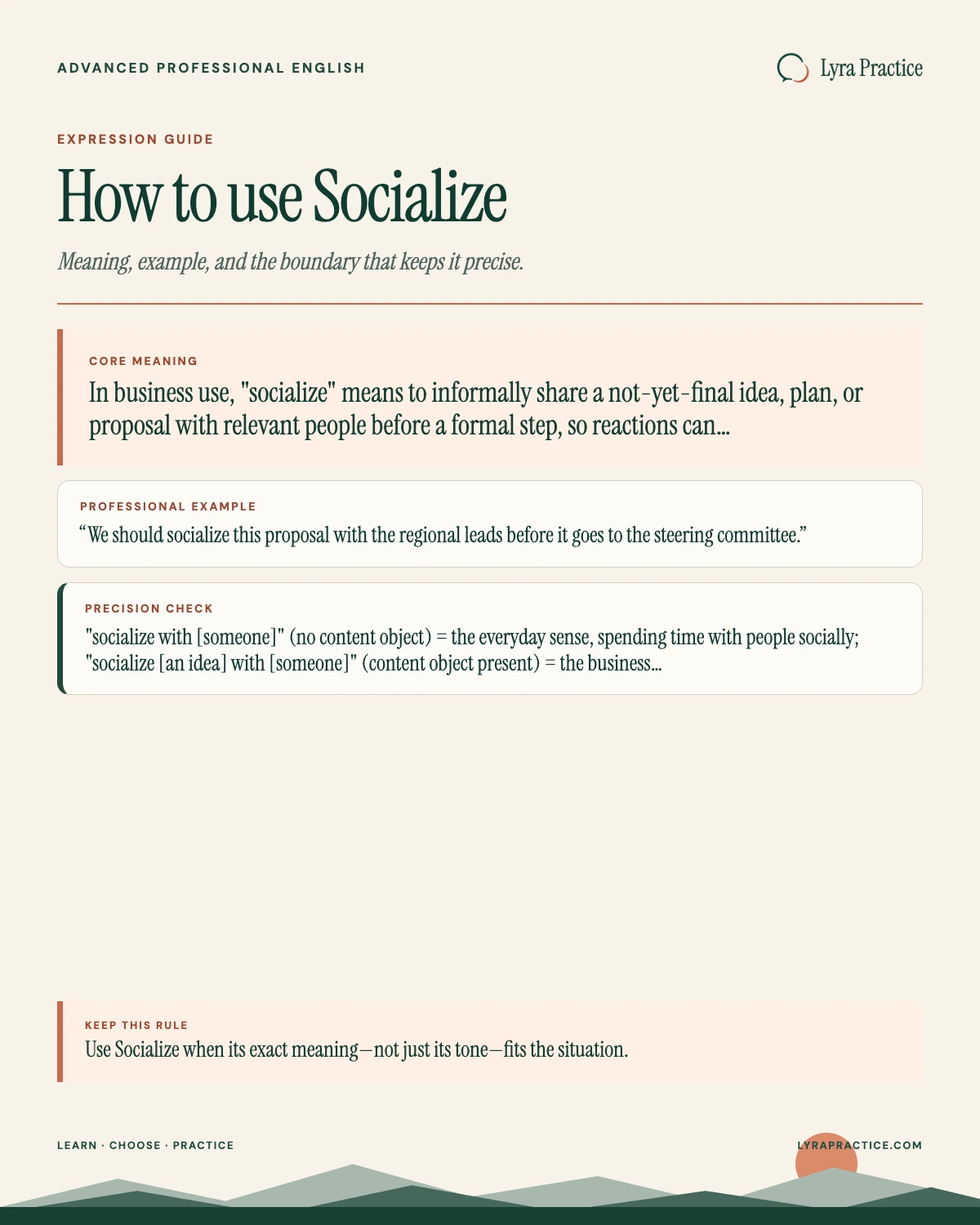
Socialize often suggests that people can still react to or shape an idea, so timing affects what the verb implies.
Usually not. "Socialize" fits best before a decision is locked or announced. Once it is final, "communicate" or "announce" is usually clearer, though some workplaces use socialize more broadly for building awareness or acceptance.
Quick check
Open decision or fixed outcome?
You know "Socialize" well.
Keep going with the full learning path — more workplace contexts, related expressions, and practice using it yourself with feedback.
Continue with "Socialize" →There's more to "Socialize" than it seems.
You've got part of it, but the full learning path goes deeper into its nuances, workplace contexts, and when it sounds natural — then gives you practice using it yourself.
Learn "Socialize" in depth →A timing mistake, not a word mistake
This is about the implication created by timing, not basic grammar. A likely, proposed, or draft decision can fit "socialize" well because people may still shape it. Once the decision is final, the date or announcement may already be set. Then "socialize" can falsely suggest that change is still possible unless the context clearly means building awareness.
The fix is not just "use another word for this idea." First, notice that the decision has reached a new stage, and then choose a verb that fits it.
What the mistake looks like
"We're socializing the layoffs, effective Monday" may mislead — a decision with a fixed effective date has already been made; "we're communicating the layoffs" is clearer.
Look closely at that sentence because the words "effective Monday" reveal the problem. Here, the fixed date shows that the decision is locked. Feedback cannot change that outcome, so "socialize" may imply more influence than employees actually have.
Try it yourself
Use "Socialize" yourself
What correct timing looks like
"We socialized a likely restructuring approach with a few directors last month, before anything was finalized" correctly uses "socialize" for something still open at the time.
This sentence works because its timing is clear. "Last month" and "before anything was finalized" show an open process where reactions could still shape the outcome.
The repair test
The repair test is simple: ask whether feedback could still change the outcome. If yes, "socialize" can fit because people's input can matter. If the outcome is locked, prefer "communicate" or "announce" unless your organization clearly uses "socialize" to mean building awareness.
Why check this before you write
Check the timing before you finish your sentence because this is more than a style issue. Using "socialize" for a final decision may imply that input matters, yet the outcome is fixed. People may feel frustrated after giving feedback that cannot change it.
Practice scenarios
Practice applying the repair test in situations like these.
- catching a sentence that uses "socialize" for a decision with a fixed effective date
- confirming that a genuinely open decision is described with "socialize," not "announce"
- rewriting a sentence once a decision moves from open to locked
Useful practice phrases to try.
- "We're communicating the layoffs, effective Monday."
- "We socialized a likely restructuring approach with a few directors last month, before anything was finalized."
- "Could a reaction right now still change this? If not, let's say 'announce,' not 'socialize.'"
Want to actually use "Socialize" naturally at work?
Understanding it is one thing. Practice its nuances, see how it works in real workplace situations, and use it yourself with feedback.
Start the "Socialize" learning path →Use the same test each time. Could feedback still change the outcome? Let that answer guide the verb, not your preferred tone.