
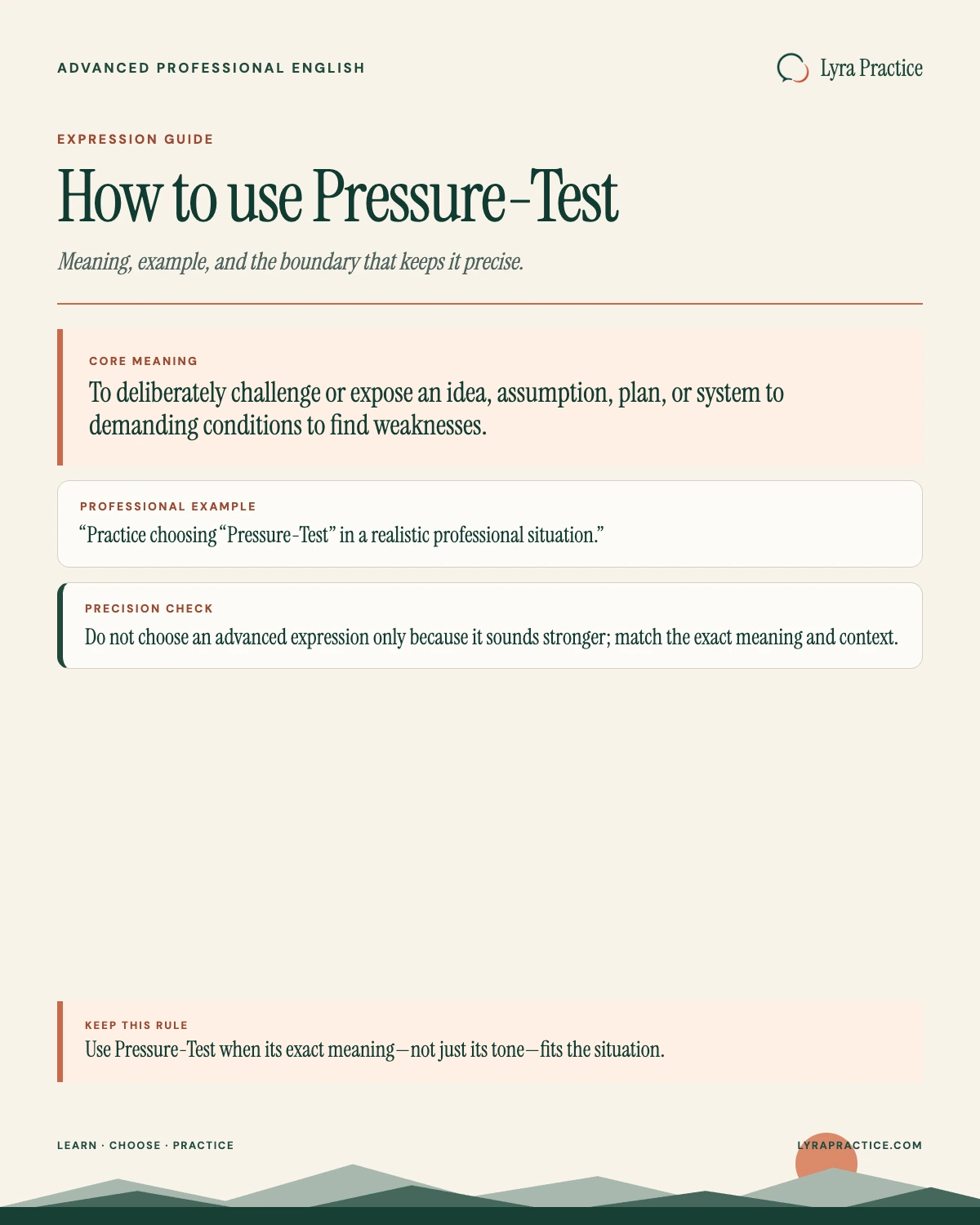
To pressure-test something is to challenge it on purpose. The goal is to find weak points before a decision, not merely to read or discuss the material.
At work, the object can be an idea, assumption, proposal, plan, model, claim, or system. A complete pressure-test also needs a hard question, skeptical input, or demanding condition.
"Before approval, Finance pressure-tested the forecast against a demand drop."
The forecast is the thing being tested. The demand drop is the condition used to challenge it.
Quick check
How well do you know "Pressure Test"?
You know "Pressure Test" well.
Keep going with the full learning path — more workplace contexts, related expressions, and practice using it yourself with feedback.
Continue with "Pressure Test" →There's more to "Pressure Test" than it seems.
You've got part of it, but the full learning path goes deeper into its nuances, workplace contexts, and when it sounds natural — then gives you practice using it yourself.
Learn "Pressure Test" in depth →Pressure-test is stronger than review
A review can be broad. Someone might inspect a proposal, discuss it, or read it carefully. A pressure-test deliberately asks how the proposal holds up when something becomes difficult.
Compare these sentences:
"The team reviewed the forecast before the meeting."
"The team pressure-tested the forecast against a demand drop."
The first sentence says that the team examined the forecast. It does not tell us how. The second sentence names a demanding condition. That challenge is the defining part of the verb.
Do not call every careful review a pressure-test. If no skeptical question or difficult condition was applied, review, check, or discuss may be more accurate.
Try it yourself
Use "Pressure Test" yourself
Natural patterns with pressure-test
The verb usually takes a direct object:
- pressure-test the assumptions
- pressure-test a proposal
- pressure-test the model
- pressure-test the plan
Use against to name the condition:
"We pressure-tested the plan against a supplier closing."
Use a whether clause to name the claim under challenge:
"We need to pressure-test whether the timeline holds if demand rises."
You can also assign the action to another person or team:
"Ask Finance to pressure-test the hiring assumption."
This learning path writes the compound verb with a hyphen: pressure-test, pressure-tested, and pressure-testing.
The verb names the test, not the result
Saying that a team pressure-tested a plan does not tell us whether the plan passed, failed, or changed. It only tells us that the team applied a deliberate challenge.
If the result matters, state it separately:
"We pressure-tested the budget against a client cancellation. The reserve covered the modeled shortfall."
The first sentence names the action. The second reports the result. Keep those claims separate unless the surrounding evidence supports both.
Practice scenarios
Practice using pressure-test in situations like:
- testing a forecast against a difficult business condition
- asking a colleague to challenge the assumptions behind a proposal
- checking whether a plan still works when one input changes
Useful practice phrases:
- "Let's pressure-test the assumptions against ___."
- "Could you pressure-test whether ___ still holds?"
- "Before we decide, we should pressure-test the proposal against ___."
Related guides
- How to Ask for Client Feedback in English Professionally
- What Does Play Devil's Advocate Mean at Work?
- How to Communicate a Project Risk and Recommend a Response
A pressure-test needs both a subject and a challenge. Name what is being tested, then name the condition that makes the test demanding.
Want to actually use "Pressure Test" naturally at work?
Understanding it is one thing. Practice its nuances, see how it works in real workplace situations, and use it yourself with feedback.
Start the "Pressure Test" learning path →