
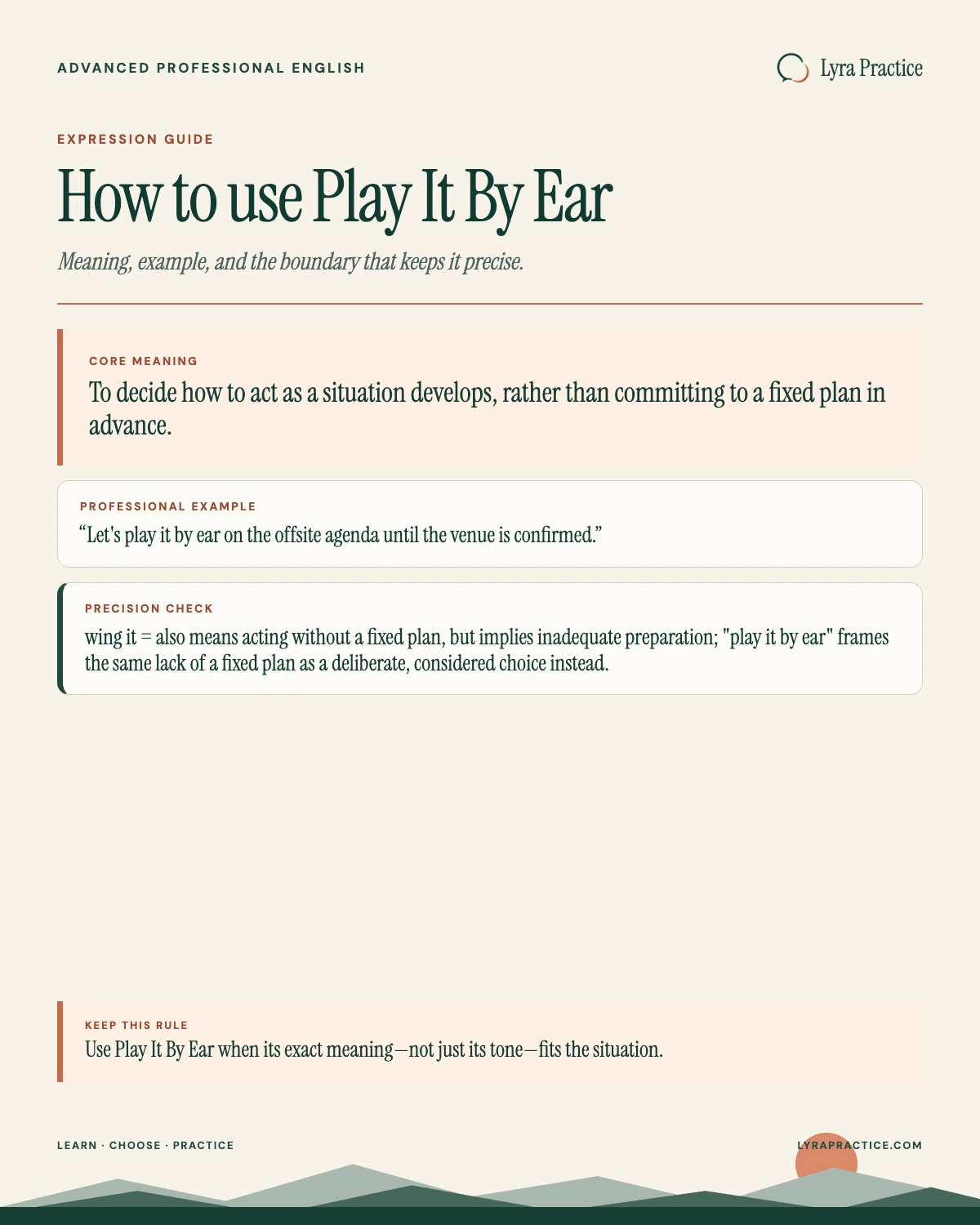
A flexible plan and an unprepared plan can sound identical if you describe them the same way. Do not claim more certainty than you have. Instead, pair the flexible part with a clear and accurate anchor.
This matters when important details remain uncertain. A rollout may depend on pilot results. An agenda may depend on attendance. A negotiation plan may depend on the other side's opening offer. In these cases, "we'll play it by ear" may be accurate. On its own, though, it may sound unprepared to a client or leader.
Quick check
Make flexibility concrete
You know "Play It By Ear" well.
Keep going with the full learning path — more workplace contexts, related expressions, and practice using it yourself with feedback.
Continue with "Play It By Ear" →There's more to "Play It By Ear" than it seems.
You've got part of it, but the full learning path goes deeper into its nuances, workplace contexts, and when it sounds natural — then gives you practice using it yourself.
Learn "Play It By Ear" in depth →The pattern: name it, then anchor it
Use a two-part structure. First, identify what may change, and then provide a useful anchor. This could be a target range, a review point, an owner, or the date when the team plans to decide.
Weak: "We're just playing it by ear on the launch date."
Stronger: "We're staying flexible on the exact launch date, and we'll confirm it once the pilot results come in next Friday."
The second version explains what the date depends on and when an update is planned. It promises neither approval nor a final date unless the speaker has the authority to do so.
Try it yourself
Add an anchor
Never answer "what's the plan?" with nothing
A client or leader who asks for the plan often wants to know what is known now and what happens next. Avoid answering only with "we'll play it by ear." Add a target, checkpoint, owner, or planned update. Label a target as a target, not a promise, and remember that a checkpoint may produce new information without a final answer.
"We don't have a fixed number yet, but we're targeting the $40-50K range, and we'll have a firm figure after vendor quotes come in next week."
Don't use it to describe something that's already decided
If a decision is fixed, documented, or binding, do not call it flexible. That would give a false view of the plan. If a change is needed, follow the proper approval or contract process. Use adaptive language only for points that are still open.
The rule
Stakeholders may accept uncertainty when the process for managing it is visible. Say what may change and why. Then state what is firm, what is only a target, who will decide, or when the next update is due. This shows a planned way to adapt without making a false promise.
Practice scenarios
Practice this pattern in situations like:
- a client asking for a launch date that depends on pilot results
- an executive update on a roadmap that's still in flux
- a negotiation prep conversation where the final position depends on the other side
Useful practice phrases:
- "We're staying flexible on X, and we'll confirm once [checkpoint]."
- "We don't have a fixed number yet, but we're targeting [range]."
- "The next firm decision point is [date/event]."
Want to actually use "Play It By Ear" naturally at work?
Understanding it is one thing. Practice its nuances, see how it works in real workplace situations, and use it yourself with feedback.
Start the "Play It By Ear" learning path →An accurate anchor can make "adaptive planning" sound deliberate. A vague answer may still sound like "improvisation."