
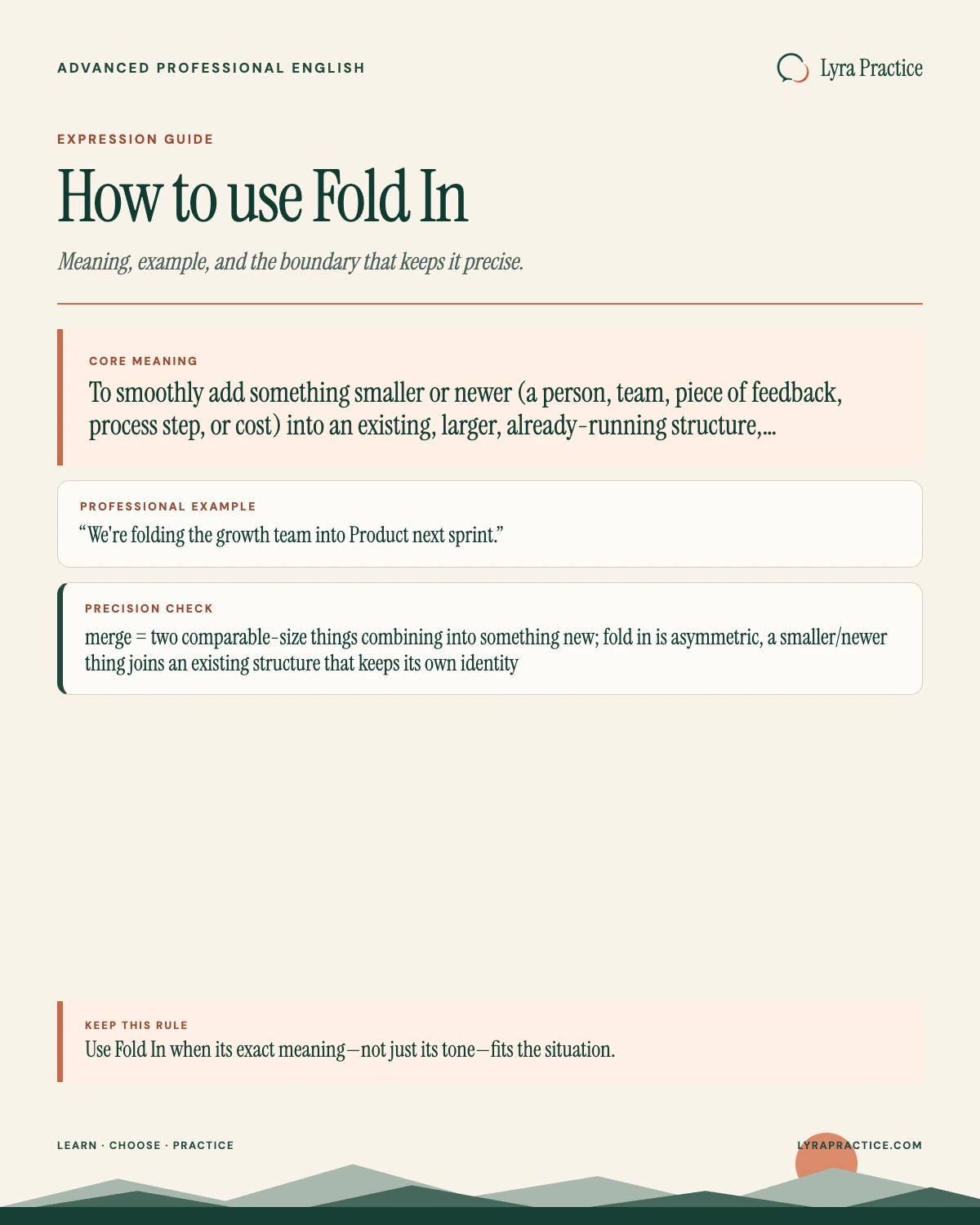
Fold in describes integration. A smaller or newer element becomes part of a larger system that is already in use. The phrase presents the element as part of existing work, not as a standalone effort. At work, it often applies to teams, feedback, workflows, and budgets. Its grammar can shift with the register.
The examples cover all four uses. They also show the pronoun rule and the gap between a casual note and a formal notice.
Quick check
How well do you know "Fold In"?
You know "Fold In" well.
Keep going with the full learning path — more workplace contexts, related expressions, and practice using it yourself with feedback.
Continue with "Fold In" →There's more to "Fold In" than it seems.
You've got part of it, but the full learning path goes deeper into its nuances, workplace contexts, and when it sounds natural — then gives you practice using it yourself.
Learn "Fold In" in depth →Org and team integration
Slack message: "Heads up -- we're folding the growth pod into Product starting next sprint."
Manager 1:1: "Your project isn't going away. We're folding it into the broader platform initiative, and you'll keep leading your piece of it."
Feedback and content
Email to a collaborator: "Fold in your comments by Friday and I'll send the final draft to legal Monday morning."
Design review comment: "These edits are small enough to fold into the current draft -- no need for a new review cycle."
Try it yourself
Use "Fold In" yourself
Process and workflow
Status update: "We folded the extra security review into the existing release process instead of adding a separate gate."
Team note: "Once this new step is folded in, nobody needs to remember it as a special case -- it just runs."
Budget and roadmap
Finance note: "We'll fold the travel costs into general overhead rather than tracking them as a separate line."
Roadmap update: "This request is small enough to fold into next quarter's roadmap without pushing anything else out."
Separable grammar with a pronoun
"The feedback came in late, but it's short -- can you fold it in before end of day?" Never "fold in it."
Formal passive announcement register
All-hands email: "Effective March 1, the support function will be folded into Customer Success."
Board note: "The acquired team's operations will be folded into our existing delivery org over the next two quarters."
What these examples have in common
Each sentence makes the same point. The new element joins work that is already in place. It may still require careful planning, meetings, or its own budget. The phrase describes integration, not how easy the change will be. This meaning holds for a team, feedback, a workflow, or a cost. It also holds in a quick Slack note or a formal notice.
The formal examples use passive voice and give an effective date. The casual ones use active voice and a present or future tense. Match the register to the channel when you use "fold in." The underlying integration stays the same, but the wording fits the reader and the stakes.
Practice scenarios
Practice using fold in in situations like:
- announcing a team or function joining a larger existing group, casually and formally
- telling a colleague their feedback will be incorporated before a deadline
- describing a new process step becoming part of an existing workflow
- using the separable pronoun form correctly
Useful practice phrases:
- "We're folding this into the existing process."
- "Can you fold it in before end of day?"
- "Effective [date], the team will be folded into [department]."
- "We'll fold the cost into general overhead."
Want to actually use "Fold In" naturally at work?
Understanding it is one thing. Practice its nuances, see how it works in real workplace situations, and use it yourself with feedback.
Start the "Fold In" learning path →The same move works in four common areas and two tones. Match the grammar and tone to the reader.