Experiment readout
Conversion is up, but there are some limitations.
“Conversion rose 12%, with one caveat: the result covers only new customers in the test cohort.”
Preserves the useful result while naming the exact population limit.
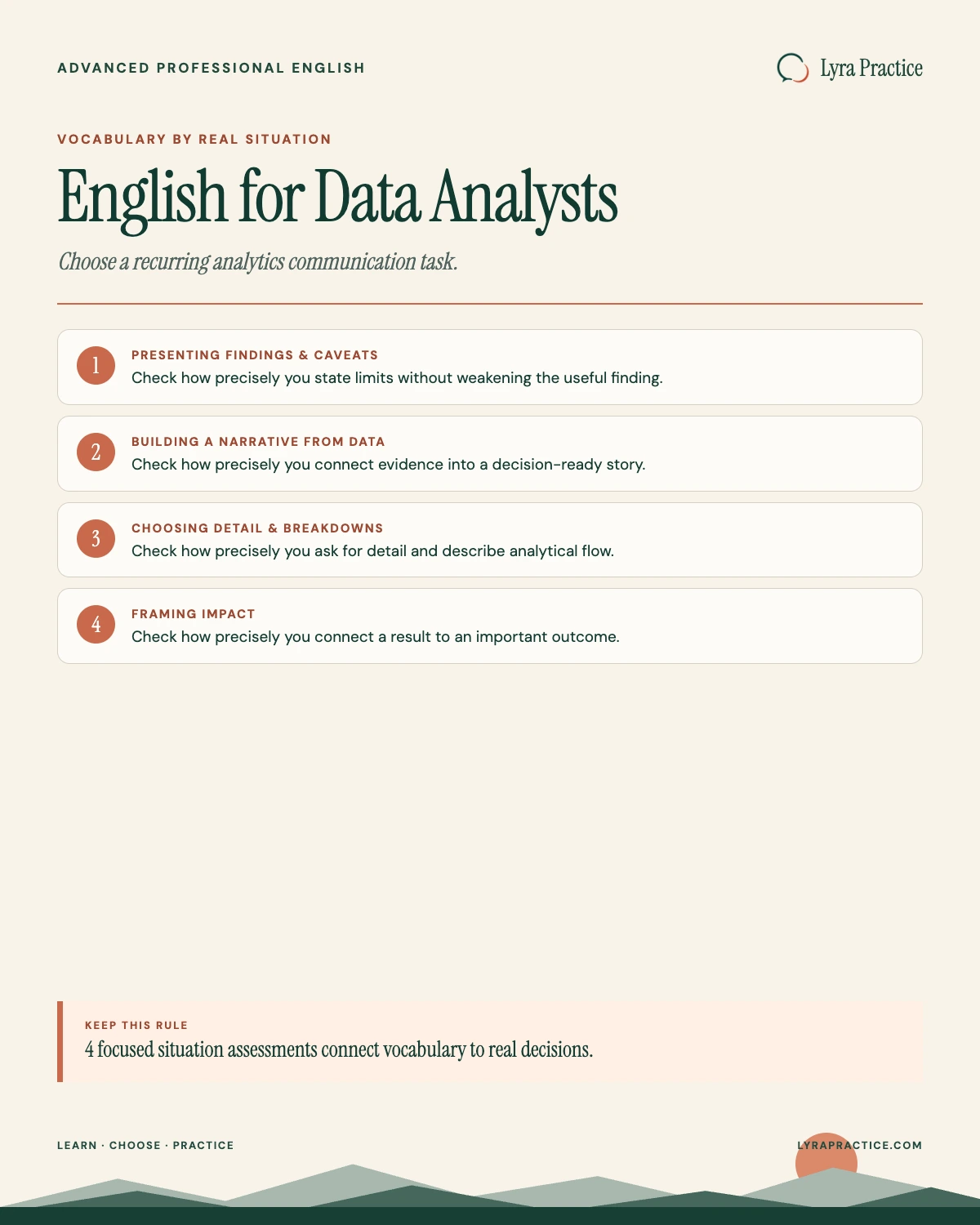
English for data analysts
Learn the English data analysts use to explain findings, qualify claims, choose the right level of detail, and connect evidence to a decision—then practice it in realistic stakeholder conversations.
For data and analytics professionals who already work in English and want to present evidence with more precision and confidence.
Try a real Lyra Practice exercise
Caveat
Free · No account needed
Your experiment shows a 12% conversion lift, but only for new customers in the test cohort. Which readout uses “caveat” precisely?
From understood to precise
A decision-ready readout separates the result, its boundary, and its consequence. Precise language helps stakeholders act on the evidence without stretching it.
Conversion is up, but there are some limitations.
“Conversion rose 12%, with one caveat: the result covers only new customers in the test cohort.”
Preserves the useful result while naming the exact population limit.
There are lots of interesting findings in the analysis.
“The salient finding is that activation, not acquisition, explains most of the retention gap.”
Selects the finding that matters for the current decision instead of praising the whole analysis.
The dashboard change was successful.
“The change improved clicks, but it did not move the needle on completed onboarding.”
Separates a local metric improvement from the important outcome.
Start with the conversation in front of you. We'll surface only the expressions that fit.
Your situation
State what the evidence supports, what limits it, and how confident the audience should be with language that makes your intent and next step clear.
Check your communication in this situationExpressions for this conversation
How Lyra Practice works
See how a careful analyst qualifies one useful finding, distinguish a caveat from general uncertainty, then practice a stakeholder-ready readout with feedback.
Example journey · caveat
285 expressions
A caveat is a specific limitation that either qualifies an otherwise confident statement or independently flags how far a claim, plan, dataset, or analysis can…
To hedge is to reduce exposure, keep another option open, or qualify a claim when the outcome is uncertain; it does not mean fully avoid, solve, or prevent the…
Something is already granted, agreed, produced, or in effect right now, but it still needs one more specific, defined step before it becomes final.
Salient describes the point(s) that stand out and deserve attention from within a larger set of facts, risks, or ideas — it's not a fancier word for…
Holistic describes an approach, view, or review that reasons about interdependent parts as one connected whole rather than handling them separately.
Misleading means likely to make people believe something that is not true, whether or not the words or figures are literally false, and without saying that…
Validity is the quality of being valid: an argument, claim, or comparison that is well grounded; a test, survey, or metric that measures what it claims to…
Verify most often means find out whether something is correct or true by checking it against evidence: a claim, a figure, an identity, a signature, an image.
A narrative is the connecting account that links a set of findings into one case, or the account an audience already holds that new facts get read through.
Compelling describes something with strong enough persuasive or attention-holding force to pull a particular audience toward attention, belief, or action.
In its main figurative use, resonate means to have particular meaning or relevance for someone, or to evoke a response or connection; by itself it does not…
Combine information or ideas from separate sources into one coherent whole.
Granular describes fine detail or resolution in data, a plan, a discussion, or a setting.
To bring a previously hidden, unnoticed, or unspoken issue into view (with an object), or for something hidden to become visible on its own (without an object).
Throughput is the rate at which a team, process, or system actually completes work or processes data over a period — not a one-time total, not a theoretical…
Correlation is an observed statistical relationship in how two variables vary; it does not by itself establish cause.
Infer means reach a conclusion from evidence, facts, wording, or a pattern.
A hypothesis is a proposed explanation for something observed that has not yet been proved and can be tested; the word reports the status of the idea, not…
Underlying describes the basic cause, problem, assumption, or pattern that lies beneath what you can see on the surface: the deeper thing a visible problem,…
To attribute X to Y is to regard X as caused by, explained by, or produced (created, said, or written) by Y: attribute the delay to a late dependency;…
To determine or check a conclusion by comparing multiple independent sources, signals, or perspectives.
Move the needle means to make a meaningful, roughly measurable difference to an important business result — it separates real impact from effort, activity, or…
A north star is the single, durable reference point a team, project, or person uses to decide among competing goals, priorities, or trade-offs — not one goal…
Trajectory names the direction and shape of a pattern over time — read from multiple points, not a single fact or event — and, by extension, where things are…
Directional describes a figure, estimate, or conclusion that can be used for its broad direction (which way it points, and often a rough sense of scale), for…
Use paraphrase as a verb for restating spoken or written material in different words while preserving its essential meaning, or as a noun for the resulting…
Use concise for language that is brief and clear because it expresses what is needed without unnecessary words.
Use discrepancy for a noteworthy difference, disagreement, or inconsistency between figures, records, claims, accounts, or conditions being compared; it often…
The tip of the iceberg is the small visible, known, or discovered part of a much larger situation that remains hidden or not yet understood.
"Draw a blank" means to be unable to remember or think of something, or to get no answer or result from an attempt or search.
To make a desperate attempt to fix a bad situation, using an option that is itself unlikely to work — because your better options have already failed or run…
To believe that a result, behavior, or feeling was caused by a particular thing.
Accommodate means to adjust or make an arrangement so a need, constraint, person, or request can be included or served.
Account for something means explain it by identifying a relevant cause or circumstance; it can also mean form a stated share of a total.
To accrue is to accumulate over time or, in accounting, to recognize income or expense in the period it is earned or incurred even when cash settlement occurs…
Achilles' heel means the particular weakness that can undermine an otherwise strong person, plan, product, or system.
Acknowledge means recognize or openly show awareness of a fact, concern, contribution, or feeling.
Actionable feedback, findings, or recommendations can be acted on: someone can base a decision or a next step on them as stated.
To adjudicate is to formally hear and decide a dispute, claim, or case through an authorized decision-making process, such as a court or administrative…
Advocate means actively support a person, proposal, policy, or course of action. It is stronger than simple agreement but does not imply final authority.
Agnostic describes something built or chosen so that it does not depend on one particular option (a database-agnostic reporting layer is not built around one…
To bring people, plans, priorities, or work into a consistent arrangement or shared direction.
Alternative means another available choice or course of action.
Something is ambiguous when its wording, data, or situation genuinely supports two or more reasonable readings — a property of the thing itself, not a claim…
To appease someone is to give them what they're demanding mainly to stop friction or pressure right now, not because the demand is fully deserved or a genuine…
In finance and business, appreciate describes an asset, currency, or investment — such as a property, a stock portfolio, or a currency — steadily increasing in…
To assign is to designate work or responsibility to someone, or in legal usage to transfer a right, property interest, or benefit to an assignee.
Back-ordered means an item has been ordered, or requested under an accepted commitment, for later fulfilment because it is not currently available to ship.
To build something into a plan, price, product, or system from the start so it becomes a fixed, hard-to-remove part of it, rather than adding it later.
A ballpark (figure) is a rough, non-final estimate — not a confirmed or exact number.
Bandwidth means the practical capacity a person, team, or organization has to take on more work, considering time, attention, energy, staffing, and priorities…
To use evidence, data, or results to confirm that a claim, prediction, or decision made earlier was correct.
Use behind schedule when work is progressing more slowly than planned or is later than the planned timeline.
A blocker is the specific thing — a missing input, pending decision, unresolved issue, or a person/team whose action is needed — that is currently preventing a…
After you strip away all the secondary detail, "boil down to" names the one essential cause, reason, or deciding factor that's left.
Book means to enter a transaction, amount, or journal entry in an accounting system or books.
A boondoggle is a costly, inefficient project or program that produces little credible value.
A bottleneck is the specific point in a process, system, team, or plan that limits how much can move forward.
A breach is a failure to comply with a contractual promise, legal duty, or protected boundary; in cybersecurity, a breach is an incident involving unauthorized…
With an object, break down means to separate something into clear parts or to dismantle a barrier to collaboration; without an object, it means a process,…
To be the one who first tells someone something significant — most often something difficult, unwelcome, or serious — that they don't already know.
In FP&A and management reporting, a bridge is a reconciliation that shows the drivers moving a financial measure from one stated starting figure to another; as…
To cause an event, result, or change to happen.
Introduce a subject so that people can discuss, consider, or deal with it.
Brittle describes something that may look stable or work well in normal conditions, but has low resilience and can fail suddenly under stress, load, change, or…
An informal, disparaging label for someone perceived as using excessive flattery or ingratiating behavior to win favor from a person in authority.
Bullish means you have a confident, forward-looking expectation that something — a market, product, deal, or initiative — will grow or succeed: a specific,…
The willing commitment of people whose cooperation a plan, decision, or change depends on—not just their formal permission.
A cadence is a deliberately recurring, established operating pattern — a rhythm a team sets and expects to continue — not a one-time event, a bare frequency…
"Call out" means to make something visible on purpose, in front of a group, instead of leaving it unnoticed — usually a risk or problem that needs attention,…
Candid means choosing to share a real opinion, assessment, or piece of information openly, rather than hedging it, softening it into euphemism, or leaving it…
In accounting, to capitalize a cost is to recognize it as part of an asset when the applicable accounting requirements are met, with later expense recognition…
To perform or do a task, plan, instruction, test, or other specified activity.
To carve out something is to deliberately create and protect a share of a limited resource, or to establish a distinct role or position, against competing…
A catch-22 is a situation where one requirement cannot be met until another is met, but the second cannot be met until the first is met.
To champion something (or someone) means to actively and visibly advocate for it over time — raising it, defending it against pushback, and keeping it alive —…
To chip away at something means to change it gradually through repeated small actions or effects -- making steady progress against something unwanted (a…
To deliberately return to a topic, question, or person after a gap, dependency, or interruption — not simply any future contact.
Use clarify to make information, meaning, expectations, or a position clearer and easier to understand, often by adding detail or removing ambiguity.
To remove unspoken tension or awkwardness between people by talking about it honestly and directly, without necessarily settling the underlying disagreement.
Cognizant means formally aware of a relevant fact, risk, or requirement — it reports that something has been noted and kept in view, not that it has been…
To genuinely accept a difficult, painful, or unwelcome situation, fact, or change, often gradually, instead of continuing to resist, deny, or avoid it.
To think of, suggest, find, or produce an idea, plan, solution, or something else that is needed.
Compromise means a negotiated agreement in which sides make concessions.
To actively and skillfully work to win over a distrustful or hostile person, or to bring two opposing sides into genuine agreement — through real diplomatic…
In the active U.S. contract-law sense, consideration is the bargained-for exchange that supports a promise: each side gives or promises something legally…
To do or say something that goes beyond an accepted standard of behavior — moral, social, professional, or an explicit rule — in a way that's judged…
Culture fit describes compatibility with specific, job-relevant working practices and values, not similarity in personality or background.
A cushion is a reserve of money, time, or staffing held back to soften the impact of a bad outcome — as a noun, the reserve itself ("a cash cushion"); as a…
David and Goliath frames a contest between a much smaller or less-resourced challenger and a powerful, established opponent; it does not predict the result.
To de-risk something means to take a deliberate, concrete action - usually before or during a decision, investment, or commitment - that makes it meaningfully…
Defensible describes a number, assumption, position, or decision that can be justified with the reasons or evidence in hand if someone challenges it; it does…
A stated range of time in which delivery is expected or accepted.
Discreet describes careful, restrained conduct or something unobtrusive, often to avoid unnecessary attention or embarrassment; privacy or secrecy may be…
Dispassionate describes a person's judgment, analysis, or conduct that stays free of their own emotional stake or bias — not someone who lacks feelings or…
To reduce complex material while preserving or drawing out its essential meaning, insight, or message.
A dog and pony show is an elaborate presentation or event seen as emphasizing appearance or persuasion over useful substance.
To drink the Kool-Aid is to accept a group's beliefs or claims with too little independent questioning.
To drive home a point, message, or piece of evidence means to make sure it doesn't just get said — through deliberate, forceful emphasis, it actually lands,…
Drop the ball means to fail to do something you were responsible for, especially by forgetting, overlooking, or mishandling it.
Efficacy is whether something — a strategy, campaign, product or feature, program, policy, or process — actually produced the result it was meant to produce,…
Elicit means to draw forth or obtain information, a response, or a reaction; purpose and attempt forms do not guarantee a result.
Equivocal describes a statement, answer, or stance built to support two or more contradictory readings on purpose, so the speaker avoids fully committing to a…
Escalate means either deliberately sending an issue to someone with more authority or expertise to resolve it, or a conflict, tension, or cost becoming more…
Cause a process, order, review, or delivery to happen or progress more quickly.
Exposure, in the sense this path practices, is the position that could face loss if a specific risk materializes, or the amount at risk: which revenue, which…
A planned or agreed arrangement — a deal, plan, sale, or agreement — fails to happen.
Famous last words is a wry response suggesting that a confident prediction may soon prove wrong.
To reach an understanding, discover something unknown, or work out a solution or plan through reasoning, calculation, or investigation.
To find out is to learn, discover, or verify information you did not already know—by being told, reading, observing, searching, studying, or investigating.
To add the missing substance or detail to something that's currently just a skeleton — a plan, draft, proposal, idea, or persona — so it becomes a complete,…
Fluff is content — words, slides, paragraphs, meeting time — that takes up space without carrying information anyone can act on.
To smoothly add something smaller or newer (a person, team, piece of feedback, process step, or cost) into an existing, larger, already-running structure,…
To take the actions needed to complete or honor something already promised, intended, or started.
Contact someone again, find out more, or take a next action connected with an earlier exchange.
In its main information-sharing sense, forthcoming describes a person, group, or party as willing or open in giving information about a matter; in that sense,…
Foster means to deliberately create the conditions that let a quality, relationship, or process grow gradually over time — not to cause it directly,…
Friction is resistance that makes a process, transaction, or working relationship harder or slower than it should be — usually something to reduce, but…
Gauge means to assess, judge, or estimate something such as interest, mood, reaction, demand, or progress; it need not name an evidence source or imply…
To finally find or make time to do something after it has been delayed or put off.
"Get carried away" means to become so excited or emotionally involved in something that you lose your ordinary restraint over what you say, do, or feel.
To correctly understand a specific point someone is communicating to you -- most often something they didn't say outright, but conveyed through a hint, a…
To form a false or mistaken impression or belief about someone or something.
To communicate directly and concisely, stating the main idea without unnecessary preamble or detail — most often a request directed at someone else's rambling,…
Give someone air cover means use authority, influence, or visible support to protect a person or team from organizational pressure while they carry out…
To give someone the benefit of the doubt is to choose the more favorable, charitable interpretation of their ambiguous words, actions, or explanation — when…
"Go back on your word" means to fail to do what you explicitly promised or committed to — you said you'd do something, and then you didn't.
To examine something carefully or review/explain its content, often to check details or make it understood.
To exceed a reasonable or acceptable degree in behavior, speech, a demand, or similar, in a way that is judged negatively.
Going in a different direction means choosing another plan, priority, supplier, candidate, role arrangement, or strategy, often without fully stating the…
"Guardrails" are the boundaries a team, process, or system operates within — clear enough to keep action in an acceptable range, but loose enough to leave real…
A Hail Mary is a final, low-probability attempt made when ordinary options have nearly run out.
"Hand over" means to give something you're holding or responsible for -- an object, control, responsibility, or authority -- directly to a specific other…
To reverse a previous decision, opinion, or feeling about something — arriving at a different position than the one you held or stated before, in either…
To begin to doubt or feel uncertain about a decision, plan, or commitment you have already made, without that doubt necessarily leading you to reverse it.
High visibility means that work, a role, or an issue receives substantial attention from an important audience.
To delay starting or doing something, without deciding against doing it.
To not allow yourself to be forced to retreat or change your position, physically or figuratively, despite pressure, opposition, or criticism pushing you to…
Imperceptible describes a real change or difference too small to notice — either because it built up gradually over time, or because it falls below what a…
In good hands means a person, task, account, or project is being cared for by someone capable and trustworthy — it endorses the caretaker, not just names who's…
In hot water is an informal idiom meaning in trouble or facing criticism or consequences because of a problem, mistake, or questionable situation.
Use in stock to say that an item is available from a seller or supplier for purchase or prompt fulfilment.
As a noun, inconvenience means difficulty, trouble, or disruption caused to someone. As a transitive verb, it means to cause that effect.
Use the transitive verb invoice to say that a supplier sends a formal request for payment for goods or services.
Resolve the remaining manageable details, problems, or differences in something already broadly workable so it can proceed smoothly.
To remain willing to consider new information, ideas, or perspectives on a specific matter, deliberately avoiding a fixed judgment before you have had the…
Keep your resume on file means retain a candidate's resume for possible consideration if a suitable role opens later.
A message, recommendation, point, or joke lands when it has the effect on the audience that the speaker intended, and doesn't land when it reaches them and…
To present a plan, set of options, or reasoning clearly and in order, so the audience can follow it and act on it.
The time required between initiating an order or process and availability or completion.
To commit fully and deliberately to something instead of avoiding it or holding back — either engaging directly with something difficult, or committing more…
To level the playing field is to reduce an unfair advantage or barrier so people can participate or compete on more comparable terms.
To level-set is to take a bounded moment, usually at the start of a conversation or a piece of work, to agree the shared baseline everyone will work from: the…
To leverage an asset, relationship, position, or piece of information is to use it so that it produces an advantage or a larger result than it would on its…
Try to find out about something, or examine the facts of a problem or situation.
Examine something (or someone), often relatively quickly, to check it or get a general impression.
Use loop in to include a relevant person or team in an information exchange or discussion so they gain context and become part of the current exchange.
Low-hanging fruit is a task, opportunity, or improvement that is both easy to achieve and worth doing — not just easy, and not just important or valuable.
Covers two related moves: (a) contributing an idea or opinion, in speech or writing, to a discussion — validity or discussion-changing force is not required,…
To manage someone out is to steer an employee toward leaving through indirect workplace conditions or decisions rather than a directly stated dismissal.
To turn something unclear, mental, or scattered into an organized, visible version other people can review or act on — either a sequence of future steps, or…
In legal and deal language, material means significant enough to affect the issue, decision, rights, obligations, or expectations under the relevant test.
Middle ground is a compromise position between two opposing sides — you can actively search for it, firmly state that none exists when a situation truly is…
To fail to grasp or address the real, central meaning or purpose of something said or done, often while getting every surface-level detail right.
Mitigate means to reduce the likelihood, severity, or consequences of something harmful — or your exposure to it — without necessarily removing it completely.
A Monday-morning quarterback criticizes a past decision after knowing the outcome, as though the correct choice had been obvious beforehand.
To move the goalposts is to change the requirements or success criteria after work or evaluation has begun, often making success harder.
To reduce a range, list, or set of possibilities by removing options until fewer remain.
To skillfully move through, or find a workable path through, a complex, difficult, or uncertain situation, system, relationship, or period of change — without…
A non-negotiable is a requirement, condition, or boundary that is fixed — stronger than merely important — because discussion will not remove or change the…
Not the right fit means that a person, role, team, solution, or partnership does not align well enough with a particular need or context.
Nuanced describes an analysis, view, explanation, or response that recognizes meaningful distinctions instead of reducing a complex issue to a simple binary.
"Off the top of my head" flags that an answer, estimate, or number is coming from memory right now, without being checked against a source.
To be on the same page (with someone) is to share the same understanding, ideas, or agreement about something — whether that's a set of facts, a plan, an…
Use on track to say that work is progressing as expected toward a stated result or date.
Open Pandora's box means to start something that releases many complicated, difficult, or unforeseen problems.
In workplace discussion, optics means how an action, decision, or situation is likely to appear to a particular audience, especially when perception may differ…
Something out of left field is unexpected and seems unrelated to what was anticipated or being discussed.
Use out of stock to say that an item is temporarily unavailable from a seller or supplier at the relevant location or channel.
Outline means to give the main points or structure of something without presenting every detail.
A comprehensive, structural rework of something judged no longer fit for purpose — not a tweak or a quick patch, but a full rebuild of how it actually works.
Overhead means the indirect cost, support effort, or coordination load needed to keep work running, separate from the main work or direct output.
To develop or turn out successfully, especially after a period of uncertainty — used to report whether a deal, plan, hire, or bet delivered on what was hoped…
Par for the course means normal, typical, or unsurprising for a particular situation.
A paradigm is the shared, often-unspoken set of assumptions a field, industry, company, or team treats as normal — and a paradigm shift is the moment those…
Performance concerns are identified issues with how someone's work meets role expectations.
A formal employer process or document stating performance concerns, expected improvements, support or actions, and a review period or checkpoints.
Pithy wording says something substantial in few, well-chosen words — it praises compact communication that keeps the point that matters (a result, risk,…
To pivot is to make a deliberate, decisive change of direction — for a company, product, team, conversation, or career — while carrying forward something real…
Pivotal describes a person, decision, event, factor, or period as crucial or centrally important to how an outcome develops - the result substantially depends…
Submit a purchase request for goods or services to a seller or supplier.
To temporarily argue a skeptical or contrary position on an idea, plan, or proposal — one you may not actually hold — in order to pressure-test it before it's…
To decide how to act as a situation develops, rather than committing to a fixed plan in advance.
"Play out" means a situation develops or unfolds over time on its own, often toward an uncertain result, or it means deliberately running through a…
To direct someone's attention to a fact, feature, problem, or a visible person/thing, without itself implying criticism, correction, or importance.
A fixed formula acknowledging that a specific argument or consideration just raised has real weight, without necessarily conceding the whole discussion or…
To deliberately challenge or expose an idea, assumption, plan, or system to demanding conditions to find weaknesses.
Use prioritize to decide or treat which tasks, needs, or goals should receive attention or action before competing ones.
Under IAS 37, a provision is a liability of uncertain timing or amount, recognized only when the applicable recognition criteria are met.
Informally postpone a decision or unresolved question because the timing, information, readiness, or ownership is not sufficient yet.
To push back is to challenge, resist, or renegotiate something so a concern is addressed before it moves forward; in scheduling, push something back means move…
Arrange for an event or activity to happen later.
To force someone, right then and with no real way to avoid it, to answer, decide, explain themselves, or do something they weren't prepared for — creating…
To put things in perspective is to compare something to other things — or to the bigger picture — so its true relative size, importance, or severity can be…
Combine parts, ideas, or people into a finished whole — assembling a physical object, creating a document or plan from separate material, or forming a group.
Continue accepting a person, behavior, or situation that is unpleasant or undesirable, even though you don't like it.
In sales, qualify means evaluate a lead, prospect, or opportunity against defined fit and buying-readiness criteria to decide whether and how it should…
To qualify a statement is to keep its central claim while making it less absolute or general by adding a clear limit on its condition, exception, scope,…
"Ramp up" means to increase something — output, hiring, effort, or a person's or team's readiness — through a deliberate, staged process moving toward a target…
To read the room is to understand a group's unstated mood, attitudes, or reactions in the moment — often so you can adjust what you say or do.
Reassure means make someone feel less worried by giving support or grounded confidence.
Recommend means to present an option, person, or action as suitable or advisable.
To reframe something is to present or consider it through a different perspective, analytic viewpoint, or metaphor.
Pay someone back for an eligible expense that person has already paid.
In contract drafting, a representation is a statement a party makes or confirms as fact.
Arrange a different time for something that was already scheduled.
Resolve means to solve or end a problem or difficulty, or to settle a disagreement.
Revamp means changing how something looks, presents, or is perceived — its design, branding, packaging, or messaging — while overhaul changes the underlying…
Your role is being eliminated means the organization is removing the position from its structure.
Roll Forward means to reconcile a balance or account from the beginning of a period to the end by showing the intervening additions, reductions, and other…
To introduce something or make it available for the first time to a defined audience; for products and systems, this commonly foregrounds actual access or use.
To exclude a person, thing, or possibility from consideration, or make it impossible.
To have none of a supply or resource left — it has reached zero.
To run something by someone (or run something past someone — both mean exactly the same thing) is to informally share an idea, plan, or draft with them before…
A sacred cow is an idea, policy, or practice that people protect from normal criticism or review.
Sanguine means calm, composed confidence about a difficult or uncertain situation, held despite a stated or implied setback, risk, or delay — not a generic…
A sanity check is a quick, coarse check that a result, figure, or plan is plausible: nothing impossible, no obvious mistake, no clearly invalid assumption.
To make something smaller than it was, or smaller than it was planned to be.
Seamless describes a process, experience, handoff, transition, or integration whose connected parts work together so smoothly that the person experiencing it…
To see (or know) where someone is coming from is to understand the reasons, background, or feelings behind their opinion or behavior — especially when you…
To correct a false belief, rumor, or piece of misinformation by stating the true facts, most often about yourself or your own actions, to people who currently…
Shake out means an uncertain situation settles into a clearer state over time, or that someone deliberately finds and removes weaknesses through a trial or…
To contribute understanding to something previously unclear — explaining a cause or revealing a fact — without claiming it's fully proven or resolved.
Ship out means to dispatch goods from the sender or fulfilment location.
To give the approval required for work to proceed or be treated as complete.
Silver bullet means one seemingly decisive solution to a difficult, multi-cause problem.
Smoke and mirrors describes an impressive or confusing presentation that obscures weak substance or an inconvenient reality.
The so-what of a finding, slide, or chart is what it means for the people reading it and the decision in front of them; it is a countable noun, neutral in an…
In business use, "socialize" means to informally share a not-yet-final idea, plan, or proposal with relevant people before a formal step, so reactions can…
To deal successfully with a problem or situation, or organize its details so it is clear or settled.
To say honestly and directly what you actually think or believe about something, without withholding or diluting its substance.
To spearhead something means to be the primary person, team, or organization that originates and actively drives a significant, usually new or difficult effort…
To state something — terms, expectations, a plan — in complete, explicit detail so nothing is left to interpretation; also used literally to mean stating…
Spurious describes a correlation, metric, or argument that looks like it has a real connection or basis, but doesn't — usually an innocent artifact, not a lie.
A person or group with an interest in, influence on, or exposure to the effects of an organization, decision, or project.
To steer is to direct or influence the course of something still in motion: a conversation, a discussion, or another person's choice, toward or away from an…
To step up to the plate is to accept responsibility and act when a challenge or need calls for someone.
In a working session, a straw man is a deliberately provisional proposal put up so that others have something concrete to react to, knock down, and improve;…
To streamline a process, workflow, or organization is to make it simpler and more efficient, typically by removing or reorganizing the unnecessary steps,…
To "strike a chord (with someone)" is for a message, story, or comment to produce a genuine, felt personal reaction in an audience — recognition, familiarity,…
Substantiate means verify or support a claim by supplying evidence.
To sunset something is to deliberately end a product, feature, service, policy, program, or vendor relationship as a planned, managed decision — usually paired…
A surge is a rapid, powerful rise in a business number — demand, traffic, costs, tickets, complaints — sharp enough to call for a real response, not just a…
In a meeting, "table" means opposite things depending on the region, and both are fully correct, standard professional English: in US business/parliamentary…
To take a mulligan is to take an informal, bounded do-over after a mistake, weak first attempt, or false start.
"Take it personally" means to interpret a remark, decision, or action as a criticism aimed at you and to react with hurt, offense, or defensiveness.
Take on has three common senses: (1) accept responsibility for a task, role, challenge, client, or person — including hiring staff; (2) compete against or face…
Begin controlling, managing, or doing something that another person or system previously controlled, managed, or did.
To take something at face value is to accept it as true, genuine, or as it appears, without questioning it or examining it more closely.
"Take something the wrong way" means to misread a remark or action as critical, unkind, or offensive when it genuinely was not meant that way.
To take something with a grain of salt is to treat a claim or story with skepticism — not fully believing it — rather than accepting it as straightforwardly…
"Take up" has three high-value senses: (1) to begin an activity, interest, role, or cause ("take up a new role," "take up painting"); (2) to fill or use up…
Technical debt is the future cost of changing or maintaining a system because its current design or implementation is less sustainable than it needs to be.
Tee up a discussion means prepare, introduce, or arrange a topic so people can discuss it productively later.
Moderate or control expectations so they are less extreme, especially by balancing optimism with limits or evidence.
Tentative is a status label for something real but not yet locked in — a date, a number, an agreement, or a conclusion that could still change.
In formal employment usage, terminate means to bring an employment relationship to an end.
To touch base means to make brief, informal-to-neutral contact with someone -- now or at a proposed future time -- to exchange a quick update or coordinate,…
"Touch on" means to mention or discuss a topic briefly, without going into full detail.
A trade-off is a situation or decision in which getting more of one thing means accepting less of another. Name both the gain and the cost when you state one.
To change the course of something for the better — often after difficulty or underperformance, but not strictly requiring a full crisis.
Turn down has two distinct senses: (1) refuse or decline an offer, request, invitation, or proposal; (2) reduce a control setting such as volume, heat, or…
Turn out has two distinct senses: (1) happen or end up in a particular way, especially unexpectedly ("it turned out to be...", "it turned out that..."); (2)…
The time from receiving work or a request to completing and returning it.
Present or found everywhere you look — so total that a professional audience can now simply assume it's there instead of checking.
To remove a specific, real obstacle that is stopping a person, team, task, decision, or process from moving forward — not general help, improvement, or full…
Under the wire means just before a deadline or cutoff, with little time remaining.
To unpack something is to break a complex idea, decision, or set of implications into its component parts so people can examine them one at a time — more than…
To retract or soften something you already said, promised, or committed to — most often a statement, a policy, or financial guidance — usually because it…
To guide someone through something step by step, in order, so they can follow it — and often act on or reproduce it themselves — rather than just telling them…
To contribute a considered opinion on a decision or discussion, usually because you were asked to or your role/expertise makes your input relevant — not to…
Wiggle room means a limited amount of room to adjust inside a constraint — a deadline, price, budget, scope, or rule — not unlimited freedom, general…
Work out means to reach a plan, agreement, or diagnosis through effort when it has an object ("work out the details"); to report how a situation ultimately…
In accounting, to write off an asset or receivable is to remove its remaining carrying amount or recorded balance, commonly because recovery or value is no…
A yes man is someone who habitually agrees with a person in authority instead of offering an independent view.
Keep exploring
Optional reading for when you want more than the practice path on one situation.
Data analysts, analytics engineers, business intelligence professionals, and data scientists who already work in English and want more precise language for presenting evidence to stakeholders.
No. Lyra Practice teaches the language used to communicate analytical work. Your methods, domain expertise, and review process determine the analysis itself.
Practice the language you need to present findings, state limits, choose useful detail, and explain impact.
Optional cookies from Google help us understand what’s useful, improve Lyra Practice, measure campaigns, and show more relevant ads. You can change your choice anytime.
Read the Privacy Policy