
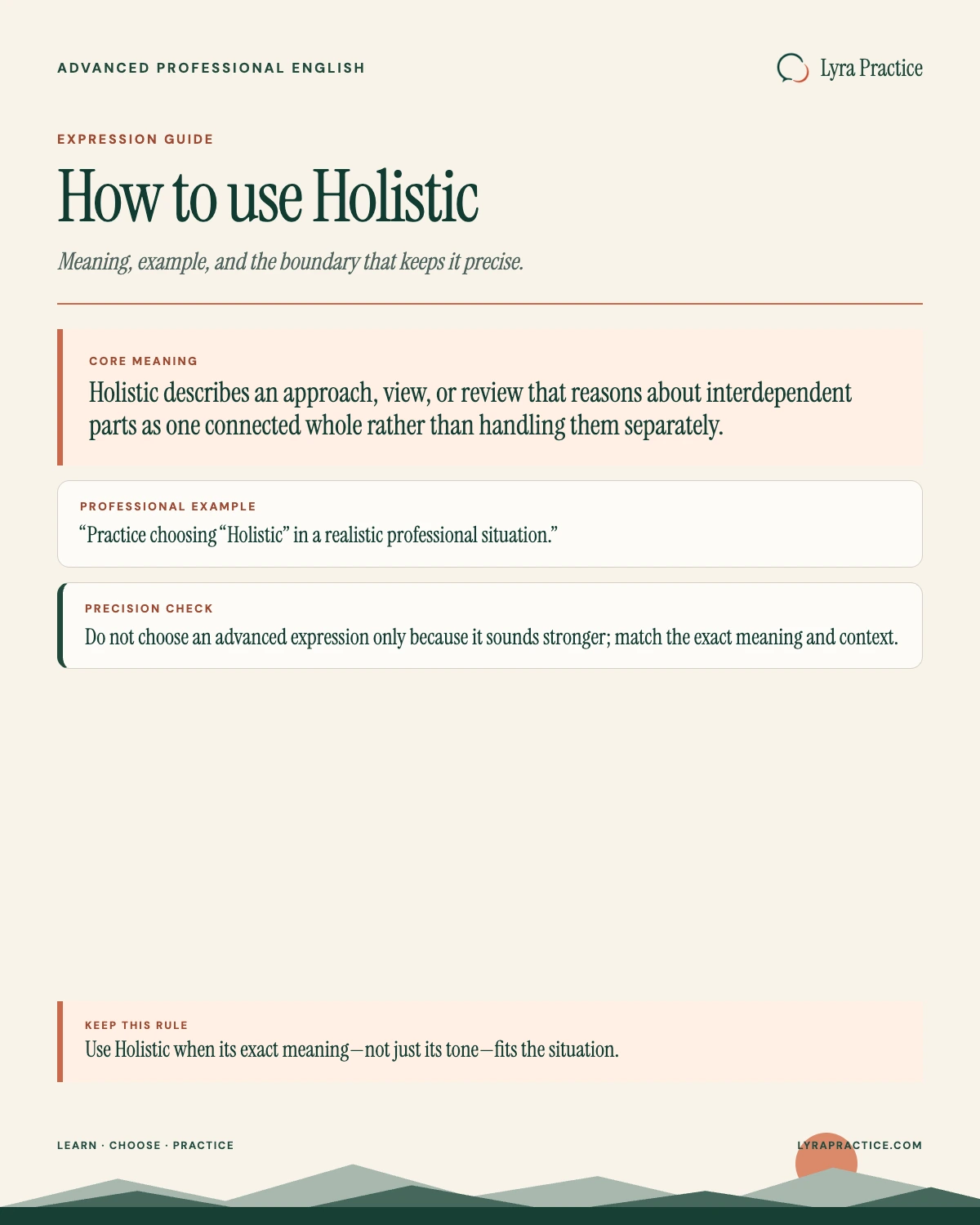
"Holistic" looks at a whole and how its parts connect. It appears in strategy, benefits, hiring, finance, and sustainability. The examples below show common patterns. The word should add more than a vague sense of breadth.
Quick check
How well do you know "Holistic"?
You know "Holistic" well.
Keep going with the full learning path — more workplace contexts, related expressions, and practice using it yourself with feedback.
Continue with "Holistic" →There's more to "Holistic" than it seems.
You've got part of it, but the full learning path goes deeper into its nuances, workplace contexts, and when it sounds natural — then gives you practice using it yourself.
Learn "Holistic" in depth →Strategy and organizational systems
"Fixing the bug backlog department by department missed the point; what the team needed was a holistic view of how the tickets connected."
"The redesign finally gave the company a holistic view of the customer journey, from the first ad to the renewal call."
"A holistic look at the supply chain revealed that the shipping delays and the inventory shortages were actually the same problem."
The adverb form
"The team agreed to address the onboarding problem holistically instead of patching each complaint separately."
HR and wellness
"The company's new benefits package takes a holistic approach to wellbeing, bundling physical, mental, and financial support together."
Hiring and assessment
"Instead of ranking applicants by a single score, the committee adopted a holistic review process that weighed experience and judgment together."
Personal finance
"Her financial advisor built a holistic plan that covered her taxes, retirement accounts, and insurance in one strategy."
Try it yourself
Use "Holistic" yourself
Naming the parts (avoiding the buzzword trap)
"We took a holistic approach to retention, connecting workload, manager quality, and pay together instead of fixing one at a time."
This example names the factors being considered. That detail makes the broad claim useful.
Pairing with "systemic"
"The systemic delays in approvals needed a holistic fix that touched legal, finance, and procurement at once."
Here "systemic" describes a problem rooted across the system. "Holistic" describes an approach that considers connected parts. The words can work together, but they are not synonyms.
The preposition frame
"Leadership wanted a holistic view of the risk landscape before approving the new market entry."
Sustainability reporting
"The sustainability report took a holistic approach to emissions, tracing them across suppliers, shipping, and packaging together."
The predicate use
"Their approach to hiring is genuinely holistic, not just a checklist with extra steps."
Practice scenarios
Practice using holistic in situations like:
- describing a wellness or benefits program that spans more than one dimension
- naming the interconnected parts behind a holistic claim in a status update
- pairing "systemic" (the problem) with "holistic" (the approach) correctly in one sentence
- describing a hiring or performance-review process that weighs several factors together
Useful practice phrases:
- "A holistic view of [system] connects [part A] and [part B]."
- "We're taking a holistic approach to [issue], covering [dimension A], [dimension B], and [dimension C]."
- "The [problem] is systemic; the fix needs to be holistic."
Want to actually use "Holistic" naturally at work?
Understanding it is one thing. Practice its nuances, see how it works in real workplace situations, and use it yourself with feedback.
Start the "Holistic" learning path →These twelve sentences show a useful test: can you name the whole and the relevant parts?
Name those parts when useful, and "holistic" becomes more precise than a broad slogan.