
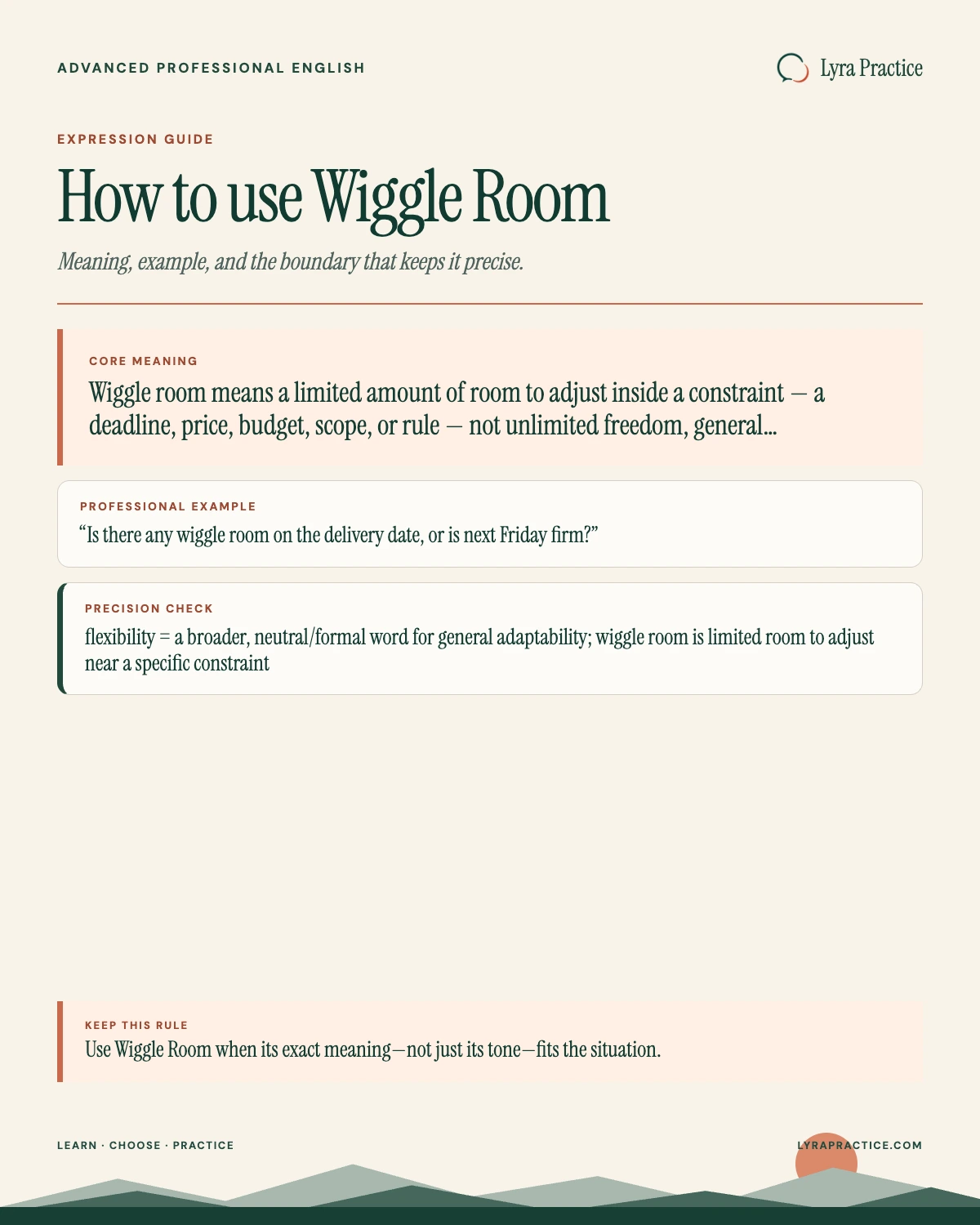
Wiggle room means "limited flexibility within a constraint." Time, budget, price, or scope may be able to move slightly. The phrase does not mean "general freedom." It also does not grant "authority to change a term."
Quick check
Bounded room, not blanket freedom
You know "Wiggle Room" well.
Keep going with the full learning path — more workplace contexts, related expressions, and practice using it yourself with feedback.
Continue with "Wiggle Room" →There's more to "Wiggle Room" than it seems.
You've got part of it, but the full learning path goes deeper into its nuances, workplace contexts, and when it sounds natural — then gives you practice using it yourself.
Learn "Wiggle Room" in depth →The grammar pattern
Wiggle room is normally uncountable. Say some wiggle room, a little wiggle room, not much wiggle room, or no wiggle room. *A wiggle room and *wiggle rooms are not natural. Total wiggle room and complete wiggle room also conflict with its limited meaning.
The preposition helps show what can move. Use in the budget or in the schedule for a plan. Use on price, on the deadline, or on scope for a term. Use with the vendor or with the client for a negotiating party. Use around timing or around the requirements for a general area. Common verbs include have, give, leave, build in, and find.
Worked examples
Negotiation, direct ask (neutral, common register): "Is there any wiggle room on the delivery date, or is next Friday truly fixed?" This asks about flexibility. It does not offer a concession or promise a change.
Budget conversation, internal: "We have a little wiggle room in the budget, maybe two or three thousand dollars, but not much more." Use this only if the budget figure is verified. Do not imply approval to spend it. If needed, ask the budget owner.
Diplomatic firm limit, client-facing (higher stakes register): "I don't have much wiggle room this week, but I could probably move Thursday's call to Friday morning." Confirm the other person's availability before treating that option as agreed.
Try it yourself
Name the small adjustment
The two mistakes that matter most
Countability errors. A wiggle room, wiggle rooms, and few wiggle rooms are unnatural. The idiom does not take an indefinite article or a plural form. Use some, a little, not much, no, or any wiggle room.
Claiming more authority than you have. Do not say "we have wiggle room" if you can only ask for approval. Also, do not imply that a law, policy, contract, or consent requirement can be ignored. Check the source, owner, scope, and exception process.
No wiggle room can state a hard constraint, but verify the claim. Give a brief reason: "No wiggle room on the compliance deadline — that's set by the regulator." If an exception process exists, explain how to use it.
Practice scenarios
Practice using wiggle room in situations like:
- asking a vendor or client whether there's flexibility on price, scope, or timing
- explaining that there's a little wiggle room in the budget, without overcommitting
- softening a firm "no" so it doesn't sound blunt to a client or senior stakeholder
- proposing that a plan build in some wiggle room before a date is locked in
Useful practice phrases:
- "Is there any wiggle room on [term]?"
- "We have a little wiggle room in [budget/schedule], but not much more."
- "There's no wiggle room on [X] — [reason]."
- "Let's build in some wiggle room around [date/requirement]."
Want to actually use "Wiggle Room" naturally at work?
Understanding it is one thing. Practice its nuances, see how it works in real workplace situations, and use it yourself with feedback.
Start the "Wiggle Room" learning path →Used well, wiggle room describes limited flexibility without promising a change.
State the amount, authority, affected terms, and approval path when they matter.