
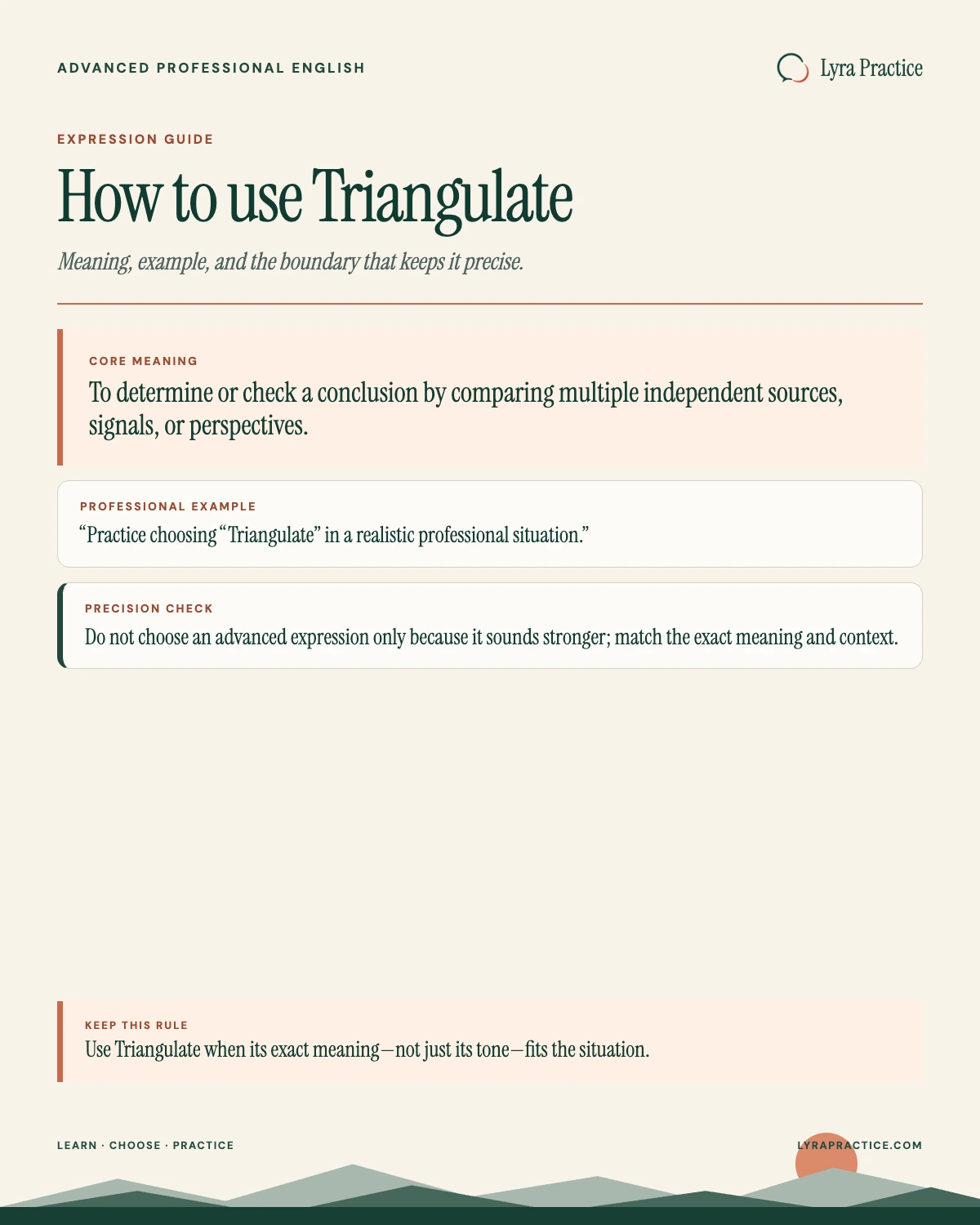
No. Triangulating sources checks a conclusion across several inputs. It does not make the conclusion certain by itself.
The word names a method. It does not promise that the claim is true.
Quick check
How well do you know "Triangulate"?
You know "Triangulate" well.
Keep going with the full learning path — more workplace contexts, related expressions, and practice using it yourself with feedback.
Continue with "Triangulate" →There's more to "Triangulate" than it seems.
You've got part of it, but the full learning path goes deeper into its nuances, workplace contexts, and when it sounds natural — then gives you practice using it yourself.
Learn "Triangulate" in depth →The method and the result are different
When a team triangulates a conclusion, it compares several separate sources, signals, or views. That tells readers how the team checked the conclusion.
"We triangulated the conclusion across several independent inputs."
This sentence describes the check. It does not state that the conclusion became certain.
The result needs its own wording. A writer can explain what the inputs showed, but the verb triangulate alone does not supply that result.
"The report says the team triangulated its finding; it does not call the finding certain."
Here, the report makes a limited statement. It names the method and stops there.
Try it yourself
Use "Triangulate" yourself
Several sources do not create a guarantee
The defining condition of triangulate is comparison across several inputs. The number of inputs does not turn the word into a guarantee.
The meaning remains narrow. It says that several sources were compared. It does not say that those sources automatically proved the claim.
Avoid sentences that build a guarantee into the verb.
"We triangulated the claim, so it must be true."
That sentence goes beyond the meaning. The first part names the method. The second part adds certainty that the method does not promise.
A clearer sentence keeps those ideas apart.
"We triangulated the claim across several independent inputs."
This version states what happened without adding a guarantee.
Use careful result language
Start by naming the conclusion or finding. Then name the separate inputs used to check it. Describe the result in a separate sentence. Base it on the report or source material.
You can use a simple structure:
- conclusion: what the team checked
- method: which separate inputs the team compared
- result: what the report says after that check
The third part does not come from the word triangulate. It must come from the report or other source material.
This structure helps you avoid a common mistake. It keeps a method claim from becoming a certainty claim.
A quick sentence check
Read your sentence once more after writing it. Ask, “Does this sentence only say that several inputs were compared?” If it also says the claim is guaranteed, check whether that extra statement appears in your source.
You can also look for words such as certain, guaranteed, or must be true. These words make a stronger claim than triangulate makes on its own.
Practice scenarios
Practice using triangulate in situations like these.
- describing a conclusion checked across several independent inputs
- reporting that a team triangulated a finding without calling it certain
- revising a sentence that treats triangulation as a guarantee
Practice these useful phrases.
- "We triangulated the conclusion across ___."
- "The report says the team triangulated ___."
- "Triangulating the claim does not make it certain by itself."
Want to actually use "Triangulate" naturally at work?
Understanding it is one thing. Practice its nuances, see how it works in real workplace situations, and use it yourself with feedback.
Start the "Triangulate" learning path →Triangulation names the check. It does not guarantee the answer.
State the method. Keep certainty separate.