
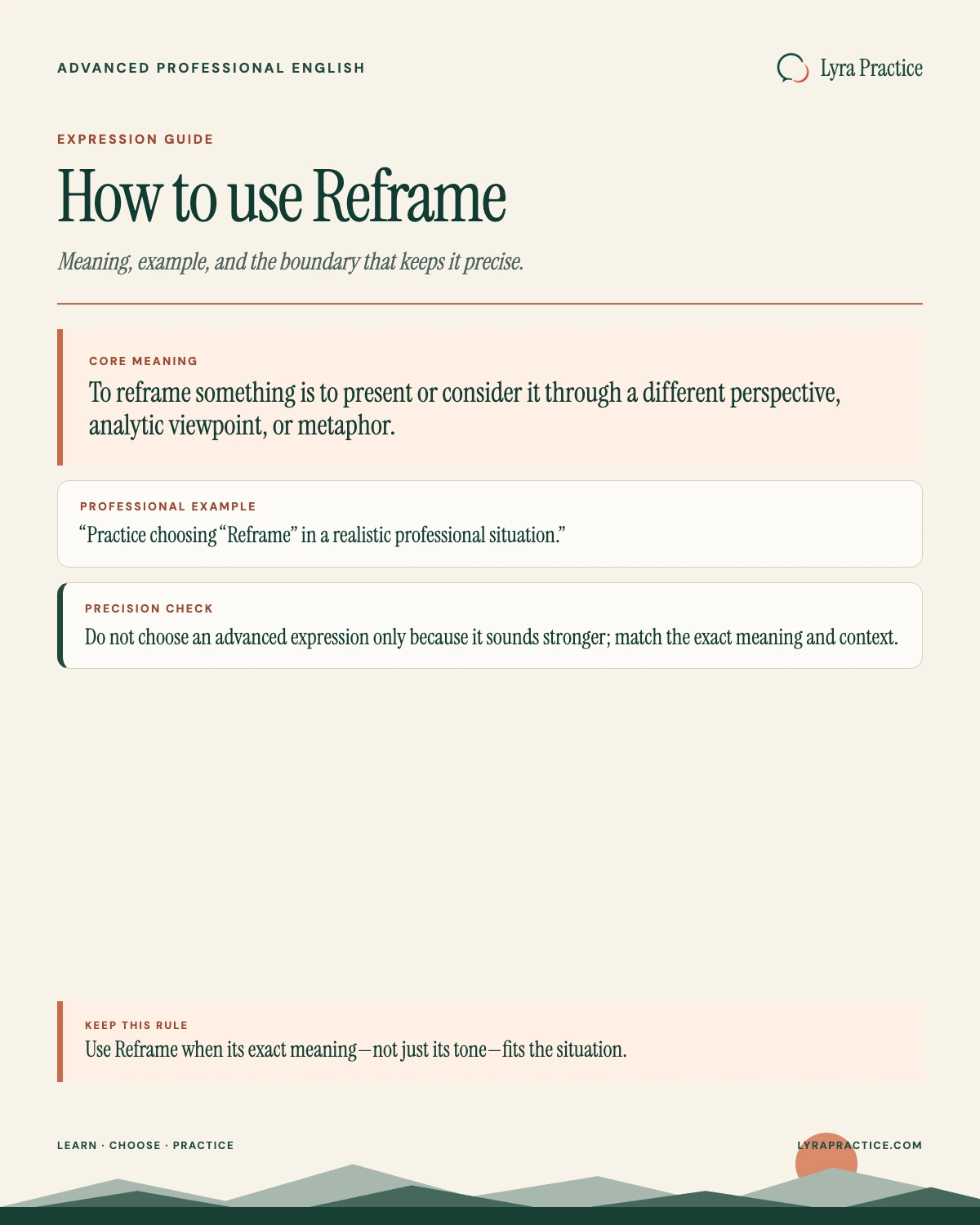
To reframe something is to present or consider it through a different perspective, analytic viewpoint, or metaphor.
The subject may stay the same. The facts may stay the same. What changes is the frame used to understand the issue, choice, or event.
"Let's reframe the vendor decision around total value, not sticker price alone."
The decision has not changed. The sentence asks the group to evaluate it through a different criterion.
Quick check
How well do you know "Reframe"?
You know "Reframe" well.
Keep going with the full learning path — more workplace contexts, related expressions, and practice using it yourself with feedback.
Continue with "Reframe" →There's more to "Reframe" than it seems.
You've got part of it, but the full learning path goes deeper into its nuances, workplace contexts, and when it sounds natural — then gives you practice using it yourself.
Learn "Reframe" in depth →Reframe changes the viewpoint
At work, people commonly reframe an issue, question, debate, decision, or discussion. The verb needs more than a cosmetic wording change. It points to a new way of considering the subject.
"The team reframed the retention problem as an onboarding problem."
This sentence changes the analytic view. It treats early employee experience, rather than retention alone, as the frame for the discussion.
A reframe does not need to be positive. It can make a risk more visible, narrow a broad debate, or move attention to a different criterion. The word itself does not say whether the new view is accurate, fair, useful, or persuasive.
Try it yourself
Use "Reframe" yourself
Reframe vs reword, summarize, and relabel
To reword something is to change the words. The meaning may stay exactly the same.
To summarize something is to give its main points, usually in a shorter form. A summary does not need a new perspective.
To relabel something is to give it a different name. A new label can leave the underlying interpretation unchanged.
To reframe something is to change the perspective through which it is considered.
Compare:
"Please reword this sentence in plain English."
"Please reframe the discussion around customer risk."
The first request concerns wording. The second concerns viewpoint.
Natural patterns with reframe
Several patterns are common in professional English:
- reframe an issue, question, debate, or decision
- reframe X as Y
- reframe X from one view to another
- reframe the discussion around a criterion
- reframe how we think about something
Examples:
"Could we reframe the delay as time for additional testing?"
"Let's reframe the review around the customers who stayed."
In the reframe X as Y pattern, put the original subject after reframe and the new perspective after as. Do not use reframe to Y for that construction.
A reframe must not invent facts
Reframing does not permit a writer to remove an important fact or add evidence that does not exist. If a pilot missed its overall target, a narrower view of one strong segment can be relevant, but the overall result remains material.
A careful sentence makes the frame visible without pretending it changes the record:
"The pilot missed its overall target, but we can reframe the follow-up around the segment with the highest retention."
Practice scenarios
Practice using reframe in situations like:
- shifting a decision from price alone to total value
- presenting the same facts through a different business question
- distinguishing a real perspective change from a simple wording edit
Useful practice phrases:
- "Let's reframe [issue] around [criterion]."
- "Could we reframe [X] as [Y]?"
- "We need to reframe how we think about ___."
Related guides
- How to Explain a Complex Idea Clearly in English
- How to Make a Point Without Overexplaining
- Narrative vs Framing: What's the Difference?
Reframing changes the perspective, not the facts. State the new view clearly enough that the reader can see what changed.
Want to actually use "Reframe" naturally at work?
Understanding it is one thing. Practice its nuances, see how it works in real workplace situations, and use it yourself with feedback.
Start the "Reframe" learning path →