
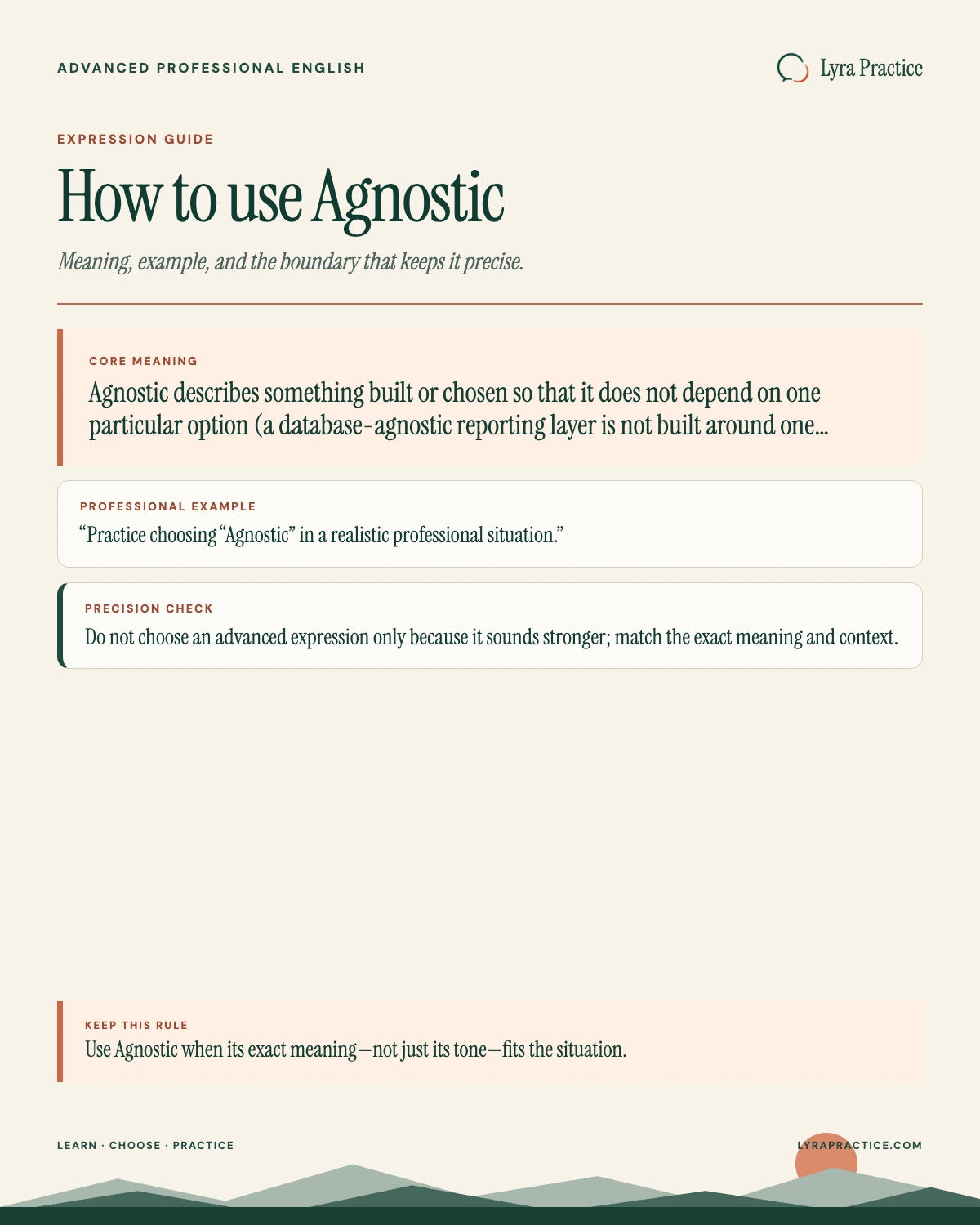
Read "our checkout flow is device-agnostic" and "I'm pretty agnostic about which restaurant we go to tonight" together. They make different claims, yet may sound similar during a quick meeting.
Most workplace uses of "agnostic" describe how a system is designed. Some describe a person's or team's stance on one decision. A few are simply casual talk outside work. Before using the word, learn which category each sentence belongs to.
Try it yourself
Use "Agnostic" yourself
Three uses, one word
This word covers three distinct ideas. First, a system, product, or process may not depend on one technology. That is a technical design claim. Second, a person or team may lack a fixed preference about a specific choice. That is a personal stance. Third, "brand-agnostic" may appear in loose, everyday talk outside a genuine work decision. That is casual talk.
Mixing these meanings can cause real communication mistakes. You might use a technical design term for a person's preference. You might also treat a casual remark as a precise business claim.
Read each sentence below, choose its category, and then check the answer.
- "Our checkout flow is device-agnostic." -- Design claim. This is a system property, not someone's opinion or casual remark.
- "I'm agnostic on which day we ship, honestly -- either works for me." -- Personal stance. The person states no preference about a specific decision.
- "I'm pretty agnostic about which restaurant we go to tonight." -- Casual talk. It extends the same "no preference" idea beyond technical work or a workplace decision.
Why the sorting matters
A common mistake is treating all three uses as identical. You might interpret a design claim, like "the tool is platform-agnostic," as someone's personal opinion. Or you may know only the casual sense and miss both workplace meanings.
You also evaluate each use differently. Test a design claim against how the system was actually built. Confirm a personal stance with the person or team expressing it. Casual talk makes no technical claim, so do not apply those standards.
Practice scenarios
Practice using agnostic in these situations.
- sort a workplace sentence as a design claim, personal stance, or casual talk
- catch a design claim that someone misreads as a personal opinion
- separate casual, non-work "agnostic" talk from a precise business claim
Useful practice phrases to try.
- "That's a design claim -- [system] is [noun]-agnostic."
- "That's a personal stance -- I'm agnostic on [decision], as long as [condition]."
- "That's casual talk, not a business claim -- [everyday preference]."
Want to actually use "Agnostic" naturally at work?
Understanding it is one thing. Practice its nuances, see how it works in real workplace situations, and use it yourself with feedback.
Start the "Agnostic" learning path →One word has three jobs. Knowing the current job makes "agnostic" precise, rather than merely fashionable.