
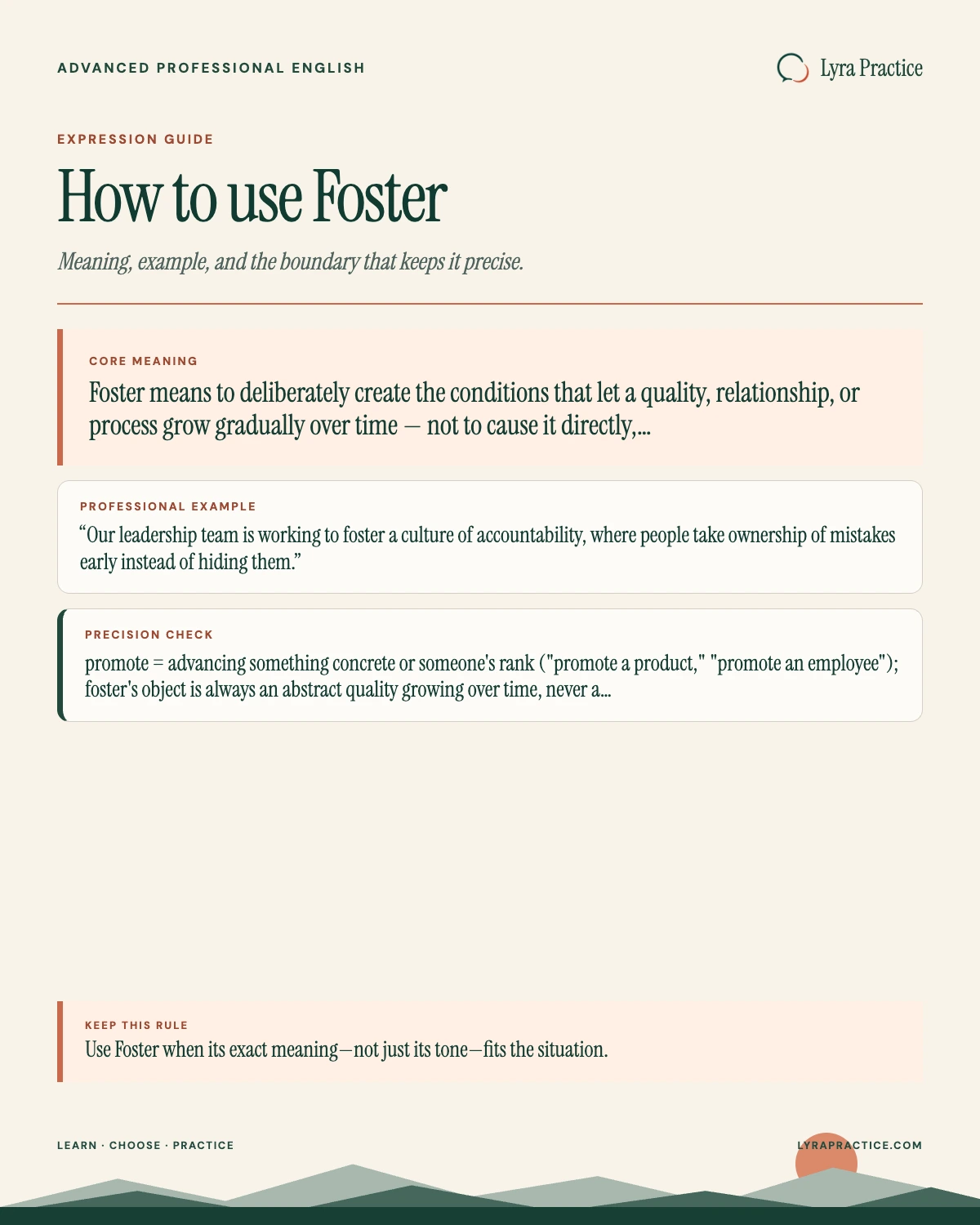
Foster means to help create a setting in which something can grow. It does not claim direct or instant control of the result. At work, its object is often a quality or a relationship. It can also be a person's growth. The same verb can describe a setting that supports harm.
The examples below group those uses by object type. The last group shows that the verb has no set moral tone.
Quick check
Which sentence fits?
You know "Foster" well.
Keep going with the full learning path — more workplace contexts, related expressions, and practice using it yourself with feedback.
Continue with "Foster" →There's more to "Foster" than it seems.
You've got part of it, but the full learning path goes deeper into its nuances, workplace contexts, and when it sounds natural — then gives you practice using it yourself.
Learn "Foster" in depth →Organizational quality or culture
Mission statement: "We foster a culture of transparency by sharing difficult results as openly as strong ones."
All-hands comment: "This program aims to foster psychological safety, so people can raise concerns early without fear of retaliation."
Retro write-up: "Team feedback suggests that shared work sessions fostered more collaboration than the new tool did."
Relationships and partnerships
Client-facing email: "We want to foster a long-term partnership by making each next step a joint choice."
Leadership note: "The offsite was designed to foster trust between departments through joint planning and open discussion."
Try it yourself
Name gradual growth
Individual growth
Performance review: "We agreed that I would use stretch tasks to foster her confidence. In later reviews, she challenged senior leaders with evidence."
Mentorship program description: "The pairing aims to foster junior engineers' judgment. The team still owns its final technical choices."
The valence-neutral property: foster works with negative objects too
Foster describes support for development, not whether the result is good. The grammar is the same for useful and harmful results.
Risk assessment: "Staff surveys suggest that the current approval process fosters a blame culture. Reporting logs show that risks are raised later."
Org-design critique: "The review suggests that six-month manager rotations may foster short-term choices by weakening long-term ownership."
If you assume foster is always good, you may misread these claims. The word can name harm without saying that anyone wanted it. Words such as suggests and may also keep the claim within the evidence.
What these examples have in common
These sentences do not describe one act with a clear end. "Fostered trust" points to a process. It does not prove that one meeting made people trust each other. "Fosters short-term thinking" names a pattern linked to an ongoing rule. It does not assign intent to a person. Ask whether the setting supports growth over time. If one act caused a known result, a more direct verb may fit.
The object is usually abstract: a quality, relationship, skill, or condition. You can foster trust or sound judgment. You do not foster a deadline or a contract.
Practice scenarios
Practice using foster in situations like:
- describing a culture-building effort in a mission statement or all-hands
- naming an unintended negative side effect of a process, precisely
- writing a performance review that credits gradual, indirect growth
- describing a partnership-building effort in a client email
Useful practice phrases:
- "We foster a culture of [quality], where [concrete behavior] happens."
- "[Policy/process], as written, fosters [negative outcome]."
- "One of my goals was to foster [person]'s [quality]."
Want to actually use "Foster" naturally at work?
Understanding it is one thing. Practice its nuances, see how it works in real workplace situations, and use it yourself with feedback.
Start the "Foster" learning path →Foster describes support for growth. It does not prove control, intent, or moral worth. A careful sentence also shows who acted. It states what evidence supports the claim and what result followed.