
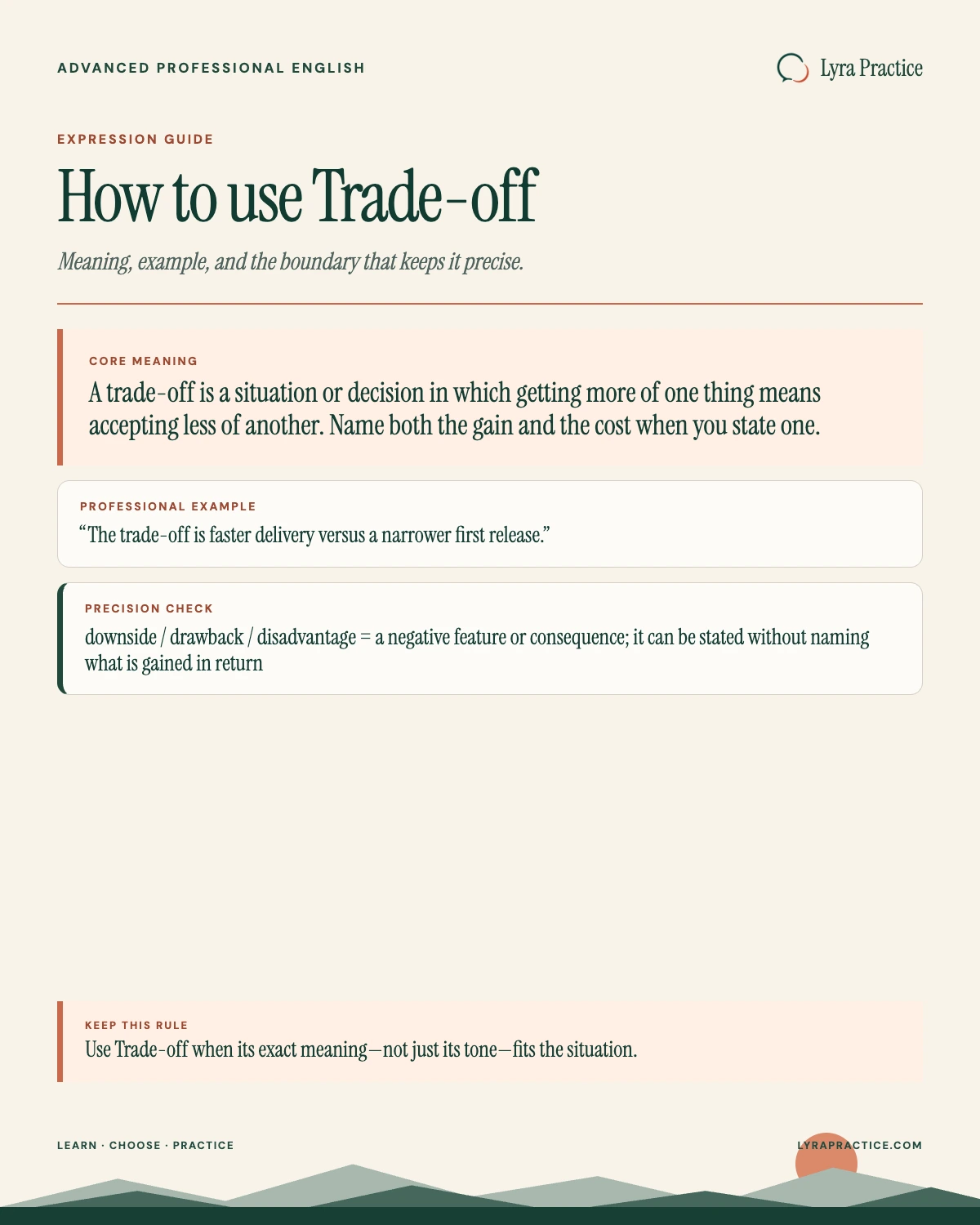
A trade-off is a choice in which you gain one thing but give up another. When you use the word, name both sides. It is not just another word for a "downside" or a "cost." Those words name only the part you lose.
Quick check
How well do you know "Trade Off"?
You know "Trade Off" well.
Keep going with the full learning path — more workplace contexts, related expressions, and practice using it yourself with feedback.
Continue with "Trade Off" →There's more to "Trade Off" than it seems.
You've got part of it, but the full learning path goes deeper into its nuances, workplace contexts, and when it sounds natural — then gives you practice using it yourself.
Learn "Trade Off" in depth →The grammar pattern
The noun has a hyphen: trade-off, trade-offs. The verb has two words: trade off, traded off, and trading off. A common pattern is trade off X against Y ("we traded off launch speed against test coverage"). Do not use the noun as a verb (*we trade-offed). Do not hyphenate the verb (*we need to trade-off scope).
The usual connector for the noun is between: the trade-off between speed and depth, not *with speed and depth. Use a trade-off or the trade-off for one clear exchange. The singular noun normally needs an article, except when it modifies another noun, as in "trade-off analysis." Use trade-offs when a plan has several exchanges: "weigh the trade-offs before committing to the roadmap." Common verbs include weigh, make, face, accept, and navigate. Avoid *do a trade-off, though do a trade-off analysis is a set phrase.
Worked examples
Product scope, internal (informal-neutral): "The trade-off is speed versus depth: we can ship in two weeks with basic reporting, or in six weeks with the full analytics suite." This states both options in plain terms.
Vendor selection, written note: "There's a real trade-off between the cheaper vendor's price and the pricier one's support response time." This puts the lower price next to the better support.
Board or executive summary (formal, higher stakes): "Growth versus margin is the trade-off the board actually needs to weigh this quarter." This is brief and focused on the choice. It still names both sides.
Try it yourself
Use "Trade Off" yourself
The two mistakes that matter most
Naming only the downside and calling it a trade-off. "The cheaper vendor has worse support" gives only the cost. Add the matching gain, such as the lower price, to state the trade-off. A one-sided statement does not explain the full choice.
The more serious version: relabeling a failure as a considered exchange. Be careful when you call an outage, missed deadline, or broken promise "an acceptable trade-off." The phrase can make an unplanned result sound like an approved choice. If no one chose the exchange, say what happened in direct terms. Then explain the cause, impact, and next step.
Also avoid using trade-off language to suggest that a legal, safety, or compliance rule is optional. A trade-off may exist, but that does not grant approval to ignore a rule. Calling it "acceptable" or "unavoidable" is a separate judgment. The right person must make that judgment based on the facts and the rules.
Practice scenarios
Practice using trade-off in situations like:
- explaining a product scope decision as speed versus depth, naming both sides
- comparing two vendors where price and support quality pull in opposite directions
- catching yourself before calling a genuine outage or missed deadline an "acceptable trade-off"
- presenting a strategic choice (growth versus margin) to a board or senior audience
Useful practice phrases:
- "The trade-off is between [A] and [B]."
- "We traded off [X] against [Y]."
- "There's a real trade-off here: we gain [X], but it costs us [Y]."
- "That wasn't a trade-off — it was a failure, and here's what we're doing about it."
Want to actually use "Trade Off" naturally at work?
Understanding it is one thing. Practice its nuances, see how it works in real workplace situations, and use it yourself with feedback.
Start the "Trade Off" learning path →A clear trade-off helps readers see both sides of a choice.
A vague trade-off can hide the real cost or make an unplanned failure sound chosen.