
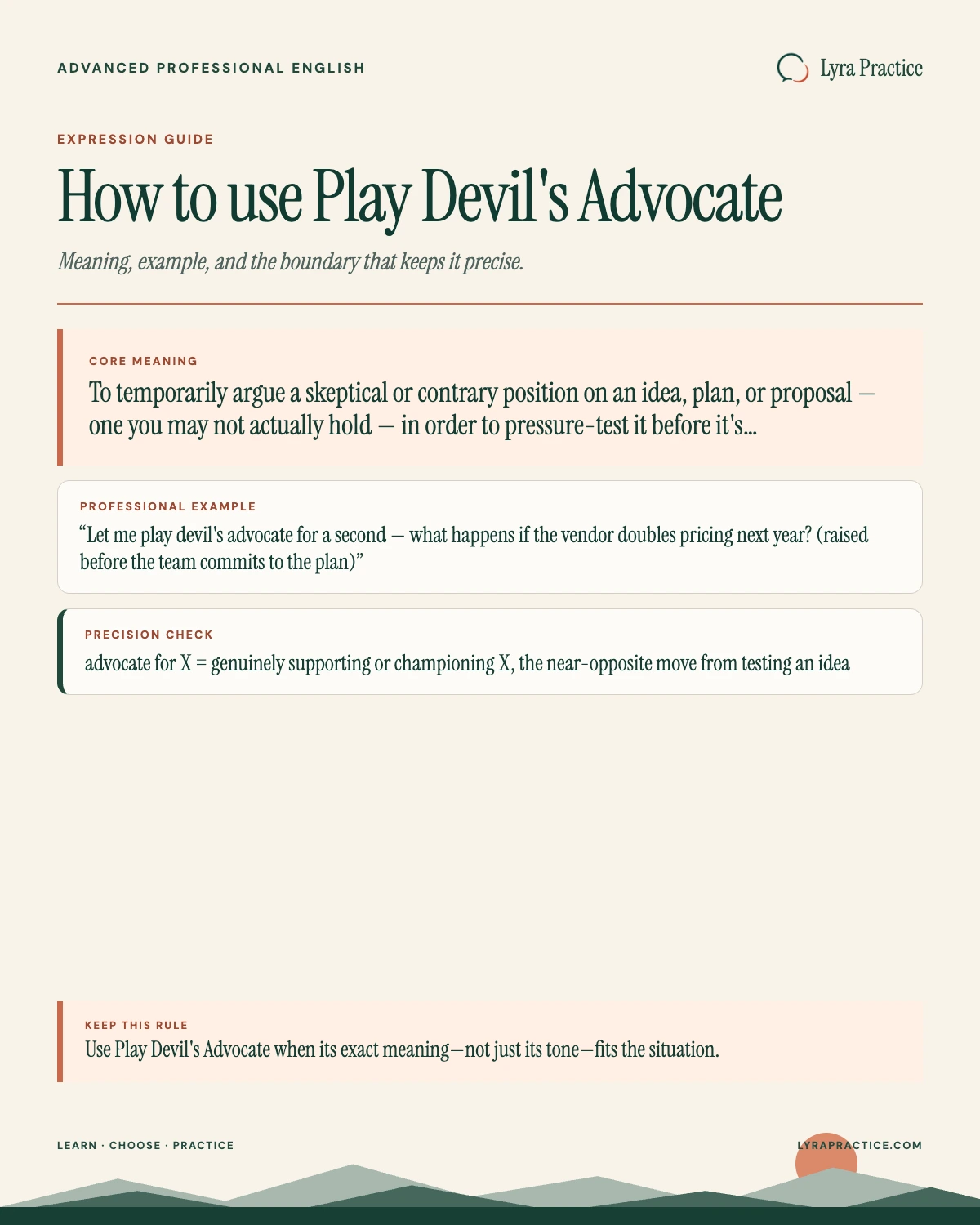
To play devil's advocate is to argue for a less accepted view for discussion. The common workplace form keeps the possessive devil's. A speaker may test an idea, plan, assumption, or prevailing view.
The examples show framed questions and descriptions of someone taking this role.
Quick check
How well do you know "Play Devil's Advocate"?
You know "Play Devil's Advocate" well.
Keep going with the full learning path — more workplace contexts, related expressions, and practice using it yourself with feedback.
Continue with "Play Devil's Advocate" →There's more to "Play Devil's Advocate" than it seems.
You've got part of it, but the full learning path goes deeper into its nuances, workplace contexts, and when it sounds natural — then gives you practice using it yourself.
Learn "Play Devil's Advocate" in depth →The core move: framed, temporary opposition
Strategy session: "Let me play devil's advocate for a second: what happens if enterprise adoption takes two quarters longer than we're modeling?"
Product review: "To play devil's advocate, are we assuming customers will actually read the onboarding flow, or just click through it?"
Pricing discussion: "I don't disagree with the discount, but playing devil's advocate here -- could this set a precedent our sales team regrets in Q3?"
Risk conversation: "Just to play devil's advocate, what's our exposure if the vendor misses the delivery date entirely?"
Try it yourself
Use "Play Devil's Advocate" yourself
The framing preamble matters
Each example uses a signal such as "let me" or "just to." This framing helps listeners recognize a temporary discussion role. It is useful, but the expression can also appear without a long preamble.
Without it, the same content reads differently:
"What happens if enterprise adoption takes two quarters longer than we're modeling?"
The question remains fair, but the speaker's purpose is less explicit. A short frame can show that the goal is to test the plan. It cannot prove what the speaker privately believes.
The label does not make every challenge constructive. Tone, timing, and trust still shape how it lands. If you hold the concern, state it plainly. Ask a direct question when the role label would distract.
Secondary sense: naming someone's role
The phrase can also name a function that someone performs in a group. The description may be positive, neutral, or critical, depending on context.
Team description: "She's usually the one who plays devil's advocate in planning meetings -- it's a role, not a personality trait, and the team relies on it."
Delegating the role: "I asked Priya to play devil's advocate on this one, since she wasn't in the room when we made the original call."
Both examples assign or recognize a discussion role. They do not tell us whether the person also shares the concern.
What these examples have in common
Each sentence presents a challenge for the sake of discussion. The speaker may or may not believe the argument. The phrase should not be used to dismiss a person or hide a settled position. If the concern is genuine, saying so directly is often clearer.
Practice scenarios
Practice using play devil's advocate in situations like:
- opening a stress-test question before a decision is finalized
- naming someone's function in a team description
- delegating the role to someone with an outside perspective
- signaling that an objection is being offered as a discussion test
Useful practice phrases:
- "Let me play devil's advocate for a second: what if [scenario]?"
- "To play devil's advocate, are we assuming [assumption]?"
- "She's usually the one who plays devil's advocate in these meetings."
- "I asked [person] to play devil's advocate on this, since they have an outside perspective."
Want to actually use "Play Devil's Advocate" naturally at work?
Understanding it is one thing. Practice its nuances, see how it works in real workplace situations, and use it yourself with feedback.
Start the "Play Devil's Advocate" learning path →Use the common form play devil's advocate and frame the purpose clearly. Challenge the idea without turning the phrase into a shield for personal criticism.