
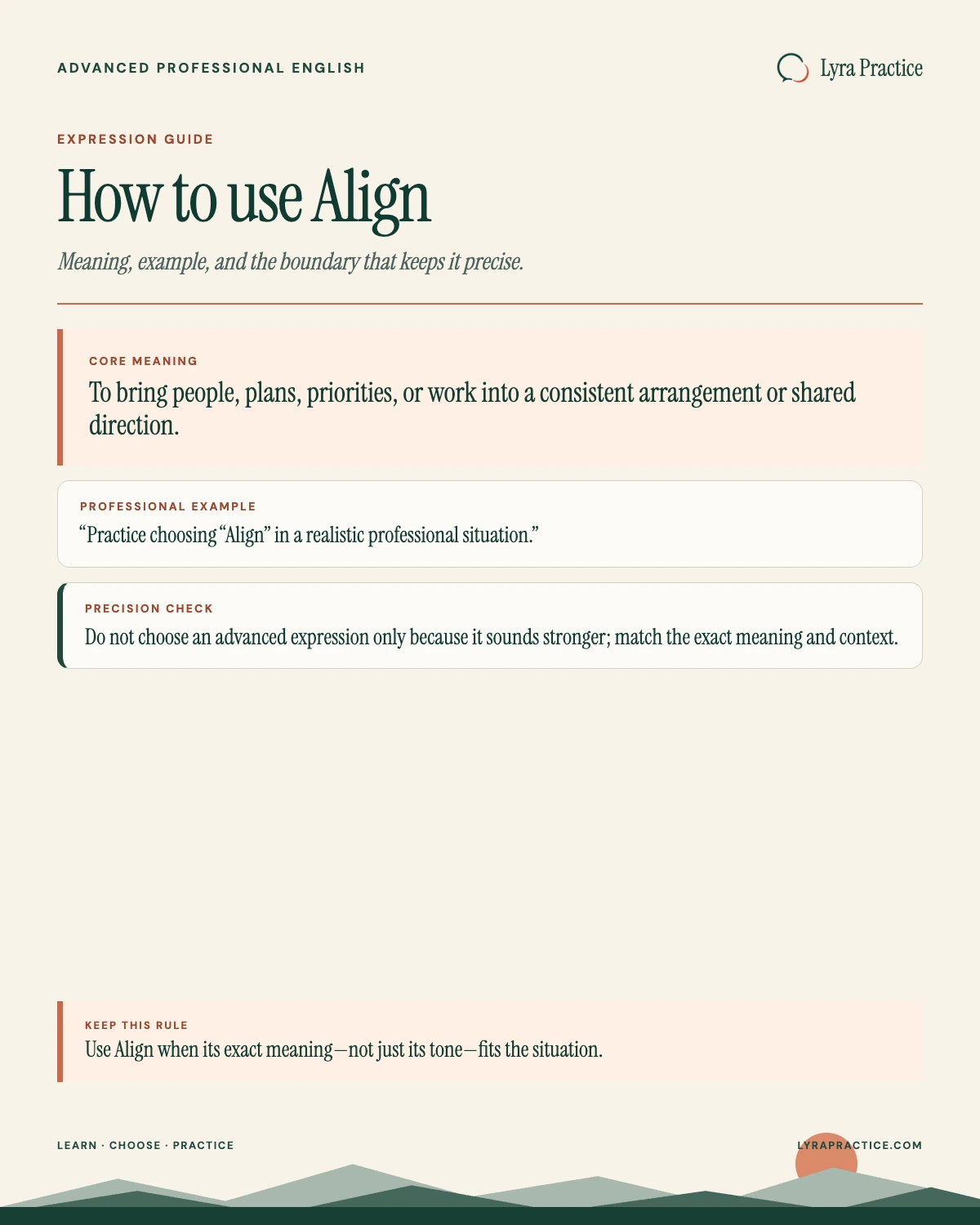
Align shows up across many kinds of work. These ten sentences show the word doing its real job: naming a shared direction.
Here are natural "align" sentences. They cover four grammar patterns: align on, align with, align...around, and be aligned on. All fit real workplace situations.
Quick check
How well do you know "Align"?
You know "Align" well.
Keep going with the full learning path — more workplace contexts, related expressions, and practice using it yourself with feedback.
Continue with "Align" →There's more to "Align" than it seems.
You've got part of it, but the full learning path goes deeper into its nuances, workplace contexts, and when it sounds natural — then gives you practice using it yourself.
Learn "Align" in depth →Ten sentences across four patterns
Each sentence below shows a real, shared direction. That is the core meaning of align. The sentences use different patterns. Some use "align on." Some use "align with." Others use "align...around" or "be aligned on." Together, they show how the word works across real work situations.
- The support and product teams align on how incoming bugs get prioritized.
- This report should align with the client's original brief.
- The new VP aligned the regional offices around one growth target.
- The design and engineering leads are aligned on the launch checklist.
- The two store managers align on holiday staffing requests every December.
- The training curriculum aligns with the certification board's updated standards.
- The conference organizers aligned the speakers around one central theme.
- Sales and marketing are aligned on which leads count as qualified.
- The pilot and co-pilot align on the pre-flight checklist before departure.
- Her performance goals align with the department's quarterly targets.
Look at what each sentence actually claims. Sentence one names a shared decision about bug priority, not just a conversation about bugs. Sentence three shows one person, the VP, bringing separate offices together around a single number. Sentence four reports a settled state: the checklist agreement already exists between the two leads. Sentence six compares a curriculum against an outside standard it is expected to match.
The pattern repeats across the full list. Every sentence either states that a shared decision was reached, or states that one thing has been matched against another, or reports that a group was brought together around a single aim. None of the sentences describe a message sent one way with no response, because that situation calls for a different word, such as "informed" or "notified."
Try it yourself
Use "Align" yourself
Reading the pattern back
Notice how the four grammar patterns map onto different kinds of agreement. "Align on" fits a specific decision point, like which bugs to prioritize or which leads count as qualified. "Align with" fits matching something against an existing standard, like a brief, a set of certification standards, or a set of quarterly targets. "Align...around" fits a leader or organizer uniting a group behind one shared aim, like a growth target or a conference theme. "Be aligned on" fits a state that is already settled, reported after the fact.
Choosing among these four is less about memorizing rules and more about naming what actually happened. Ask what kind of agreement the sentence is describing, and the right pattern usually follows.
The common mistake
A common mistake is writing a sentence where people only exchange information. That is not an "align" sentence. Every real "align" sentence needs a stated shared direction. It needs more than just a conversation.
Before using "align" in a new sentence, check whether a real decision, match, or shared aim is actually present. If only information changed hands, choose a different verb instead.
Practice scenarios
Practice writing your own natural align sentences in situations like:
- naming a shared decision reached by two departments
- comparing your own work against an outside standard it should match
- describing a leader uniting a group around one shared aim
Practice these useful phrases.
- "The two teams align on how priority gets decided."
- "This should align with the standard we were given."
- "She aligned the group around one shared aim."
Want to actually use "Align" naturally at work?
Understanding it is one thing. Practice its nuances, see how it works in real workplace situations, and use it yourself with feedback.
Start the "Align" learning path →Ten sentences, one recurring shape: a real, shared direction.
Once you can spot that shape, the word almost writes itself.