
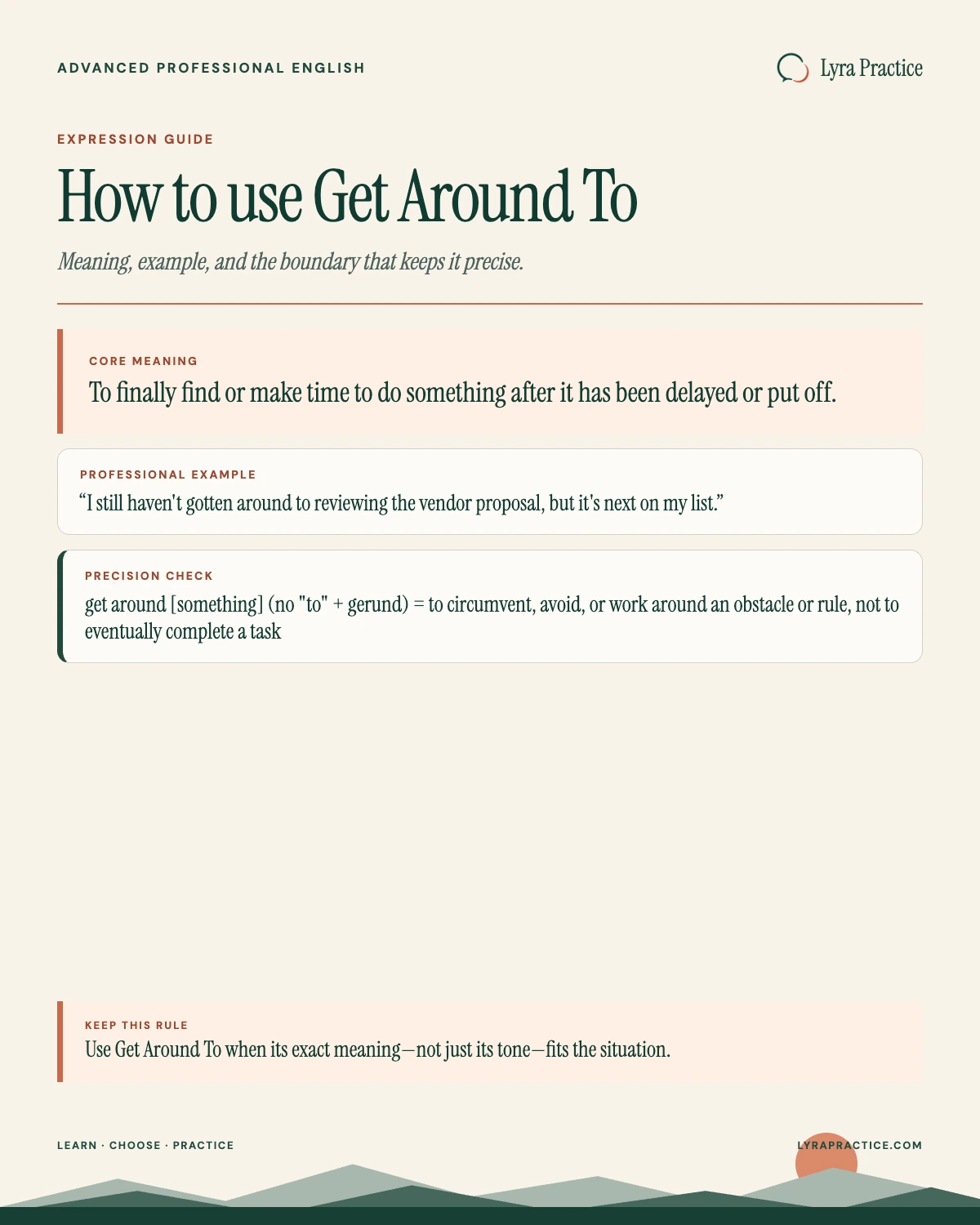
Get around to means to do something after a delay, often because competing priorities came first. It can describe a task that is still open or one that is now done, but the phrase neither explains nor excuses the delay. The examples below show common tenses and workplace settings.
Quick check
How well do you know "Get Around To"?
You know "Get Around To" well.
Keep going with the full learning path — more workplace contexts, related expressions, and practice using it yourself with feedback.
Continue with "Get Around To" →There's more to "Get Around To" than it seems.
You've got part of it, but the full learning path goes deeper into its nuances, workplace contexts, and when it sounds natural — then gives you practice using it yourself.
Learn "Get Around To" in depth →Present perfect negative: the most common frame
Standup update: "Quick update: I still haven't gotten around to the QA pass. I plan to finish it tomorrow."
Slack apology: "Sorry, I haven't gotten around to your feedback yet -- I plan to review it today."
Simple past: task finally completed
Peer check-in: "Did you ever get around to updating the doc?"
Follow-up reply: "Yes -- finally got around to it this morning."
Try it yourself
Use "Get Around To" yourself
Future and modal: acknowledging a task still pending
1:1 comment: "I might get around to the deck redesign next week, after the launch work slows down."
Casual promise: "I'll get around to it eventually -- just not this sprint."
Grammar: gerund only, never a bare infinitive
In this phrase, "to" is followed by a noun, a pronoun, or a gerund. Do not put a bare verb after it.
Correct: "I haven't gotten around to reviewing the report." Incorrect: "I haven't gotten around to review the report."
Grammar: dropping "to" changes the meaning
Without "to," "get around" something often means to avoid or bypass it. That is a different meaning.
"I finally got around to it" (I completed the task). "I finally got around it" (I found a way to avoid or bypass it).
What these examples have in common
Each example refers to a delay. The phrase may sound less direct than "I forgot" or "I didn't do it," but it does not prove that the task stayed on a list. It also does not remove responsibility for a missed date. The tone is informal or neutral, so it fits standups, Slack, and 1:1s. In a formal client report, "still pending" or "not yet completed" may be clearer.
Practice scenarios
Practice using get around to in situations like:
- reporting a delayed task in a standup or async update
- admitting a delay to a manager without sounding defensive
- checking in with a peer about a task they were supposed to finish
Useful practice phrases:
- "I haven't gotten around to it yet."
- "I finally got around to reviewing the report."
- "I'll get around to it next week."
Want to actually use "Get Around To" naturally at work?
Understanding it is one thing. Practice its nuances, see how it works in real workplace situations, and use it yourself with feedback.
Start the "Get Around To" learning path →In the present perfect, past, or future, the phrase presents a task as delayed. Context may add, "The work is still planned."