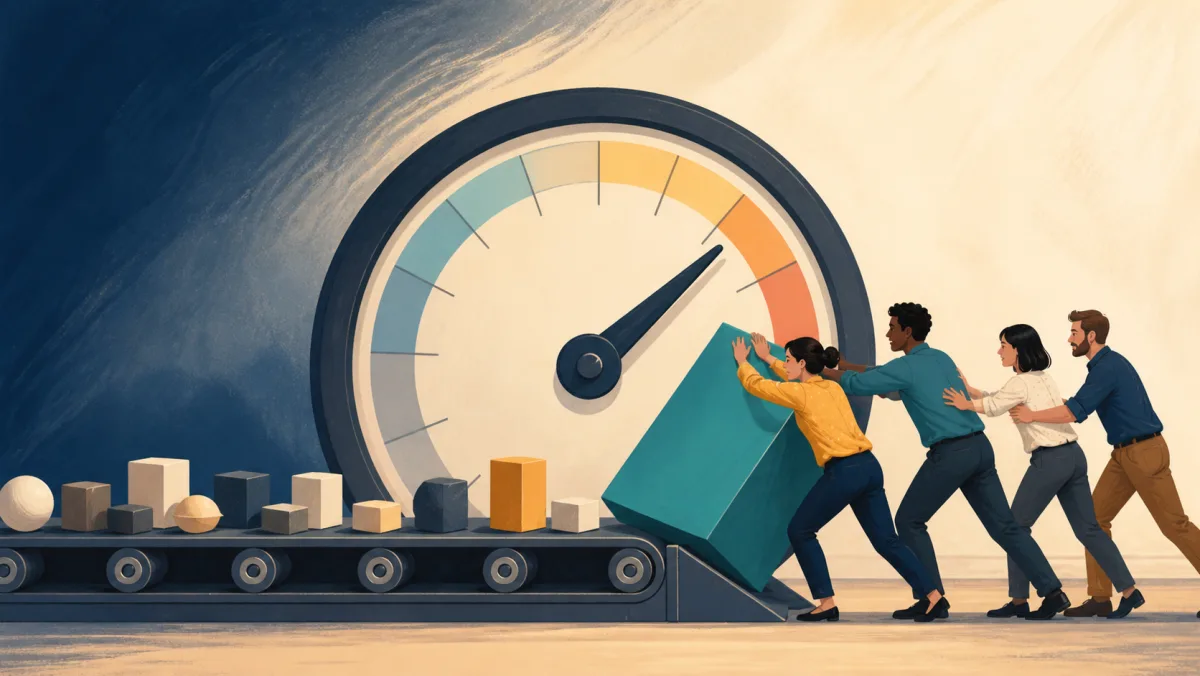
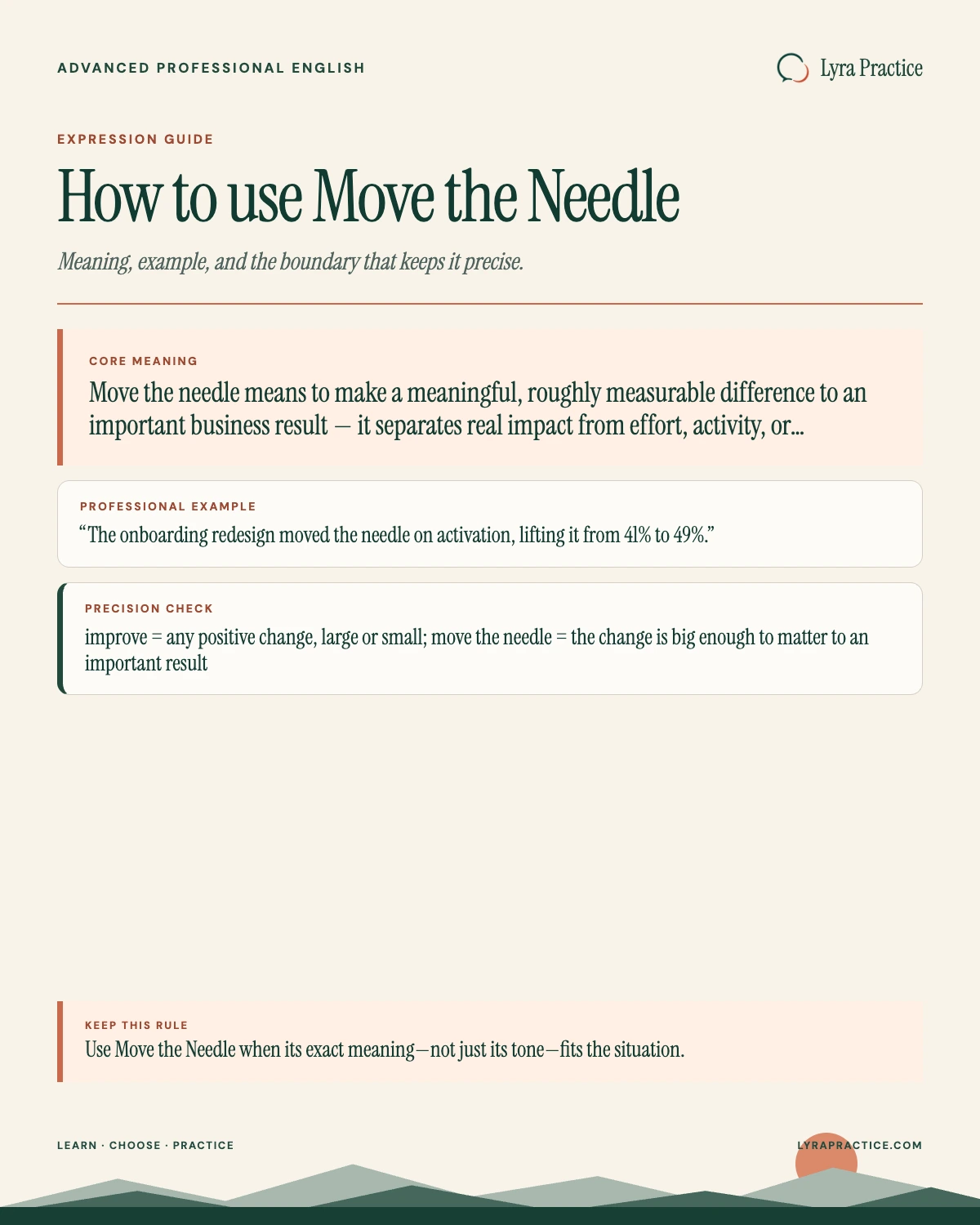
Move the needle means making a meaningful change to an important outcome. It describes impact, not activity alone. A useful sentence names the outcome and matches the claim to the evidence.
Quick check
Activity or measured impact?
You know "Move The Needle" well.
Keep going with the full learning path — more workplace contexts, related expressions, and practice using it yourself with feedback.
Continue with "Move The Needle" →There's more to "Move The Needle" than it seems.
You've got part of it, but the full learning path goes deeper into its nuances, workplace contexts, and when it sounds natural — then gives you practice using it yourself.
Learn "Move The Needle" in depth →Core meaning
The phrase focuses on an outcome, not the work itself. You can make progress without changing the result yet. The change should be large enough to matter in context. It need not transform the whole business. Before results exist, use a calibrated form such as "could move the needle." Use "likely to" only when evidence supports that level of confidence.
Grammar pattern
The standard form is "move the needle." Use "the," not "a." In this idiom, move is the usual verb. Add the measure with on: move the needle on retention. Add the affected group with for: for enterprise customers. If both appear, placing the measure first is usually clear. Adverbs such as meaningfully can modify the phrase. Do not say "very move the needle."
Worked examples across contexts
A status update, reporting an observed result:
"In our randomized test, checkout conversion rose from 2.1% to 2.8%. That result suggests the new design moved the needle."
A roadmap conversation before anything has shipped:
"This could move the needle on activation, based on the prototype; the live test will tell us more."
A status update about an outcome that worsened:
"After the pricing change, the needle moved in the wrong direction: renewals fell for the first time this year."
Try it yourself
Turn Nexo’s result into an impact sentence
Common mistakes to avoid
First, do not use the idiom as a substitute for activity. "We are moving the needle while we brainstorm" confuses work with impact. Second, avoid more confidence than the evidence supports. "Will" is a strong forecast; "could" leaves room for uncertainty. Even an observed change does not by itself prove what caused it. Name the baseline, time period, data source, and other plausible factors. Credit the people and prior work that helped produce the result. For a funding decision, also state assumptions, costs, downside, and who can approve it.
Practice scenarios
Practice using move the needle in situations like:
- reporting a metric that genuinely changed, with the number attached
- arguing for a not-yet-shipped feature using a calibrated, evidence-matched modal
- catching yourself before claiming impact for busy, in-progress work that hasn't changed a result yet
Useful practice phrases:
- "[Change] moved the needle on [metric], from [X] to [Y]."
- "This could/is likely to move the needle on [metric] once it ships."
- "We made progress on [work], but it hasn't moved the needle on [outcome] yet."
Want to actually use "Move The Needle" naturally at work?
Understanding it is one thing. Practice its nuances, see how it works in real workplace situations, and use it yourself with feedback.
Start the "Move The Needle" learning path →The useful check is simple: did the important outcome change, or did only the activity increase?
Then match your wording to the evidence. That keeps the claim useful and fair.