
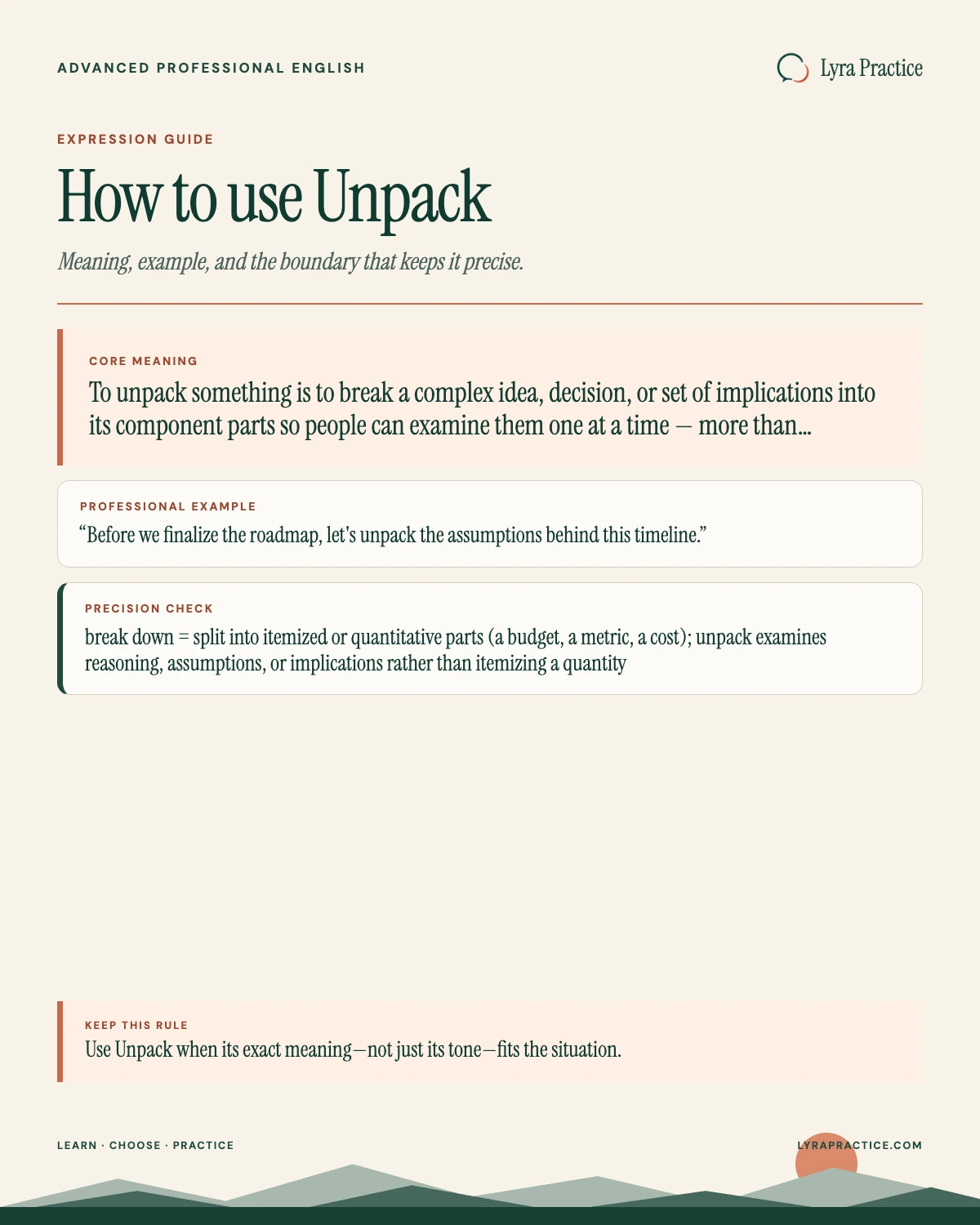
At work, unpack can mean examine the parts of a complex idea. The examples below focus on this figurative sense. The literal sense still applies to boxes, files, and shipments.
Quick check
Choose the more useful sentence
You know "Unpack" well.
Keep going with the full learning path — more workplace contexts, related expressions, and practice using it yourself with feedback.
Continue with "Unpack" →There's more to "Unpack" than it seems.
You've got part of it, but the full learning path goes deeper into its nuances, workplace contexts, and when it sounds natural — then gives you practice using it yourself.
Learn "Unpack" in depth →Live meeting and discussion
Meeting comment: "Before we decide, I want to unpack the reasoning behind this recommendation -- what's actually driving it?"
Facilitation request: "Can you unpack that for the team? I don't think everyone's tracking the assumption you're making."
Written analysis
Report opening line: "This memo unpacks the three factors driving the increase in support tickets over the last quarter."
Executive summary: "The section below unpacks what changed in the renewal process and why."
Try it yourself
Turn complexity into a next step
HR and coaching conversations
1:1 note: "I want to unpack how that feedback landed for you before we move on."
Coaching prompt: "Let's unpack the assumption behind that decision -- what were you weighing at the time?"
The fixed idiom: "a lot to unpack"
Retro comment, honest use with a follow-up: "There's a lot to unpack here -- let's take the top three drivers first and come back to the rest next week."
Status update: "That's a lot to unpack in one thread. I'll pull the key points into a doc and share it by Friday."
What these examples have in common
Each sentence signals a closer look at an idea, result, or reaction. In “Let's unpack that,” the speaker invites discussion. In “This memo unpacks...,” the verb introduces written analysis. Both uses are transitive, so unpack takes an object.
“There's a lot to unpack” points to complexity. It is more useful when followed by a plan. Without a next step, it may delay a hard topic.
In coaching or HR talks, unpack can feel personal or therapy-like. Do not push someone to discuss a reaction they want to keep private. A direct option is: “Which part of the feedback should we review first?”
Practice scenarios
Practice using unpack in situations like:
- opening an analytical discussion before a team makes a decision
- writing a topic sentence for a report section
- responding to feedback in a coaching conversation
- following "there's a lot to unpack" with a concrete next step
Useful practice phrases:
- "I want to unpack the reasoning behind this before we decide."
- "This memo unpacks the three factors driving the increase."
- "There's a lot to unpack here -- let's start with the top three."
Want to actually use "Unpack" naturally at work?
Understanding it is one thing. Practice its nuances, see how it works in real workplace situations, and use it yourself with feedback.
Start the "Unpack" learning path →The figurative verb means to examine a complex point in parts. State what you want to unpack and why.