
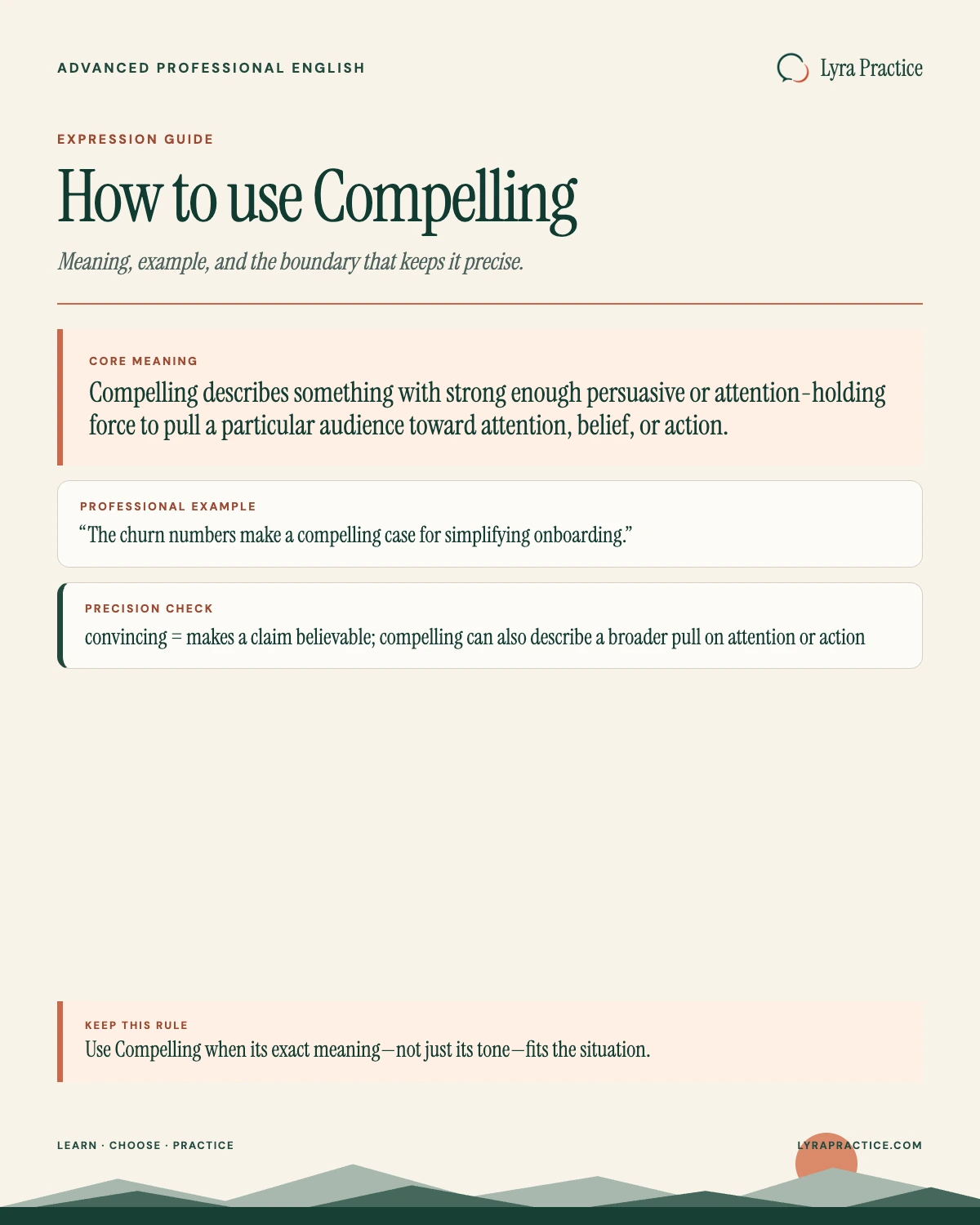
"This is really compelling" is a sentence that says almost nothing.
Compelling describes an effect. It doesn't say what caused that effect. That makes it easy to attach the word to anything you like, without saying why. Instead, name the specific evidence, reason, or stakes that make something compelling. Don't use the word as empty enthusiasm. And be careful about who you say it applies to -- don't claim something was compelling to everyone.
Quick check
How well do you know "Compelling"?
You know "Compelling" well.
Keep going with the full learning path — more workplace contexts, related expressions, and practice using it yourself with feedback.
Continue with "Compelling" →There's more to "Compelling" than it seems.
You've got part of it, but the full learning path goes deeper into its nuances, workplace contexts, and when it sounds natural — then gives you practice using it yourself.
Learn "Compelling" in depth →Two risks, one fix
The first risk is saying too much with too little proof. "A really compelling deck" shows up a lot in client decks and board memos. Being specific sounds stronger than just being enthusiastic. The second risk is claiming the audience actually reacted a certain way. The word points to a real reaction someone had, not just your wish to persuade them. Saying something was "compelling to everyone," or assuming people were moved when you never actually checked, claims more than really happened.
Vague: "The deck was really compelling." Anchored: "The deck was compelling because it tied the cost savings directly to the two accounts we're at risk of losing."
Overclaiming: "Everyone found the pitch compelling." Calibrated: "Some of the panelists said the pitch was the most compelling of the round; others wanted more detail on rollout."
Both problems have the same fix. Say what exactly made it compelling. Say who found it compelling, and be honest that it's just so far, in this one case. Don't make a big, unsupported claim.
Try it yourself
Use "Compelling" yourself
The mistake: saying the word louder instead of naming the evidence
Don't treat the word "compelling" as proof on its own. Saying it louder, or saying it more often, doesn't replace naming what actually created the pull. A specific, honest claim sounds stronger than a big, vague one, especially to a skeptical or senior audience.
Practice scenarios
Practice using compelling in situations like:
- rewriting a vague "this is compelling" into an evidence-anchored statement
- scoping a claim to who actually found something compelling, not "everyone"
- pushing back on empty praise in a client deck or board memo
Useful practice phrases:
- "This is compelling because..."
- "The most compelling evidence so far is..."
- "I found [x] compelling because..."
Want to actually use "Compelling" naturally at work?
Understanding it is one thing. Practice its nuances, see how it works in real workplace situations, and use it yourself with feedback.
Start the "Compelling" learning path →Compelling is not louder praise. It's a specific claim about a specific audience's specific reaction.
Anchor it, or leave it out.