
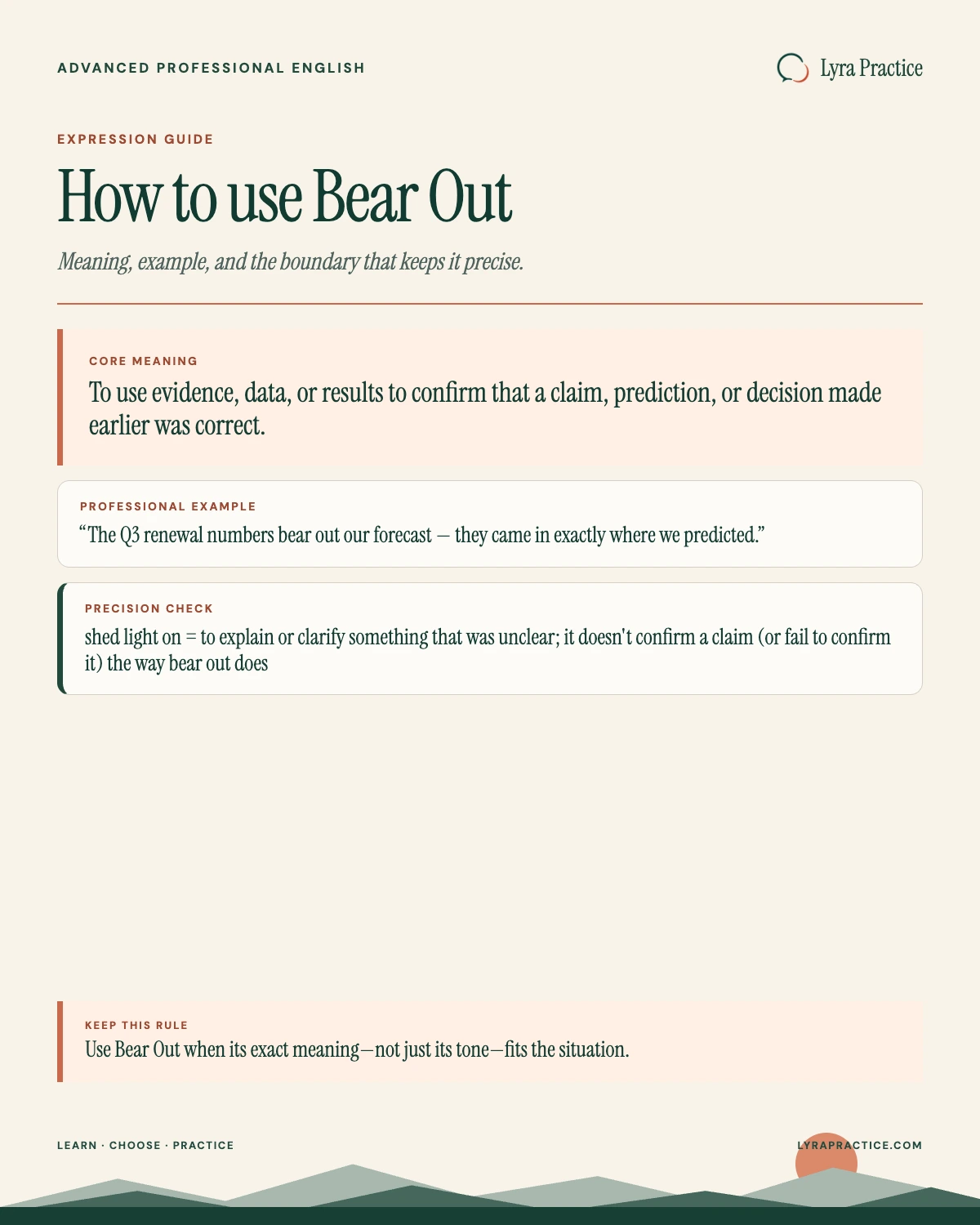
"Bear out" means to support or confirm something with evidence. The evidence may come from data, results, testimony, or later events. The examples below cover positive, negative, and future forms. The future form lets you wait for evidence. You can then reach a firmer view.
Quick check
How well do you know "Bear Out"?
You know "Bear Out" well.
Keep going with the full learning path — more workplace contexts, related expressions, and practice using it yourself with feedback.
Continue with "Bear Out" →There's more to "Bear Out" than it seems.
You've got part of it, but the full learning path goes deeper into its nuances, workplace contexts, and when it sounds natural — then gives you practice using it yourself.
Learn "Bear Out" in depth →Affirmative: evidence confirms a claim
Analytics review: "The Q3 numbers bear out our forecast -- results are close to the range we projected."
Retrospective: "The pilot results bore out the product team's hypothesis about onboarding friction."
Negative: evidence does not support a claim
Status update: "The survey data doesn't bear out that concern -- reported satisfaction held steady this quarter."
Client-facing note: "Early results haven't borne out the assumption that price was the main blocker."
Try it yourself
Use "Bear Out" yourself
Future hedge: deferring judgment
Leadership comment: "Later results may bear out this forecast, but we do not have enough evidence yet."
Board note: "The next two quarters may bear out the forecast of lasting demand in this segment."
Retrospective validation of a decision
Performance review: "The launch results bore out the reasoning behind her recommendation to run another test."
The grammar that matters most: borne, not born
In this expression, the past participle of "bear" is "borne," not "born." Use it with has, have, or had, and in the passive form.
Correct: "The assumption is borne out by the latest data." Incorrect: "The assumption is born out by the latest data."
What these examples have in common
Each sentence links evidence to something that can be tested. That object may be a claim, forecast, concern, account, or line of reasoning. It is not usually a person. The negative form ("the data doesn't bear that out") challenges the claim instead of judging the person who made it. It also limits the point to the evidence at hand. New evidence could change the result.
Practice scenarios
Practice using bear out in situations like:
- reporting whether pilot or test results support an original hypothesis
- questioning an assumption with the available evidence
- hedging on an uncertain outcome with "time will bear this out"
Useful practice phrases:
- "The results bear out our forecast."
- "The data doesn't bear that out."
- "Time will bear this out."
Want to actually use "Bear Out" naturally at work?
Understanding it is one thing. Practice its nuances, see how it works in real workplace situations, and use it yourself with feedback.
Start the "Bear Out" learning path →In each form, evidence supports a claim now or later.