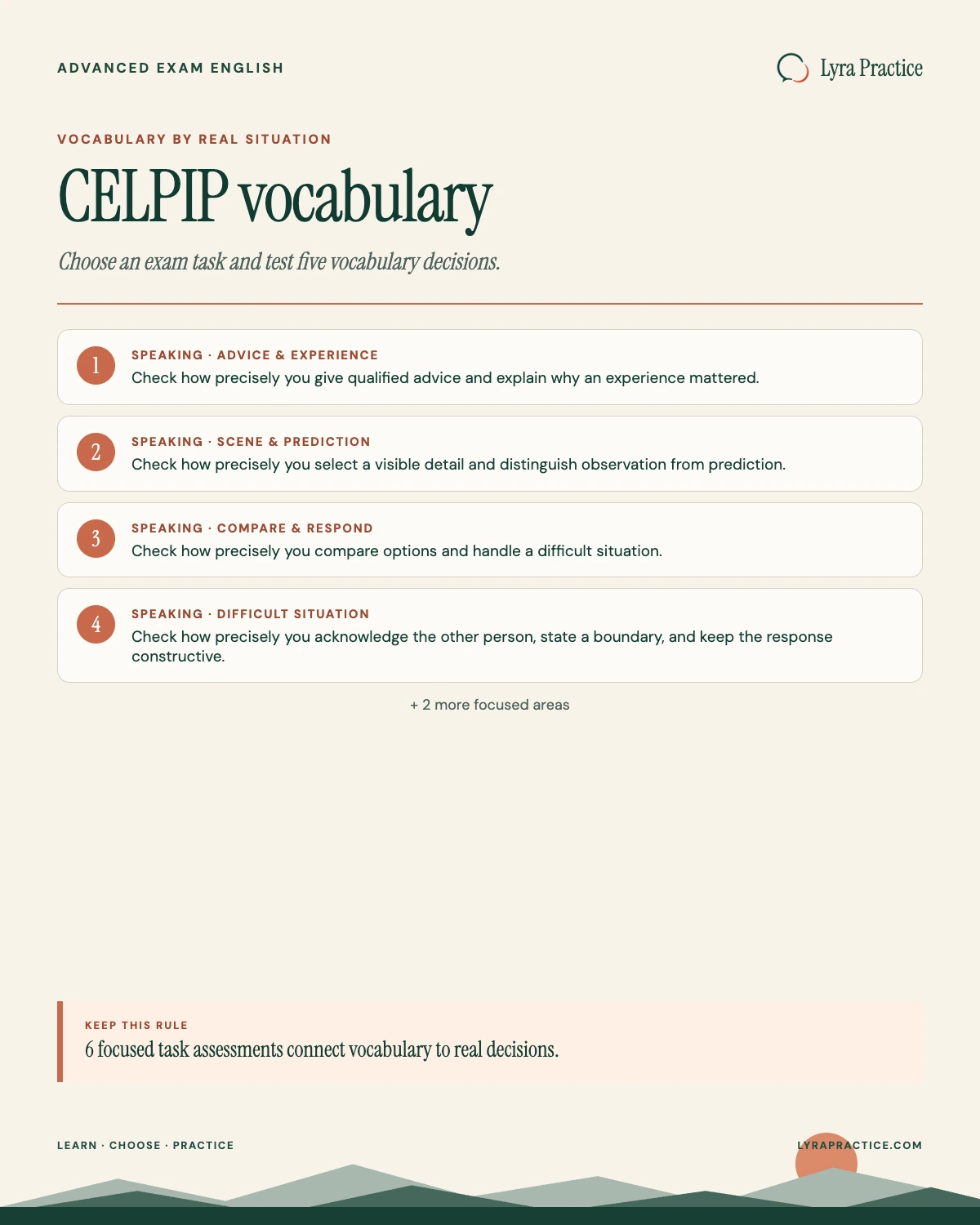
Choose vocabularyfor the CELPIP task in front of you.
CELPIP General moves between everyday, community, educational, and workplace communication. Giving advice, describing a scene, persuading someone, writing an email, and interpreting a viewpoint need different lexical decisions. Lyra Practice helps you make those decisions precisely.
For CELPIP candidates who already communicate comfortably in English and want more control over meaning, register, collocation, and retrieval under time pressure.
Vocabulary for CELPIP organized around the situations where precision matters.
Try a real Lyra Practice exercise
Nuanced
Free · No account needed
nuanced-unified-1
A report calls the customer response “nuanced.” What does that most likely mean?
From understood to precise
Use vocabulary that does the task, not vocabulary that decorates it.
A precise response shows control by matching the word to the communicative job. Advice should be feasible, a prediction should follow from evidence, and a difficult message should preserve both the boundary and the relationship.
CELPIP General · Response ReviewQuestion 1 of 2 00:18:30
Speaking Task 1 · Giving AdviceResponse 1
First draft
You should definitely move immediately because it will solve everything.
Your response
“I would first explore a shorter commute; one caveat is that moving may reduce travel time without addressing the cost of housing.”
Adds a relevant limitation instead of presenting one recommendation as a guaranteed solution.
Speaking Task 5 · Comparing and PersuadingResponse 2
First draft
The first option is better and has more good things.
Your response
“The lower rent outweighs the longer commute, especially because it leaves room in your budget for the course you want to take.”
Names the comparison and ties it to a reason that matters to the listener.
Writing Task 2 · Survey ResponseResponse 3
First draft
This is a complicated issue and both sides are right.
Your response
“A more nuanced policy would extend evening service on busy routes while preserving the quieter neighbourhood schedule.”
Distinguishes cases and proposes a specific position instead of retreating to a vague middle.
Word count: 0HelpNext →
Choose what you want to communicate
Start with the conversation in front of you. We'll surface only the expressions that fit.
Your situation
Speaking Task 1 · Giving Advice
Recommend a feasible action, account for constraints, and explain the next step with language that makes your intent and next step clear.
Choose an expression to use in this task
Open a free exam-shaped response prompt and get focused feedback on how you use it.
Learn each expression deeply enough to use it naturally.
Hear each word in real use, understand its meaning and register, distinguish it from nearby choices, then retrieve it in a CELPIP-shaped communication task with feedback.
Example journey · nuanced
Browse the full expression catalogShared advanced vocabulary grouped by the current CELPIP General task in which each lexical decision is most useful.
173 expressions
Navigate
Speaking Task 1 · Giving Advice
To skillfully move through, or find a workable path through, a complex, difficult, or uncertain situation, system, relationship, or period of change — without…
Mitigate means to reduce the likelihood, severity, or consequences of something harmful — or your exposure to it — without necessarily removing it completely.
A caveat is a specific limitation that either qualifies an otherwise confident statement or independently flags how far a claim, plan, dataset, or analysis can…
Speaking Task 2 · Talking about a Personal Experience
Pivotal describes a person, decision, event, factor, or period as crucial or centrally important to how an outcome develops - the result substantially depends…
Speaking Task 2 · Talking about a Personal Experience
In its main figurative use, resonate means to have particular meaning or relevance for someone, or to evoke a response or connection; by itself it does not…
Speaking Task 2 · Talking about a Personal Experience
To "strike a chord (with someone)" is for a message, story, or comment to produce a genuine, felt personal reaction in an audience — recognition, familiarity,…
Speaking Tasks 3 & 4 · Describing a Scene and Making Predictions
Depict means to show or represent someone or something in a work such as a picture, film, map, statue, or piece of writing; the object is what is shown, and as…
Speaking Tasks 3 & 4 · Describing a Scene and Making Predictions
Trajectory names the direction and shape of a pattern over time — read from multiple points, not a single fact or event — and, by extension, where things are…
Speaking Tasks 3 & 4 · Describing a Scene and Making Predictions
A surge is a rapid, powerful rise in a business number — demand, traffic, costs, tickets, complaints — sharp enough to call for a real response, not just a…
Speaking Tasks 3 & 4 · Describing a Scene and Making Predictions
Imperceptible describes a real change or difference too small to notice — either because it built up gradually over time, or because it falls below what a…
A trade-off is a situation or decision in which getting more of one thing means accepting less of another. Name both the gain and the cost when you state one.
Compelling describes something with strong enough persuasive or attention-holding force to pull a particular audience toward attention, belief, or action.
Speaking Task 6 · Dealing with a Difficult Situation
Candid means choosing to share a real opinion, assessment, or piece of information openly, rather than hedging it, softening it into euphemism, or leaving it…
Speaking Task 6 · Dealing with a Difficult Situation
To push back is to challenge, resist, or renegotiate something so a concern is addressed before it moves forward; in scheduling, push something back means move…
Speaking Task 6 · Dealing with a Difficult Situation
Middle ground is a compromise position between two opposing sides — you can actively search for it, firmly state that none exists when a situation truly is…
Speaking Task 6 · Dealing with a Difficult Situation
A non-negotiable is a requirement, condition, or boundary that is fixed — stronger than merely important — because discussion will not remove or change the…
Speaking Task 6 · Dealing with a Difficult Situation
To actively and skillfully work to win over a distrustful or hostile person, or to bring two opposing sides into genuine agreement — through real diplomatic…
Speaking Task 6 · Dealing with a Difficult Situation
In finance and business, appreciate describes an asset, currency, or investment — such as a property, a stock portfolio, or a currency — steadily increasing in…
Nuanced describes an analysis, view, explanation, or response that recognizes meaningful distinctions instead of reducing a complex issue to a simple binary.
Advocate means actively support a person, proposal, policy, or course of action. It is stronger than simple agreement but does not imply final authority.
To hedge is to reduce exposure, keep another option open, or qualify a claim when the outcome is uncertain; it does not mean fully avoid, solve, or prevent the…
Reiterate means say a statement, point, position, or request again, usually to make it clear or to stress it; the word itself tells the listener that it was…
Something is ambiguous when its wording, data, or situation genuinely supports two or more reasonable readings — a property of the thing itself, not a claim…
Equivocal describes a statement, answer, or stance built to support two or more contradictory readings on purpose, so the speaker avoids fully committing to a…
To touch base means to make brief, informal-to-neutral contact with someone -- now or at a proposed future time -- to exchange a quick update or coordinate,…
Dispassionate describes a person's judgment, analysis, or conduct that stays free of their own emotional stake or bias — not someone who lacks feelings or…
A paradigm is the shared, often-unspoken set of assumptions a field, industry, company, or team treats as normal — and a paradigm shift is the moment those…
Use paraphrase as a verb for restating spoken or written material in different words while preserving its essential meaning, or as a noun for the resulting…
Use discrepancy for a noteworthy difference, disagreement, or inconsistency between figures, records, claims, accounts, or conditions being compared; it often…
Speaking Task 6 · Dealing with a Difficult Situation
To remove unspoken tension or awkwardness between people by talking about it honestly and directly, without necessarily settling the underlying disagreement.
Speaking Task 2 · Talking about a Personal Experience
To have an argument or disagreement with someone that damages the relationship — you stop being on friendly terms, at least for a while, specifically because…
To find out is to learn, discover, or verify information you did not already know—by being told, reading, observing, searching, studying, or investigating.
To communicate directly and concisely, stating the main idea without unnecessary preamble or detail — most often a request directed at someone else's rambling,…
Speaking Task 6 · Dealing with a Difficult Situation
To give someone the benefit of the doubt is to choose the more favorable, charitable interpretation of their ambiguous words, actions, or explanation — when…
Speaking Task 2 · Talking about a Personal Experience
For two people who were once close to gradually become less close over time — typically because of changing circumstances, interests, or life paths — with no…
Covers two related moves: (a) contributing an idea or opinion, in speech or writing, to a discussion — validity or discussion-changing force is not required,…
Speaking Task 6 · Dealing with a Difficult Situation
To be on the same page (with someone) is to share the same understanding, ideas, or agreement about something — whether that's a set of facts, a plan, an…
Speaking Task 6 · Dealing with a Difficult Situation
A fixed formula acknowledging that a specific argument or consideration just raised has real weight, without necessarily conceding the whole discussion or…
Speaking Task 6 · Dealing with a Difficult Situation
To force someone, right then and with no real way to avoid it, to answer, decide, explain themselves, or do something they weren't prepared for — creating…
To put things in perspective is to compare something to other things — or to the bigger picture — so its true relative size, importance, or severity can be…
Speaking Task 6 · Dealing with a Difficult Situation
To see (or know) where someone is coming from is to understand the reasons, background, or feelings behind their opinion or behavior — especially when you…
To correct a false belief, rumor, or piece of misinformation by stating the true facts, most often about yourself or your own actions, to people who currently…
To take something with a grain of salt is to treat a claim or story with skepticism — not fully believing it — rather than accepting it as straightforwardly…
Respond that something attracts attention or deserves thought; depending on delivery, it can also be a polite holding response or skeptical understatement.
Speaking Task 2 · Talking about a Personal Experience
To warm up to someone or something is to begin to like, enjoy, or feel more positive toward them; a noticeable period of dislike or hesitation is not required.
Speaking Task 2 · Talking about a Personal Experience
To keep a strong feeling suppressed and hidden instead of expressing or dealing with it; deliberate or sustained restraint is common but not an absolute…
Speaking Task 2 · Talking about a Personal Experience
To genuinely accept a difficult, painful, or unwelcome situation, fact, or change, often gradually, instead of continuing to resist, deny, or avoid it.
Speaking Task 2 · Talking about a Personal Experience
For two people who were once close to gradually become less close over time — typically through the slow accumulation of changing circumstances, interests, or…
Recover from an illness or a distressing experience, or return toward your usual health or emotional state after it. Recovery can be partial or complete.
To correctly understand a specific point someone is communicating to you -- most often something they didn't say outright, but conveyed through a hint, a…
To reverse a previous decision, opinion, or feeling about something — arriving at a different position than the one you held or stated before, in either…
To begin to doubt or feel uncertain about a decision, plan, or commitment you have already made, without that doubt necessarily leading you to reverse it.
To not allow yourself to be forced to retreat or change your position, physically or figuratively, despite pressure, opposition, or criticism pushing you to…
To remain willing to consider new information, ideas, or perspectives on a specific matter, deliberately avoiding a fixed judgment before you have had the…
A slippery slope is a situation, habit, course, or initial move presented as likely to lead to increasingly serious, difficult, or unacceptable outcomes.
An informal expression that most often works as understated praise for something good or impressive, though depending on the benchmark and surrounding language…
Combine parts, ideas, or people into a finished whole — assembling a physical object, creating a document or plan from separate material, or forming a group.
Take on has three common senses: (1) accept responsibility for a task, role, challenge, client, or person — including hiring staff; (2) compete against or face…
Speaking Task 6 · Dealing with a Difficult Situation
Turn down has two distinct senses: (1) refuse or decline an offer, request, invitation, or proposal; (2) reduce a control setting such as volume, heat, or…
Speaking Task 2 · Talking about a Personal Experience
Turn out has two distinct senses: (1) happen or end up in a particular way, especially unexpectedly ("it turned out to be...", "it turned out that..."); (2)…
"We'll see" postpones a decision or commitment until more is known; by itself it does not mean yes, no, a promise to act, or certainty about what happens next,…
"Whatever works" accepts any option, method, or arrangement that is effective or suitable for the situation; depending on context and delivery it can sound…
Speaking Task 6 · Dealing with a Difficult Situation
A conventional preface that introduces a disagreement or correction, especially in a formal or status-sensitive situation — talking to someone senior, more…
"And all that jazz" is a casual, informal phrase meaning "and other things of the same general kind" -- it refers back to one or more mentioned or clearly…
"Another day in paradise" is a fixed phrase, usually added to the end of a short account of your day, whose meaning flips depending on what you've just…
"Asking for a friend" is a casual, informal tag attached to a question -- a way to add a little social distance to something personal, awkward, or pointed by…
Speaking Task 6 · Dealing with a Difficult Situation
To make an unusual, above-normal effort — often at some inconvenience to yourself — specifically to help, please, or accommodate a particular person or…
An obvious problem, fact, or topic that everyone present is aware of but is avoiding, usually because raising it directly would feel awkward, tense, or…
"Get carried away" means to become so excited or emotionally involved in something that you lose your ordinary restraint over what you say, do, or feel.
To make a desperate attempt to fix a bad situation, using an option that is itself unlikely to work — because your better options have already failed or run…
"Hand over" means to give something you're holding or responsible for -- an object, control, responsibility, or authority -- directly to a specific other…
Speaking Task 6 · Dealing with a Difficult Situation
To say or bring up something that provokes a strong, often visible emotional reaction in someone, usually because it touches a subject that's sensitive,…
"Settle down" has three distinct senses: (1) to become calm, quiet, or comfortable after a period of excitement or anxiety; (2) to begin living a stable, quiet…
Speaking Task 2 · Talking about a Personal Experience
To go somewhere with a person or group, typically to a place or activity you didn't organize and often without a specific invitation or a defined role.
"Take up" has three high-value senses: (1) to begin an activity, interest, role, or cause ("take up a new role," "take up painting"); (2) to fill or use up…
Speaking Task 6 · Dealing with a Difficult Situation
To blame or sacrifice someone else — often someone who trusted you or was on your side — to protect yourself or gain an advantage when blame or consequences…
Speaking Task 2 · Talking about a Personal Experience
"Turn up" has three distinct senses: (1) to arrive, especially unexpectedly or without much warning; (2) with an object, to increase the volume, heat,…
Speaking Task 2 · Talking about a Personal Experience
"We should get coffee" doesn't carry one fixed meaning on its own -- it can be a genuine invitation the speaker plans to follow up on, or a warm, non-committal…
No. Lyra Practice focuses on vocabulary precision and retrieval. Use official CELPIP materials for the complete test format, timing, scoring, and preparation guidance.
Does advanced vocabulary guarantee a CELPIP level?
No. A word only helps communication when its meaning, register, grammar, and collocation fit. Lyra Practice does not predict or guarantee a score.
Does this cover CELPIP General or CELPIP General LS?
The hub maps all four CELPIP General components: Listening, Reading, Writing, and Speaking. The Listening and Speaking practice is also relevant to the two-component CELPIP General LS test.
Is this an official CELPIP product?
No. Lyra Practice is independent and is not affiliated with or endorsed by CELPIP or Prometric. Current task names should always be confirmed in official CELPIP materials.
Do I need to sign up to try this?
No. The practice question and catalog are open without an account. Signing up unlocks the scheduled practice path for each expression.
Practice vocabulary for the task in front of you.
Start with any expression above, or begin a guided path organized around CELPIP communication tasks.
Lyra Practice is not affiliated with or endorsed by CELPIP or Prometric.
Your privacy choices
Optional cookies from Google help us understand what’s useful, improve Lyra Practice, measure campaigns, and show more relevant ads. You can change your choice anytime.