
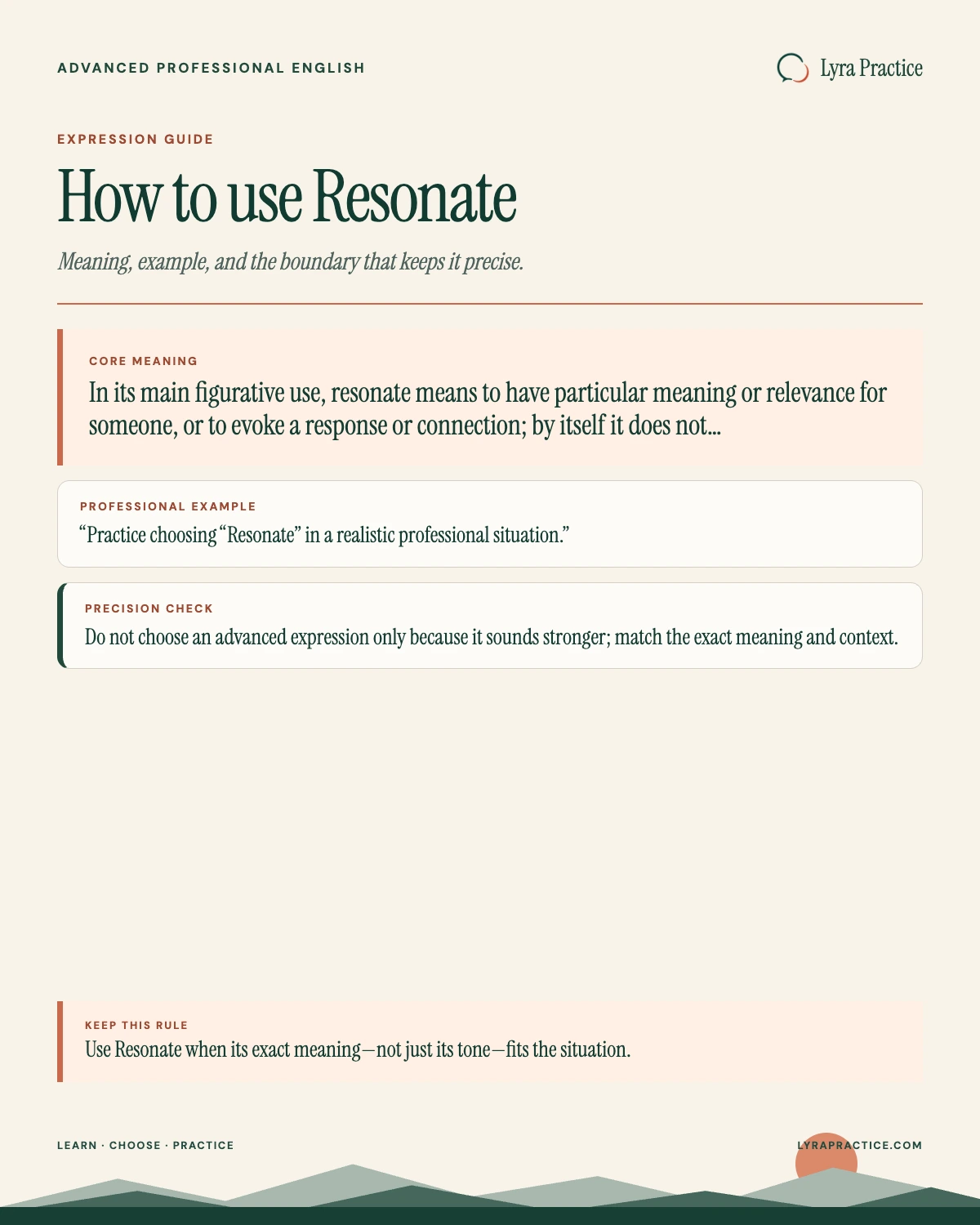
Resonate means that a message or idea has a strong effect or feels relevant. It may connect with what people value, need, or have lived through. It can also match an earlier finding or experience. It does not simply mean that people heard or approved it.
Quick check
Which pitch detail actually resonated?
You know "Resonate" well.
Keep going with the full learning path — more workplace contexts, related expressions, and practice using it yourself with feedback.
Continue with "Resonate" →There's more to "Resonate" than it seems.
You've got part of it, but the full learning path goes deeper into its nuances, workplace contexts, and when it sounds natural — then gives you practice using it yourself.
Learn "Resonate" in depth →The grammar pattern: intransitive, always "with"
Resonate does not take a direct object in this use. Something resonates with a person, group, idea, or experience. You do not resonate someone or something. With a place or organization, you may use another preposition.
"The pitch resonated with the product team because it named a problem they'd been raising for months."
For an organization, you can use "throughout" or across. You can also leave out the audience and use still to show that the effect continues:
"The CEO's message about customer trust resonated throughout the organization."
"The warning still resonates, three quarters after the incident."
Try it yourself
Report the warehouse managers' reaction
Three worked examples
In casual speech, such as coaching or feedback:
"That resonates with me, because I've felt the same pressure to over-promise on timelines."
In research or strategy writing:
"These findings resonate with what we saw in the pilot: users disengage at the same step every time."
When you need to explain the exact reason:
"The framing resonated with several engineers in particular, because it named the on-call burden directly rather than gesturing at 'burnout.'"
Common mistakes
Using it transitively. "The data resonated the team's concerns" is not standard grammar. Use "confirmed" or "reflected" for that meaning. You can also say the data resonated with the team's experience.
Using it as empty praise. "This really resonates with me" gives little detail by itself. Add the reason when it matters. If you speak for a group, state what your evidence shows. Do not claim it applies to "everyone" unless you know that.
Practice scenarios
Practice using resonate in situations like:
- reporting which part of a pitch or design connected with users, and why
- responding personally to a colleague's point without over-committing to full agreement
- rewriting an unsupported "this really resonates" comment into specific, actionable feedback
Useful practice phrases:
- "This resonated with [audience], specifically because [reason]."
- "That resonates with me, though I'm not sure I agree with [conclusion]."
- "The message resonated throughout [team/organization] after [event]."
Want to actually use "Resonate" naturally at work?
Understanding it is one thing. Practice its nuances, see how it works in real workplace situations, and use it yourself with feedback.
Start the "Resonate" learning path →Resonate is useful when you name what connected and why.
Without a reason, it can sound like vague praise.