
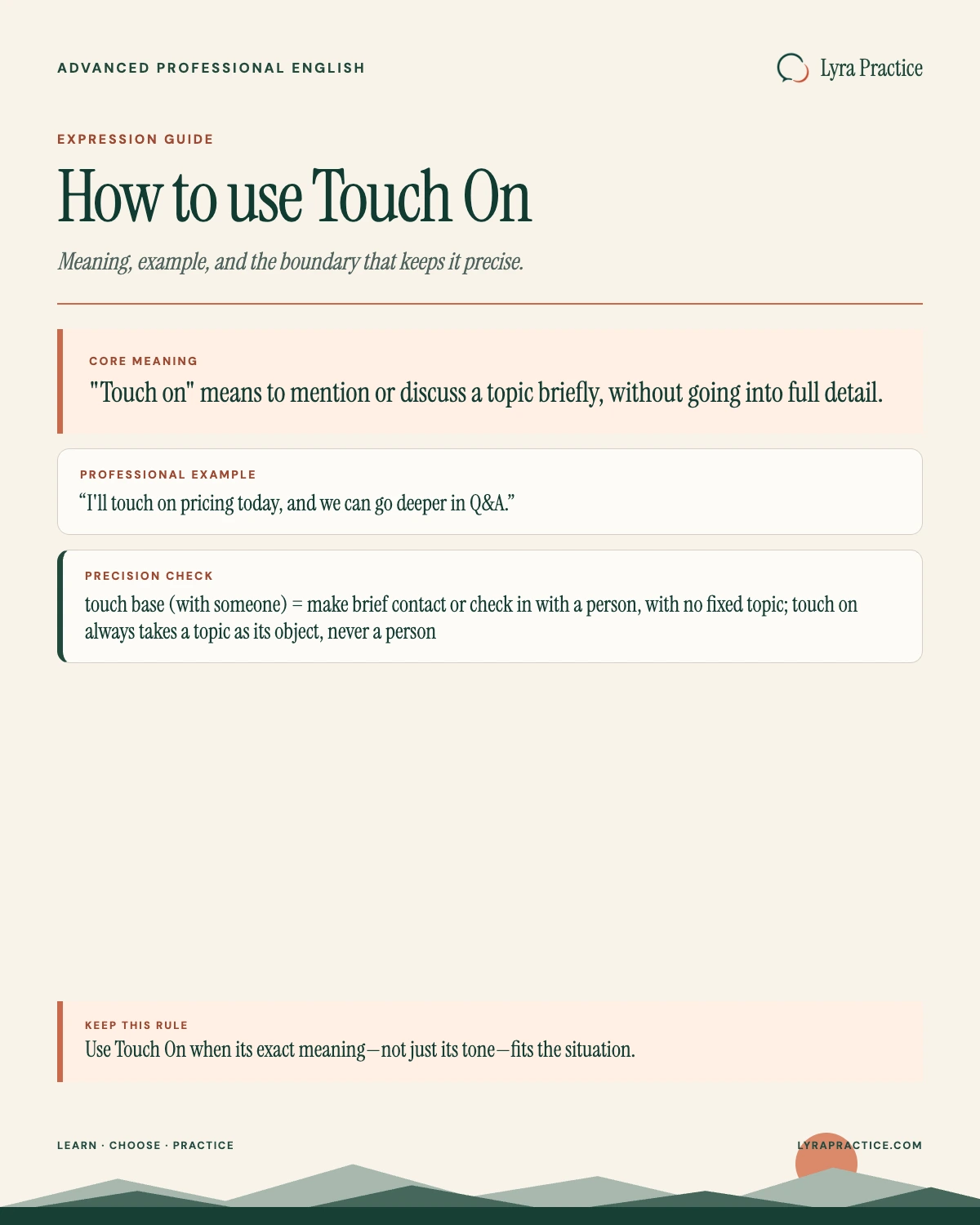
"I'll touch on that" sets an expectation that the next point will be brief. The phrase can manage scope in a meeting, memo, or presentation. Your next words should match that stated scope.
Quick check
Keep the scope promise
You know "Touch On" well.
Keep going with the full learning path — more workplace contexts, related expressions, and practice using it yourself with feedback.
Continue with "Touch On" →There's more to "Touch On" than it seems.
You've got part of it, but the full learning path goes deeper into its nuances, workplace contexts, and when it sounds natural — then gives you practice using it yourself.
Learn "Touch On" in depth →Setting the expectation up front
The clearest use of "touch on" comes near the start, when it can distinguish a short review from a full discussion.
"I'll touch on pricing first, then we can go deeper in Q&A." "This memo touches on three risk areas; a follow-up will size each one."
An early scope note helps the audience follow the agenda and gives you a clear point at which to move on. Yet the phrase does not prove that brief coverage is sufficient. A material risk or request may still need dedicated time.
Keeping the promise
Once you say "I'll touch on X," keep that section brief. One or two sentences may be enough before you move on or direct people to more detail.
"I'll touch on the timeline: we're on track for the March release. More detail on the milestones is in the appendix."
If you start to explain or answer several questions, you have moved from "touch on" to "discuss." That may be appropriate, but name the change so people can adjust the schedule and agenda.
Try it yourself
Reset the agenda honestly
When a topic turns out to need more time
Sometimes a brief point becomes a substantial discussion. Say so when it happens, and let the group choose between more time now and a separate meeting. That scheduling choice needs the group's consent, not only the speaker's preference.
"I planned to just touch on this, but it looks like we need more time -- can we set up a separate session?"
This approach is clearer than letting a short agenda item take fifteen minutes without warning.
Using it for a sensitive topic
For a sensitive point, pair "touch on" with a request for time. This signals that you do not plan an immediate resolution and lets others agree to the timing. A brief mention should not imply consent, assign blame, or determine an outcome.
"I want to touch on the missed deadline before we wrap up -- can we take fifteen minutes on it separately?"
Practice scenarios
Practice using touch on to manage scope in situations like:
- opening a meeting or deck with a preview of how much time each topic gets
- noticing mid-conversation that a "brief mention" needs to become a real discussion
- pairing a sensitive-topic mention with a request for dedicated time
Useful practice phrases:
- "I'll touch on [topic] first, then we can go deeper in Q&A."
- "I planned to just touch on this, but we need more time -- can we set up a separate session?"
- "I want to touch on [topic] -- can we take fifteen minutes on it separately?"
Want to actually use "Touch On" naturally at work?
Understanding it is one thing. Practice its nuances, see how it works in real workplace situations, and use it yourself with feedback.
Start the "Touch On" learning path →The phrase sets an expectation, while your timing, level of detail, and response to the audience keep the promise.