
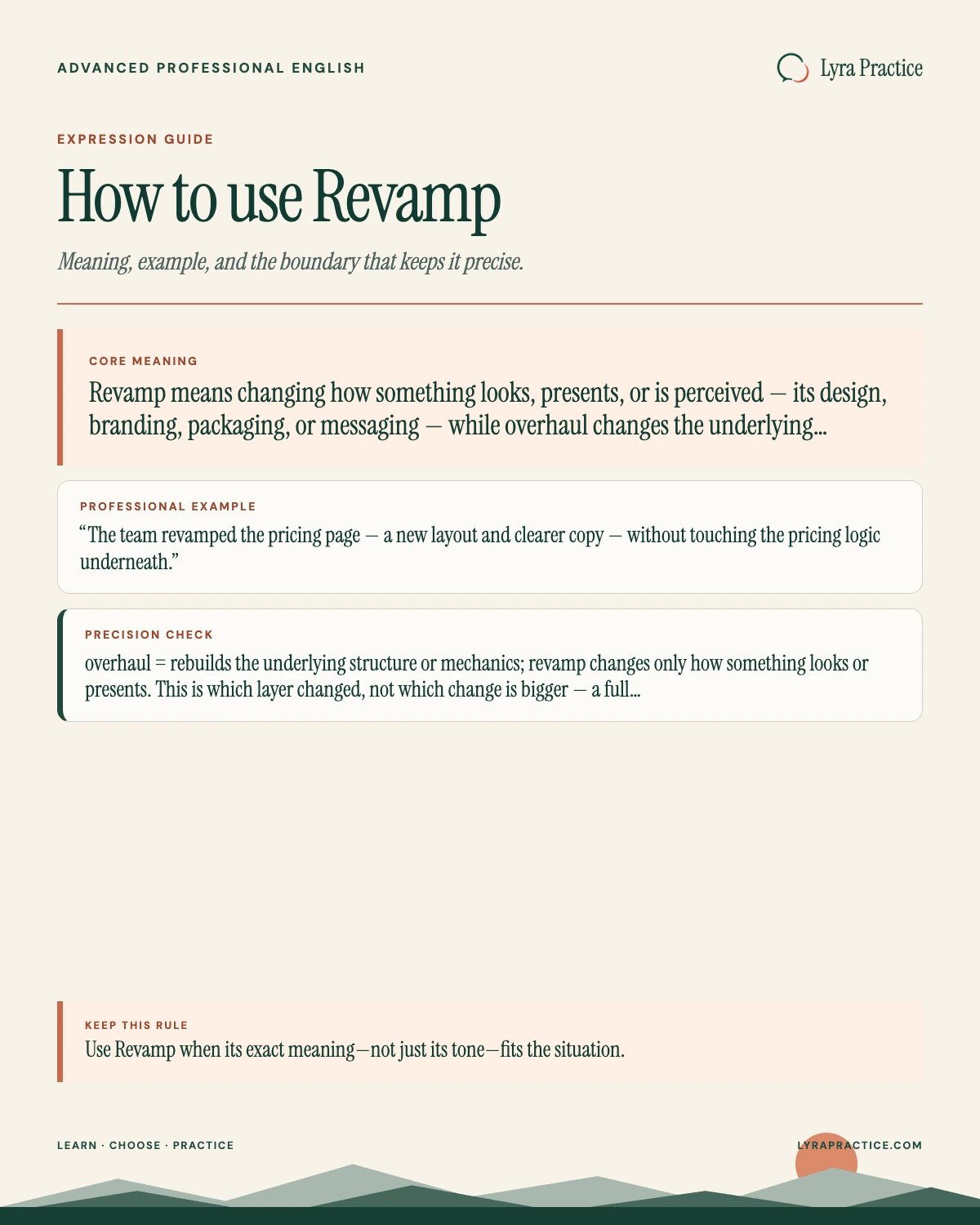
Revamp causes four different kinds of mistakes, so check each one on its own. One broad "did I use revamp right?" question may miss an error.
Correct grammar cannot fix a wrong-layer mistake, and choosing the right layer cannot add a missing article. Each mistake needs its own fix.
Quick check
Object, article, or technical precision?
You know "Revamp" well.
Keep going with the full learning path — more workplace contexts, related expressions, and practice using it yourself with feedback.
Continue with "Revamp" →There's more to "Revamp" than it seems.
You've got part of it, but the full learning path goes deeper into its nuances, workplace contexts, and when it sounds natural — then gives you practice using it yourself.
Learn "Revamp" in depth →Mistake 1: using it for backend changes
"Revamp" can describe a major revision to a system, including work behind the scenes. However, it does not identify the technical change precisely. For a database schema or algorithm, "overhauled" or "restructured" is often clearer.
Broad: "Engineering revamped the database schema to fix the replication lag." More precise: Engineering restructured the database schema to fix the replication lag.
A schema is not visible to most users, but that does not make "revamp" incorrect. The issue is precision: a technical verb can explain what kind of change occurred.
Mistake 2: dropping the object
As a verb, "revamp" takes an object because something does not "revamp" by itself. A machine, by contrast, can "start" or "fail" by itself. Keep the object, or use the passive form when the actor does not matter.
Wrong: "The homepage revamped last quarter." Right: "The homepage was revamped last quarter," or "We revamped the homepage last quarter."
Try it yourself
Fix the menu update
Mistake 3: dropping the article on the noun
The singular count noun needs an article: "a revamp," "the revamp." Therefore, do not use the singular noun "revamp" without a determiner.
Wrong: "The restaurant menu needs revamp, not just new seasonal specials." Right: "The restaurant menu needs a revamp, not just new seasonal specials."
Mistake 4: copying loose usage without knowing why
Native speakers sometimes use "revamp" loosely for a strategy or process. In such cases, the exact change may be unclear: perhaps only the documents changed, or perhaps the real process changed too. Do not copy this loose usage just because a change seems vague. It will make your own writing unclear. When you know which layer changed, name it directly. Use the loose form only when the details are not yet known.
Why check all four separately
A writer can get the grammar right but choose the wrong layer. Another writer can choose the right layer but drop the article. Check all four points separately because one fix cannot cover every error. This helps "revamp" sound natural as well as correct.
Practice scenarios
Practice using revamp in these situations.
- replacing a broad "revamp" with a more precise verb for a backend change
- adding the missing object or switching to the passive
- adding the required article to the noun form
- resisting the pull to copy loose, unclear native usage into precise writing
Useful practice phrases to try.
- "'Revamped' is possible, but 'restructured' describes the technical change more precisely."
- "[X] was revamped last quarter" (not "[X] revamped").
- "[X] needs a revamp" (not "needs revamp").
Want to actually use "Revamp" naturally at work?
Understanding it is one thing. Practice its nuances, see how it works in real workplace situations, and use it yourself with feedback.
Start the "Revamp" learning path →There are four distinct mistakes, and each one needs a separate fix.
Check each one on its own, and using "revamp" will become much easier with practice.