
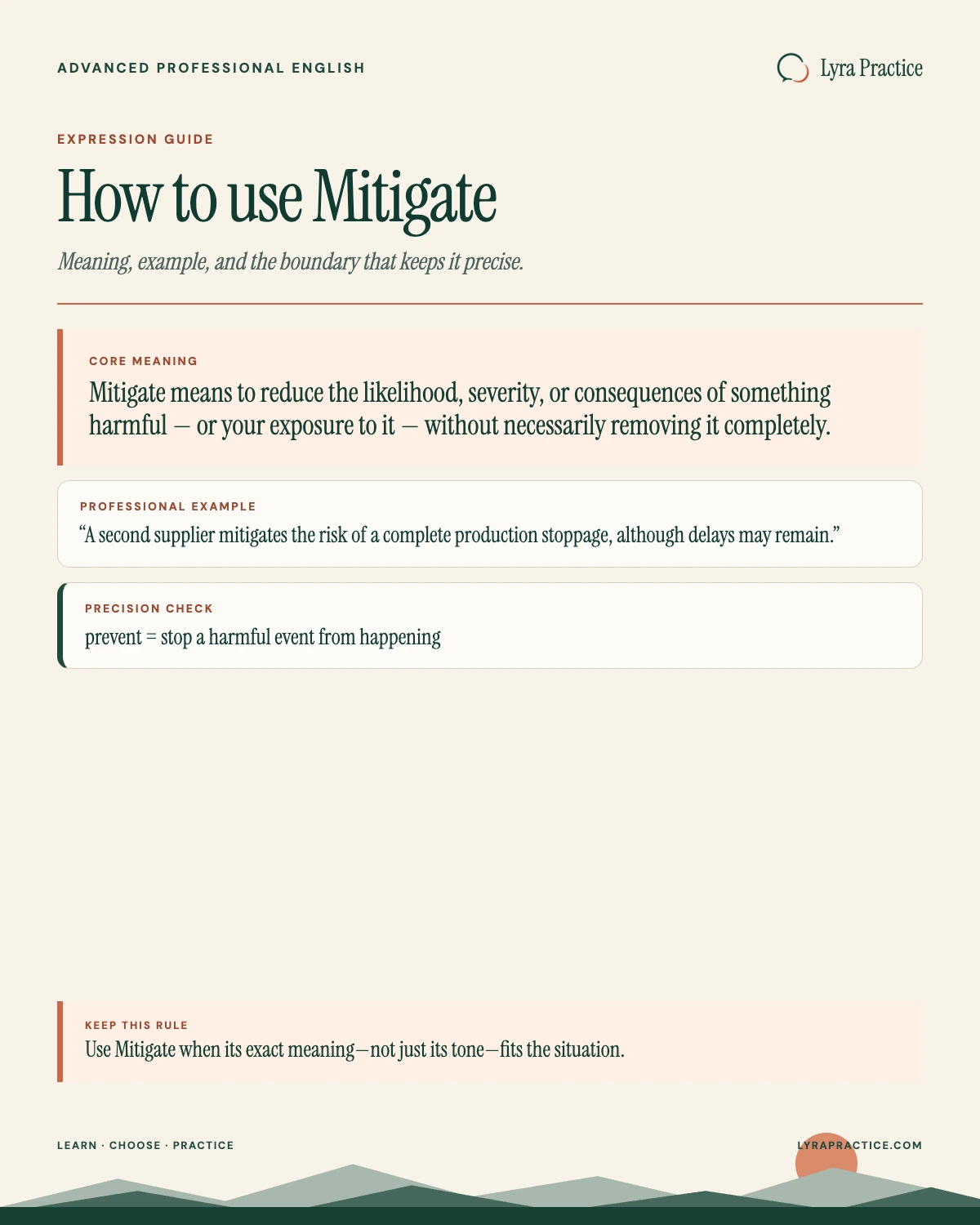
You may see "mitigate" outside business writing. It can appear in health, legal, and formal texts. Some uses are common in those settings but sound stiff in daily speech.
Quick check
How well do you know "Mitigate"?
You know "Mitigate" well.
Keep going with the full learning path — more workplace contexts, related expressions, and practice using it yourself with feedback.
Continue with "Mitigate" →There's more to "Mitigate" than it seems.
You've got part of it, but the full learning path goes deeper into its nuances, workplace contexts, and when it sounds natural — then gives you practice using it yourself.
Learn "Mitigate" in depth →Two uses to recognize, not produce
One use is common in health writing: mitigate pain, mitigate side effects, or mitigate the effects of jet lag. The verb means reduce the harm or severity. It does not mean remove the problem. A second, more formal use applies to anger or punishment. Here, it means make something less severe.
Medical/everyday (recognition only): "The nurse practitioner suggested a few strategies to mitigate the effects of jet lag."
Legal/formal (recognition only): "The judge mitigated the sentence in light of the defendant's age."
The first example reports that a clinician suggested options. It is a language example, not medical advice or a claim that the options will work. The second example uses a current legal sense. In less formal speech, people are more likely to say ease pain, ease the effects of jet lag, calm someone, or reduce a sentence.
Try it yourself
Use "Mitigate" yourself
Mitigate is a formal word, even outside business
Mitigate is formal in most settings. It fits technical reports, policies, and careful written accounts. In casual talk about a small personal problem, a plain verb often sounds more natural.
Casual conversation, plainer verb preferred: "That coffee really eased my headache" rather than the stiff-sounding "That coffee mitigated my headache."
Recognition, not production, is the actual skill here
The word can appear with pain, symptoms, anger, or a penalty. Those objects are not errors. Still, natural word choice depends on the setting and audience. In workplace writing, mitigate most often takes a harmful effect, risk, or impact as its object. It normally takes that object directly: mitigate risk, not mitigate against risk.
Practice scenarios
Practice recognizing mitigate in situations like:
- reading medical or wellness content that uses mitigate for pain or side effects
- recognizing a formal or less common use where anger is the direct object
- choosing a plainer verb for a casual conversation about a personal matter
Useful practice phrases:
- "The strategies suggested to mitigate the effects of..." (recognition, not production)
- "That's a formal use — anger as the object, rather than a risk."
- "In casual conversation, 'eased' or 'relieved' fits better than 'mitigated.'"
Want to actually use "Mitigate" naturally at work?
Understanding it is one thing. Practice its nuances, see how it works in real workplace situations, and use it yourself with feedback.
Start the "Mitigate" learning path →Mitigate can apply to pain, anger, or the effects of jet lag.
In business writing, it usually describes reducing a risk or harmful effect.