
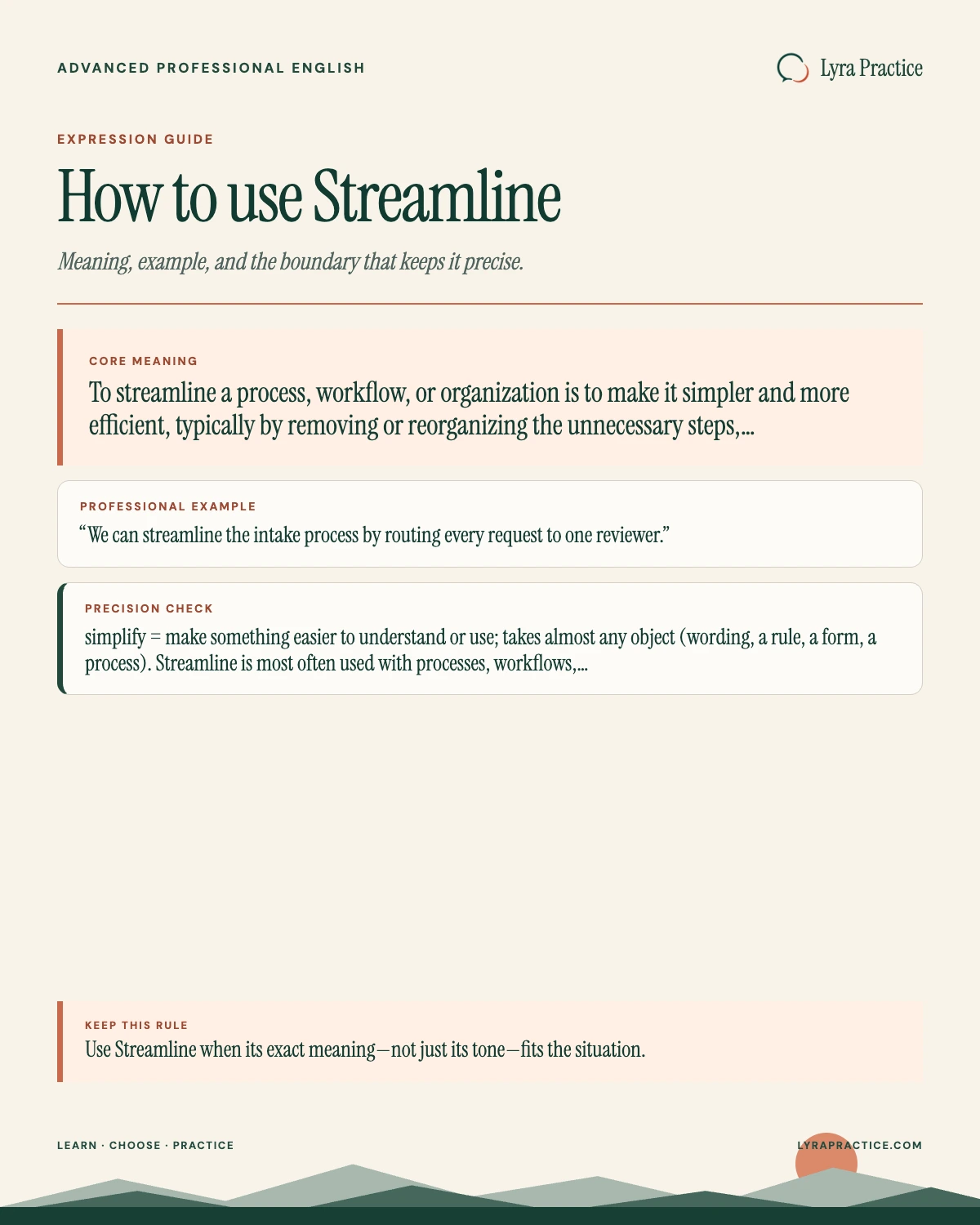
Streamline means to make something simpler or more efficient. At work, it often applies to a process, flow, system, or task. You might remove a repeated step or combine two forms. The word does not prove that quality, safety, jobs, or key controls stayed the same.
Quick check
How well do you know "Streamline"?
You know "Streamline" well.
Keep going with the full learning path — more workplace contexts, related expressions, and practice using it yourself with feedback.
Continue with "Streamline" →There's more to "Streamline" than it seems.
You've got part of it, but the full learning path goes deeper into its nuances, workplace contexts, and when it sounds natural — then gives you practice using it yourself.
Learn "Streamline" in depth →The core pattern: streamline + process, by + -ing
Streamline is transitive, so it needs an object. A process, workflow, system, operation, or pipeline is common. You can also streamline text or a document by making it simpler and easier to use.
"We can streamline the approval process by removing the duplicate sign-off."
You can state the method with by + -ing or with a purpose clause:
"We streamlined onboarding by combining the two setup forms into one."
The adjective form is streamlined, not streamline:
"The workflow is now streamlined: one form instead of four, and no separate login step."
Try it yourself
Use "Streamline" yourself
Three worked examples
Operations, naming the concrete change:
"We streamlined intake by routing requests directly to the right reviewer instead of through a shared queue."
Product and UX, external-facing:
"The streamlined checkout flow now takes two steps instead of five."
Organizational, handled carefully:
"We streamlined the team by merging two overlapping coordinator roles into one -- no other headcount changes."
The last example needs care. When streamline refers to a team, name the real change and its effect on people. The word should not hide who made the choice, whether roles ended, or what support workers received.
Common mistakes
Vague buzzword use. "We want to be more streamlined" or "let's streamline everything" gives no clear plan. Name what will change and why. If the change affects jobs, access, consent, or required controls, state that impact instead of hiding it.
The missing -d. "A streamline process" (missing the adjective ending) is a common, visible mistake. It's streamlined.
One useful guide is this: streamline often stresses a smoother or more efficient result. Simplify stresses making something less complex. Both verbs can apply to a process, text, or policy. Choose the one that best states the real change.
Practice scenarios
Practice using streamline in situations like:
- proposing a process fix that names the specific friction being removed
- describing a streamlined product or checkout flow with a concrete detail
- catching yourself before letting streamline stand alone as cover for a headcount cut
Useful practice phrases:
- "We can streamline [process] by [removing/combining] [specific friction]."
- "[Process] is now streamlined: [what changed]."
- "We streamlined [team/structure] by [naming the concrete change]."
Want to actually use "Streamline" naturally at work?
Understanding it is one thing. Practice its nuances, see how it works in real workplace situations, and use it yourself with feedback.
Start the "Streamline" learning path →Streamline is most useful with a clear detail: the step removed, the forms joined, or the queue skipped.
Without that detail, readers cannot judge what changed, who chose it, or whether it helped.