
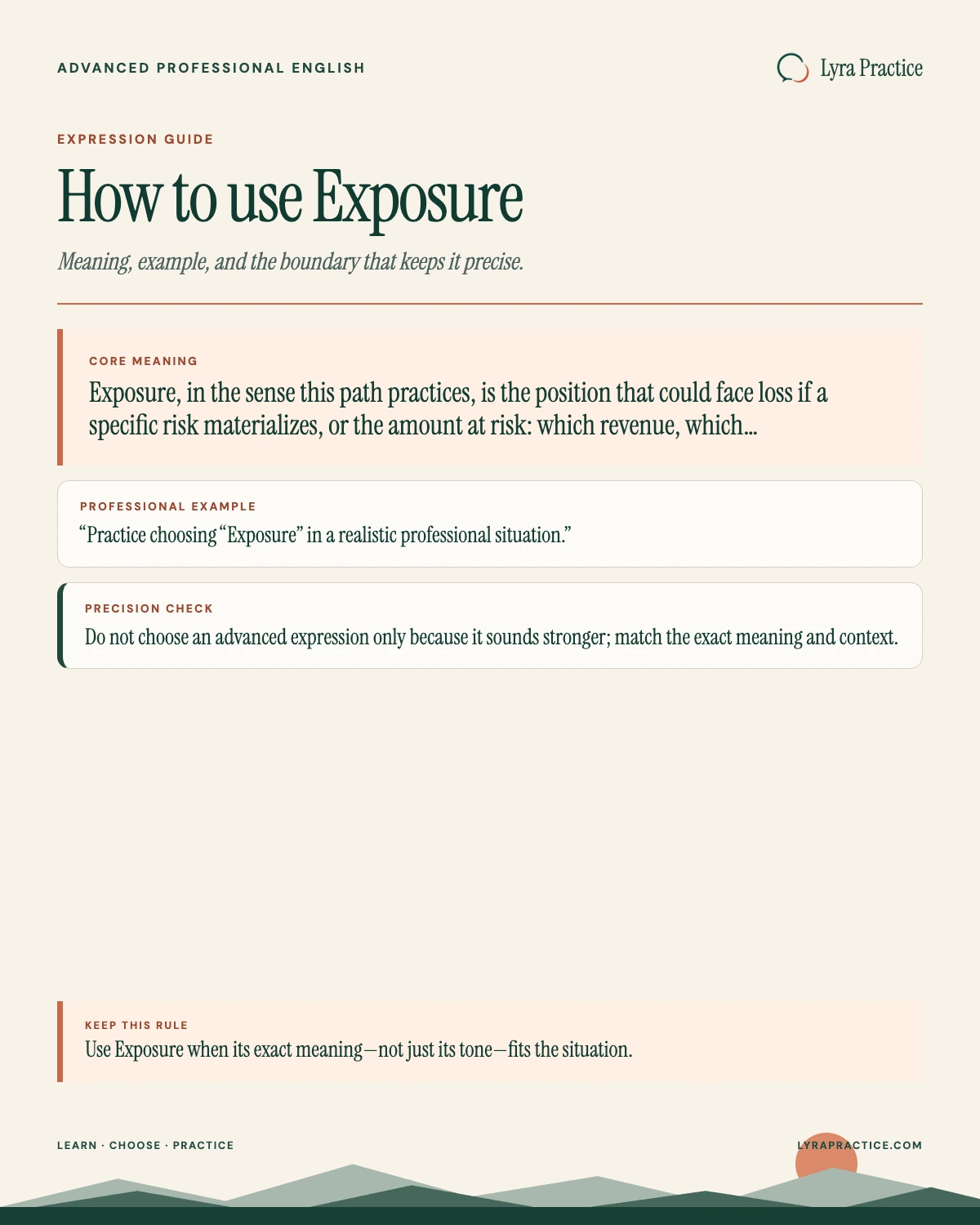
Exposure can describe a risk without saying it became harm. Four common claims go too far. They treat a safety step or possible event as final proof.
Quick check
How well do you know "Exposure"?
You know "Exposure" well.
Keep going with the full learning path — more workplace contexts, related expressions, and practice using it yourself with feedback.
Continue with "Exposure" →There's more to "Exposure" than it seems.
You've got part of it, but the full learning path goes deeper into its nuances, workplace contexts, and when it sounds natural — then gives you practice using it yourself.
Learn "Exposure" in depth →The four overclaims
Do not say a hedge removes all exposure. Do not equate exposure with a recorded accounting liability. Legal or compliance approval does not remove every liability. Possible data exposure also does not prove theft or a breach. The facts do not support those claims.
"The hedge reduces our currency exposure -- it doesn't eliminate it, so a sudden move could still hurt us."
"A possible data exposure at the vendor doesn't by itself prove records were stolen or that a legally defined breach occurred -- that determination takes a formal investigation."
"Legal's sign-off on the contract limits our exposure, but it doesn't remove liability -- and when the quarterly risk report called the pending claim a recognized liability, the finance team corrected it: it's exposure, potential vulnerability, not liability, an actual, existing obligation."
Try it yourself
Use "Exposure" yourself
Why the difference matters
A hedge can reduce exposure. It may not remove it fully. A compliance review can limit future exposure. It does not erase a liability that already exists. Exposure alone is not a recorded accounting liability. It describes possible loss or harm. A liability is a present obligation under the relevant rules.
The common mistake, stated plainly
All four claims make the same mistake. They say "the risk is gone" after a hedge or review. A fair claim is that exposure fell, not vanished. Keep "reduced" apart from "eliminated." Keep "exposure" apart from "liability."
Practice scenarios
Practice using exposure in these situations.
- rewriting an overstated risk claim after a hedge is put in place
- correcting a report that calls a possible data exposure a confirmed breach
- clarifying that legal sign-off limits exposure without removing liability
Useful practice phrases to try.
- "The hedge reduces our exposure -- it doesn't eliminate it."
- "This is exposure, not necessarily a recognized liability; recognition depends on the applicable accounting rules."
- "Legal's approval limits exposure going forward; it doesn't remove liability retroactively."
Want to actually use "Exposure" naturally at work?
Understanding it is one thing. Practice its nuances, see how it works in real workplace situations, and use it yourself with feedback.
Start the "Exposure" learning path →Reduced does not mean eliminated. Exposure does not mean liability. Keep each claim precise.