
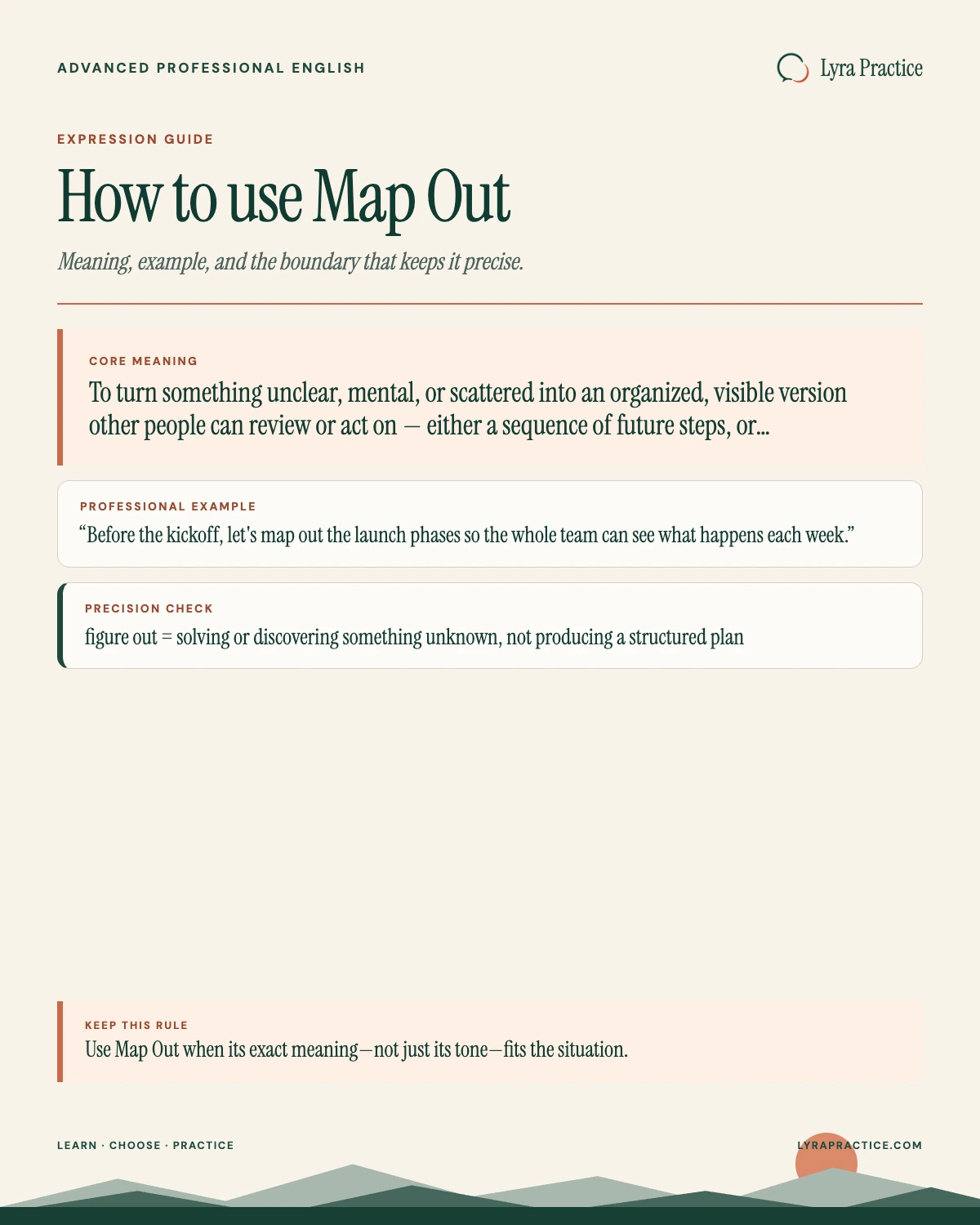
Map out can take two kinds of object. You can map out something for the future, such as a plan, a launch, or next steps. You can also map out a system that exists now, such as dependencies, an approval process, or an organizational structure. In both cases, you put the parts into a clear form that other people can review.
The examples below show both uses. They also show where to place the object and how to use the form "have it mapped out."
Quick check
How well do you know "Map Out"?
You know "Map Out" well.
Keep going with the full learning path — more workplace contexts, related expressions, and practice using it yourself with feedback.
Continue with "Map Out" →There's more to "Map Out" than it seems.
You've got part of it, but the full learning path goes deeper into its nuances, workplace contexts, and when it sounds natural — then gives you practice using it yourself.
Learn "Map Out" in depth →Future plans and sequences
Status update: "Before we commit to a launch date, I want to map out the full rollout -- phases, owners, and dependencies."
Slack message: "Can we map out next steps before end of day? I don't want this to slip because nobody wrote it down."
Exec note: "Product has mapped out a three-quarter roadmap for the platform migration, with clear checkpoints at each phase."
Structures and relationships that already exist
Cross-team email: "I mapped out the dependencies between our team and Platform before we start the joint project -- there are more shared points than I expected."
Process review: "We mapped out the current approval process and found four handoffs that may not be needed."
Onboarding note: "Part of week one is mapping out the team structure so you can see the documented owners."
Try it yourself
Make the planning concrete
Separable grammar
Full noun phrase, either order: "Let's map out the migration plan this week," or equally natural, "Let's map the migration plan out this week."
Pronoun object, split required: "The client asked for a rollout plan -- can you map it out by Friday?" Never "map out it."
The stative form: already mapped out
Status update: "The first two phases are already mapped out; we're still working through phase three."
Meeting comment: "I have the whole onboarding sequence mapped out -- happy to walk the team through it."
What these examples have in common
Each sentence turns unclear or scattered details into an "organized view." Other people can then review, question, or use that view. The object may be a future sequence or a current system. The main idea stays the same.
Do not treat "map out" as a bare plan to think later, such as "we'll figure that out." It suggests work to show the parts or steps. It can also describe a plan that is already decided, but the phrase itself does not mean that anyone approved it. In "let me lay out the plan," lay out often means to present details that are ready. Map out puts more focus on finding or arranging the structure.
Practice scenarios
Practice using map out in situations like:
- proposing a plan or set of next steps in a meeting or Slack message
- describing the dependencies or structure of something that already exists, before a joint initiative starts
- using the separable pronoun form correctly under time pressure
- reporting that a plan is already arranged in a clear form, using the stative form
Useful practice phrases:
- "Let's map out the next phase before we commit to a date."
- "Can you map it out by Friday?"
- "I have the whole sequence mapped out."
- "We mapped out the dependencies before kicking this off."
Want to actually use "Map Out" naturally at work?
Understanding it is one thing. Practice its nuances, see how it works in real workplace situations, and use it yourself with feedback.
Start the "Map Out" learning path →One verb can cover future plans and current structures. Keep one grammar rule in mind: put a pronoun between the two parts.