
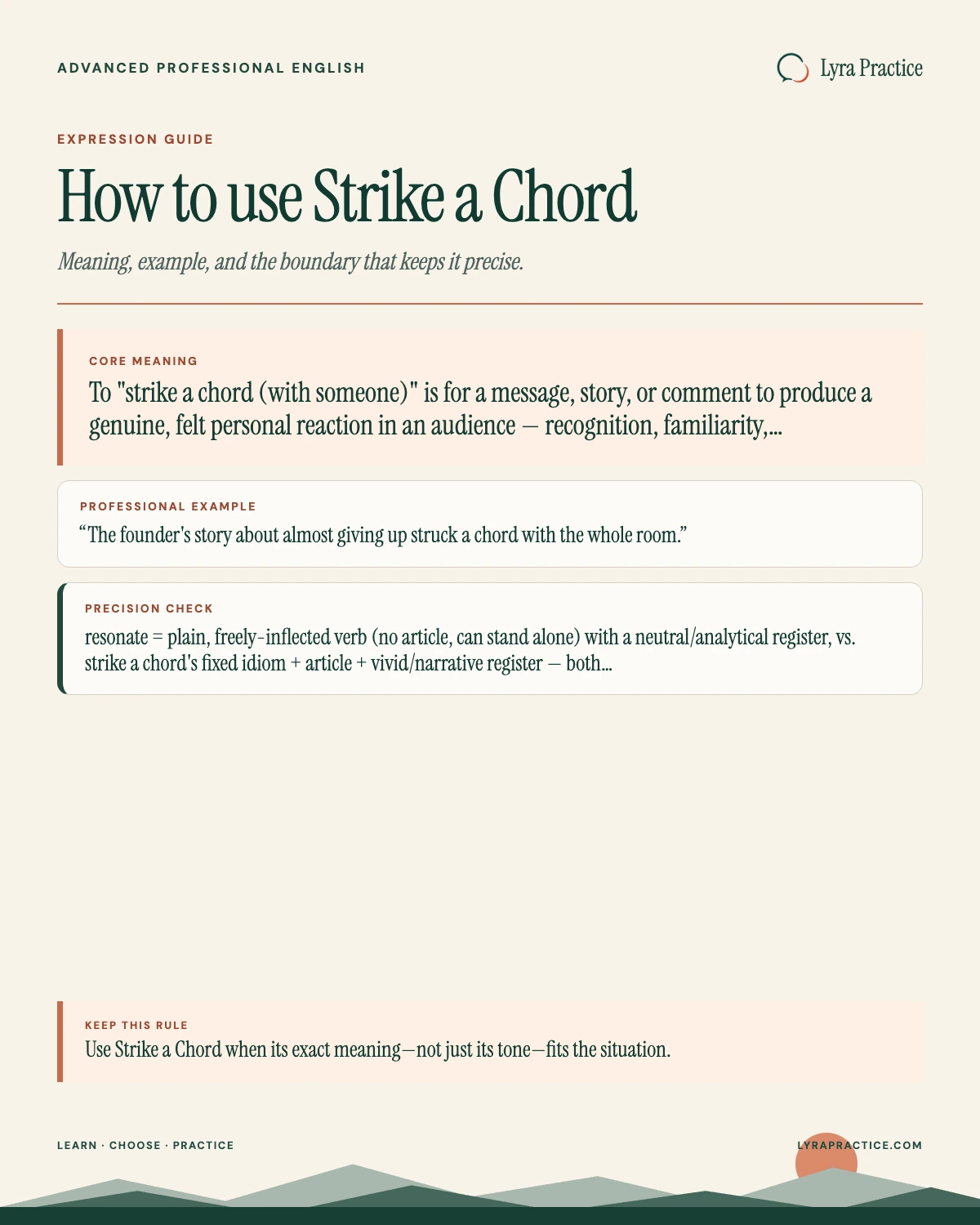
Strike a chord means to create a strong feeling of recognition or emotional connection. The clearest pattern puts the message in the subject position. The person or group responds to it.
The examples show formal and informal workplace use. They also show that the reaction may be positive or uneasy.
Quick check
How well do you know "Strike A Chord"?
You know "Strike A Chord" well.
Keep going with the full learning path — more workplace contexts, related expressions, and practice using it yourself with feedback.
Continue with "Strike A Chord" →There's more to "Strike A Chord" than it seems.
You've got part of it, but the full learning path goes deeper into its nuances, workplace contexts, and when it sounds natural — then gives you practice using it yourself.
Learn "Strike A Chord" in depth →The message is always the subject
Client presentation recap: "The customer story about the failed handoff struck a chord with the room -- three people said it reflected their own experience."
Leadership update: "That line in your email about slowing down to move faster really struck a chord with the team."
Marketing review: "The new tagline struck a chord with beta testers in a way the old one never did."
In these examples, a story, line, or tagline does the striking. The audience follows with. "I struck a chord when I heard the story" says that you caused a response; it does not say the story affected you. To express your reaction, say that the story struck a chord with you. A person can be the subject when their name stands for their words, actions, or performance.
Negative form: it didn't land
Presentation debrief: "The pitch was clear and well-organized, but it didn't strike a chord with the audience -- their survey comments said it felt distant."
Feedback note: "The framing was accurate, but it just didn't strike a chord with the skeptics in the room."
Try it yourself
Write the reaction
Not always positive
Retro comment: "His remark about the missed deadlines struck a chord in the room, and not in a comfortable way -- everyone knew exactly who he meant."
Performance review reflection: "That feedback about my delegation habits struck a chord -- it wasn't fun to hear, but it was accurate."
These sentences describe recognition, not praise. A hard truth can strike a chord, just as a hopeful story can. The idiom suggests a felt response. It does not prove support, consent, or agreement. Ask people what they thought instead of guessing from silence or body language.
Irregular verb, required article
Written correctly: "struck a chord" -- never "striked a chord."
Written correctly: "strike a chord with the team" -- never "strike chord" (the article "a" never drops).
The other pattern: "the right/wrong chord"
A related pattern uses a different article and makes a different judgment.
Event debrief: "The opening joke struck exactly the right chord -- it loosened up the room without undercutting the seriousness of the topic."
Message review: "The apology email struck the wrong chord -- too formal for a team that usually talks to each other casually."
"A chord" points to emotional connection. "The right/wrong chord" judges whether the tone fit the moment. It does not tell you that everyone shared the reaction. Notice the article: use "the," not "a," before "right" or "wrong."
What these examples have in common
Each sentence puts the message in the subject position. The audience often comes after "with." The phrase in the room can instead name where the response happened. Keep the article in a chord, and use the irregular past form struck. The clearest patterns are something strikes a chord with someone and something strikes the right or wrong chord.
The feeling can range from warm ("the story struck a chord and moved people") to uneasy ("the remark struck a chord and made the room tense"). The grammar stays the same. Use the idiom when emotion or personal recognition matters. For neutral evidence, report the actual comments, survey result, or action instead.
Practice scenarios
Practice using strike a chord in situations like:
- explaining why a customer story resonated with a leadership team
- describing a piece of feedback that landed uncomfortably but accurately
- reporting that a pitch was clear but didn't create real recognition
- keeping the message, not the person, as the grammatical subject
- judging whether a message hit the right tone, using "the right/wrong chord"
Useful practice phrases:
- "The story struck a chord with [audience] because..."
- "It was clear, but it didn't strike a chord."
- "That struck exactly the right chord for this audience."
- "That remark struck a chord, and not comfortably."
- "Struck a chord" -- never "striked."
Want to actually use "Strike A Chord" naturally at work?
Understanding it is one thing. Practice its nuances, see how it works in real workplace situations, and use it yourself with feedback.
Start the "Strike A Chord" learning path →For a clear report, name the message that struck a chord and the audience that responded.