Lyra Practice · Video lessons
Business English video lessons
Choose a short lesson, read its transcript, then practice the expression in Lyra Practice.

Iron Out
When Does Iron Out Sound Too Reassuring?
Learn when iron out sounds constructive and when it becomes vague, minimizing, or too informal for high-stakes records.

Iron Out
Iron Out: Word Order, Prepositions, and Verb Forms
Learn object choice, pronoun placement, the with preposition, and tense patterns that mark progress or completion.

Iron Out
Iron Out vs Similar Expressions: What's the Difference?
Compare iron out with work out, hammer out, resolve, smooth over, solve, fix, and finalize.

Iron Out
What Does Iron Out Mean at Work?
Learn how iron out describes calmly resolving the remaining details, issues, or differences in something already formed.

Ambiguous
When to Use Ambiguous
Calling something a colleague or client wrote ambiguous, right to their face, can land as blunt or critical — especially in client-facing or upward communication.

Ambiguous
Ambiguous: Grammar and Sentence Patterns
Ambiguous pairs with a small set of prepositions, and each one points at a different piece: what the ambiguity is about, how formally it's scoped, and whose reading it's judged from.

Ambiguous
Ambiguous vs Similar Expressions: What's the Difference?
Equivocal makes a claim that ambiguous never makes: that the speaker chose vague or non-committal wording on purpose, to dodge a clear answer. "The clause is ambiguous" stays neutral, about the text. "His answer was equivocal" is a claim about the speaker — reach for it only when the scenario shows that pattern of dodging.
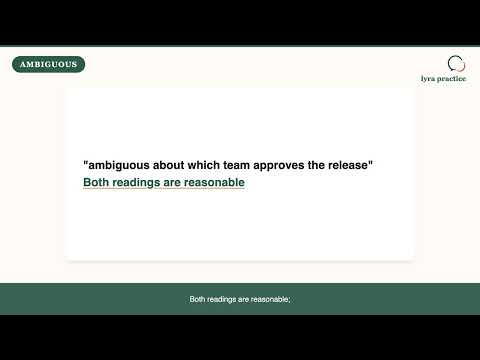
Ambiguous
What Does Ambiguous Mean in Business English?
What does ambiguous mean at work? Ambiguous describes wording, data, or a situation that genuinely supports two or more reasonable readings — a property of the thing itself, not a claim about who caused the confusion or why.
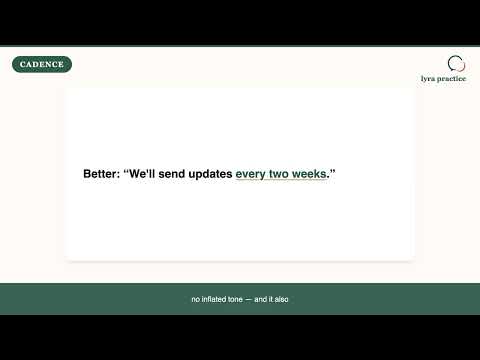
Cadence
When Does Cadence Sound Too Jargony?
Cadence is polished operations vocabulary, but it can sound unnecessarily stiff in casual or client-facing logistics when plain timing language is clearer.

Cadence
Cadence: Grammar and Sentence Patterns
Learn the natural verbs, articles, modifiers, prepositions, and operating cadence compound used to describe recurring work precisely.

Cadence
Cadence vs Similar Expressions: What's the Difference?
Learn how cadence differs from frequency, schedule, cycle, pace, and rhythm in workplace planning and operations.

Cadence
What Does Cadence Mean at Work?
A cadence is a deliberately recurring, established operating pattern that a team sets and expects to continue.

Caveat
When Does Caveat Sound Too Evasive?
Caveat is useful for one specific limitation, but stacked caveats can sound evasive and the word should never soften a real blocker or compliance issue.

Caveat
Caveat: Grammar and Sentence Patterns
Learn how caveat qualifies a stated claim or stands alone, plus its formal patterns, natural verb partners, and countable forms.

Caveat
Caveat vs Similar Expressions: What's the Difference?
Learn how caveat differs from a condition or prerequisite, a deal-breaker or fatal flaw, an exception, a reservation, an assumption, and a disclaimer.

Caveat
What Does Caveat Mean at Work?
A caveat is a specific, nameable limitation that qualifies a confident statement or flags how far a claim, plan, or dataset can be trusted.

Drive Home
Drive Home: Word Order, Prepositions, and Verb Forms
Learn the separable word order, the required preposition to, and the irregular active and passive forms of drive home.

Drive Home
When Does Drive Home Sound Too Insistent?
Drive home is neutral to positive, but repetition can weaken its emphasis and directing it at peers can sound top-down.

Drive Home
Drive Home vs Similar Expressions: What's the Difference?
Learn how drive home differs from hammer home, underscore, make a point, reinforce, emphasize or stress, belabor the point, and hit home.

Drive Home
What Does Drive Home Mean in Business English?
Make a point, message, or evidence fully understood and remembered through deliberate emphasis.
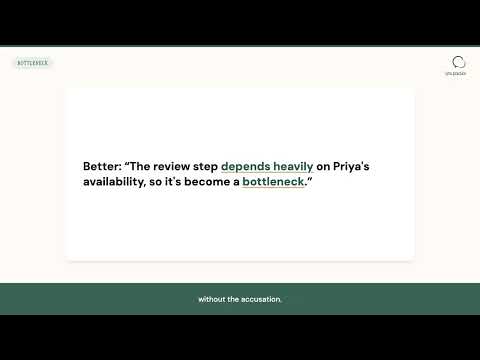
Bottleneck
When Does Bottleneck Sound Too Blaming?
Learn to diagnose bottlenecks by process stage and business impact without turning the label into a personal accusation.

Bottleneck
Bottleneck: Grammar and Sentence Patterns
Learn how to identify, place, and resolve a bottleneck, including the correct in, at, and to prepositions.

Bottleneck
Bottleneck vs Similar Expressions: What's the Difference?
Compare bottleneck with delay, blocker, roadblock, backlog, constraint, dependency, single point of failure, and overhead.

Bottleneck
What Does Bottleneck Mean at Work?
Learn how bottleneck names the specific point that caps flow or capacity for everything downstream.

De-Risk
When Does De-Risk Sound Too Jargony?
De-risk is natural in startup, product, and strategy work, but formal audiences may prefer plainer language and no audience should hear it paired with an absolute claim.

De-Risk
De-Risk: Grammar and Sentence Patterns
Learn how to name the undertaking, method, and timing, use de-risking and de-risked, and choose the right preposition and spelling.

De-Risk
De-Risk vs Similar Expressions: What's the Difference?
Learn how de-risk differs from mitigate, hedge, validate or pilot, a contingency plan, safeguard or protect, and reduce the risk of.

De-Risk
What Does De-Risk Mean at Work?
To de-risk a plan, decision, or investment is to take deliberate action that makes the undertaking meaningfully safer to move forward with, without claiming it is risk-free.

Hedge
When Does Hedge Sound Too Indecisive?
Hedge is neutral and technical in risk contexts, but casual idioms or stacked qualifiers can make a message sound indecisive. One evidence-based hedge is usually stronger.

Hedge
Hedge: Grammar and Sentence Patterns
Learn hedge against, hedge an exposure, hedge your bets, and the noun and communication patterns used at work.

Hedge
Hedge vs Similar Expressions: What's the Difference?
Learn how hedge differs from mitigate, avoid, insure, diversify, qualify, waffle, and equivocate across risk and communication contexts.

Hedge
What Does Hedge Mean at Work?
Watch a lesson on how hedge can mean reducing exposure, keeping an option open, or qualifying a claim when uncertainty remains.

Bandwidth
When Does Bandwidth Sound Too Abrupt?
Learn when bandwidth sounds natural, when it feels evasive, and how a timeframe or alternative makes capacity limits collaborative.

Actionable
What Does Actionable Mean at Work?
What does “actionable” mean at work? It describes information, feedback, or a plan that gives someone enough detail and control to take a concrete next step. In legal and HR settings, it can carry a different formal meaning. Here's how to tell the two senses apart.

Bandwidth
Bandwidth: Grammar and Sentence Patterns
Learn bandwidth as an uncountable noun, plus its to-infinitive, for-phrase, possessive, and resource-management patterns.

Bandwidth
Bandwidth vs Similar Expressions: What’s the Difference?
Watch a lesson comparing bandwidth with capacity, time, availability, resources, budget, priority, and bottleneck at work.

Push Back
When Does Push Back Sound Too Confrontational?
Learn to challenge a proposal, assumption, price, or timeline without targeting the person behind it.

Push Back
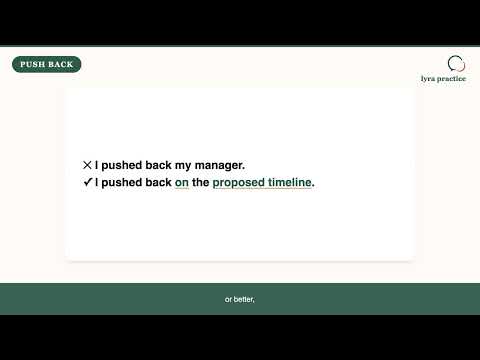
Push Back: Word Order, Prepositions, and Verb Forms
Learn push back on versus against, scheduling word order, and the uncountable one-word noun pushback.
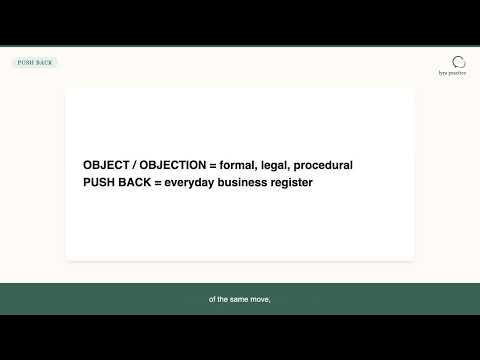
Push Back
Push Back vs Similar Expressions: What's the Difference?
Compare push back with reject, disagree, challenge, feedback, object, postpone, delay, backlash, escalate, and counter-propose.
Push Back
What Does “Push Back” Mean at Work?
Watch a short lesson on pushing back at work: challenge a proposal or renegotiate a request without ending the conversation.

Bandwidth
What Does Bandwidth Mean at Work?
Learn how bandwidth describes practical capacity across time, attention, energy, staffing, and competing priorities.