
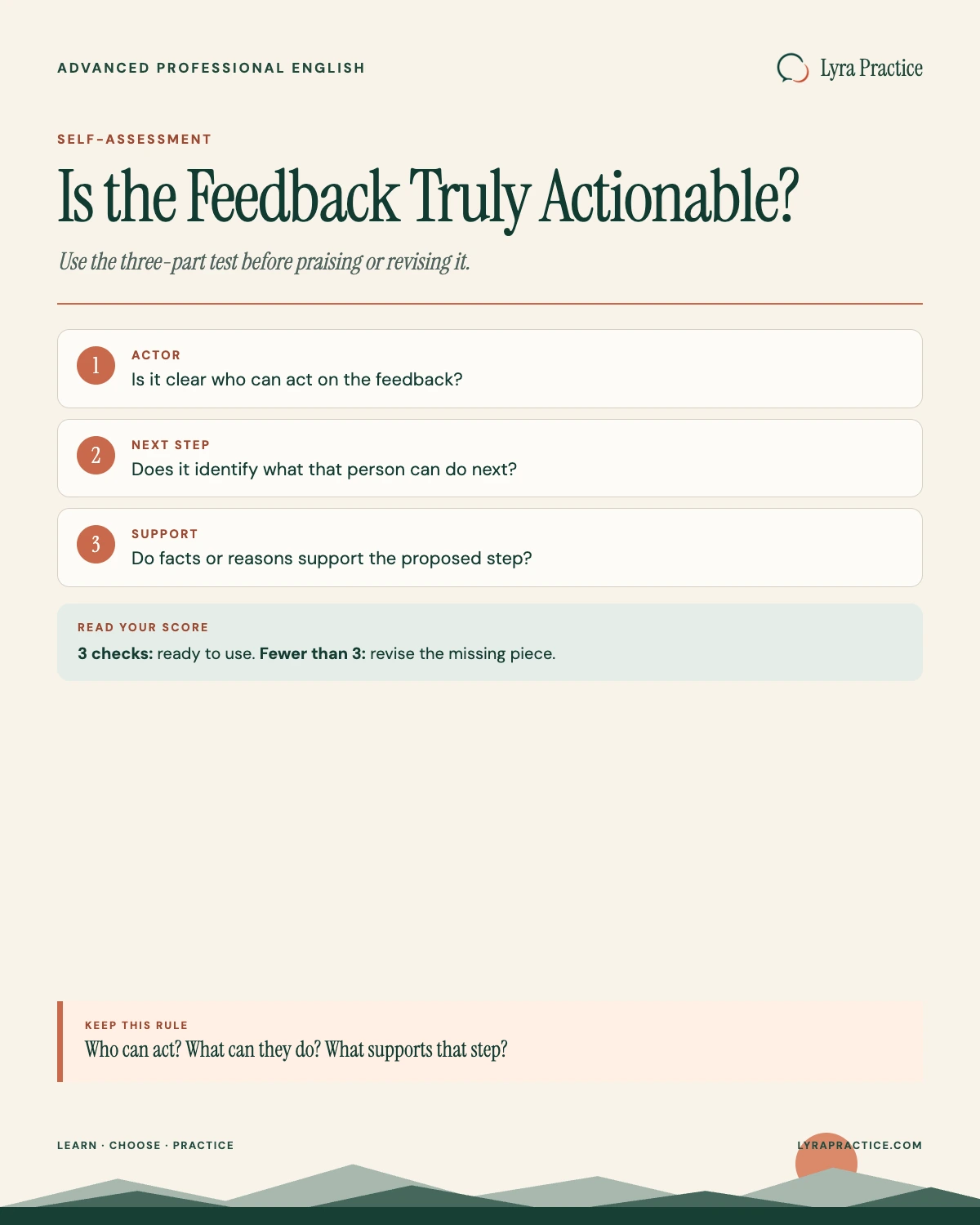
Actionable means ready to guide or support an action. Ask three questions. Who can act? What can they do next? What facts or reasons support that step? The answers do not need to be in one sentence. They do need to be clear from the context.
This test sets actionable apart from nearby words. A point can be serious, urgent, or detailed but still not guide an action. It may lack a clear next step. It may also reach a person who cannot take that step.
Quick check
How well do you know "Actionable"?
You know "Actionable" well.
Keep going with the full learning path — more workplace contexts, related expressions, and practice using it yourself with feedback.
Continue with "Actionable" →There's more to "Actionable" than it seems.
You've got part of it, but the full learning path goes deeper into its nuances, workplace contexts, and when it sounds natural — then gives you practice using it yourself.
Learn "Actionable" in depth →The grammar pattern
Actionable can come before a noun: actionable feedback, actionable insights, actionable recommendations, actionable steps. It can also follow a linking verb when the context is clear: "The report isn't actionable yet."
For emphasis, people often use immediately actionable, directly actionable, highly actionable, or specific and actionable. Plain very actionable is grammatical, but it is less natural.
Two more patterns are useful at work: make [X] actionable ("Can we make this feedback more actionable?") and actionable for [owner] ("This finding is actionable for the platform team, but not for marketing — they don't own the fix.") The second form names the right actor. That actor may have formal authority, an assigned task, or a clear path to seek approval. Do not confuse readiness to act with permission to make the final decision.
Worked examples across registers
In a data readout:
"The churn numbers are interesting, but the recommendation isn't actionable until we know which onboarding step to change."
In a performance review, distinguishing actionable feedback from feedback that's merely kind:
"Your presentations could be stronger" is constructive, but it isn't actionable — nothing in it tells you what to change. "Cut the background context and open with the recommendation" is.
In an HR-adjacent sentence, where the word shifts registers entirely:
"Legal flagged the complaint as potentially actionable, meaning it may support a formal grievance, not just informal feedback."
The third example shows a less common sense. In legal use, a claim or act may be actionable if the law allows a legal action based on it. In HR or policy use, people may use the word more broadly. It can mean that facts may support a formal response, not merely that they are "practical." It does not prove the claim or decide the outcome. Make the intended sense clear and seek legal review when needed.
Try it yourself
Use "Actionable" yourself
The two mistakes that matter most
Filler praise with no action named. "Great, actionable insights!" may be empty praise. Test it by adding "...because it tells us to [do X]." If no useful step follows, choose a more exact word.
The severity/detail fallacy. A point is not actionable just because it is urgent or well supported. An alert may still lack a next step or a person who can own it. Evidence, urgency, and readiness for action are separate ideas.
Also, actionable is not the same as applicable or feasible. Applicable means relevant to this case. Feasible means possible within the limits. A useful recommendation may pass one test but fail another. An actionable input also differs from an action item. The input supports the task; it is not the task.
Practice scenarios
Practice using actionable in situations like:
- turning a vague piece of manager feedback into one specific, ownable next step
- separating an actionable finding from the action item it should produce
- checking whether an urgent, detailed alert actually has an owner before calling it actionable
- disambiguating the practical sense from the formal/legal sense in an HR-adjacent sentence
Useful practice phrases:
- "This is useful, but it's not actionable until [missing piece]."
- "Can we make this more actionable? Right now it doesn't say who should do what."
- "This is actionable for [team], but not for [other team] — they don't own it."
- "Is this actionable, or just interesting?"
Want to actually use "Actionable" naturally at work?
Understanding it is one thing. Practice its nuances, see how it works in real workplace situations, and use it yourself with feedback.
Start the "Actionable" learning path →Actionable works best when the context shows who can act, what the next step is, and why it makes sense. The word should not stand in for "good" or "important." It should tell readers that the information can guide action.