
A report can get every fact right and still bore the room. That simple gap separates convincing from compelling.
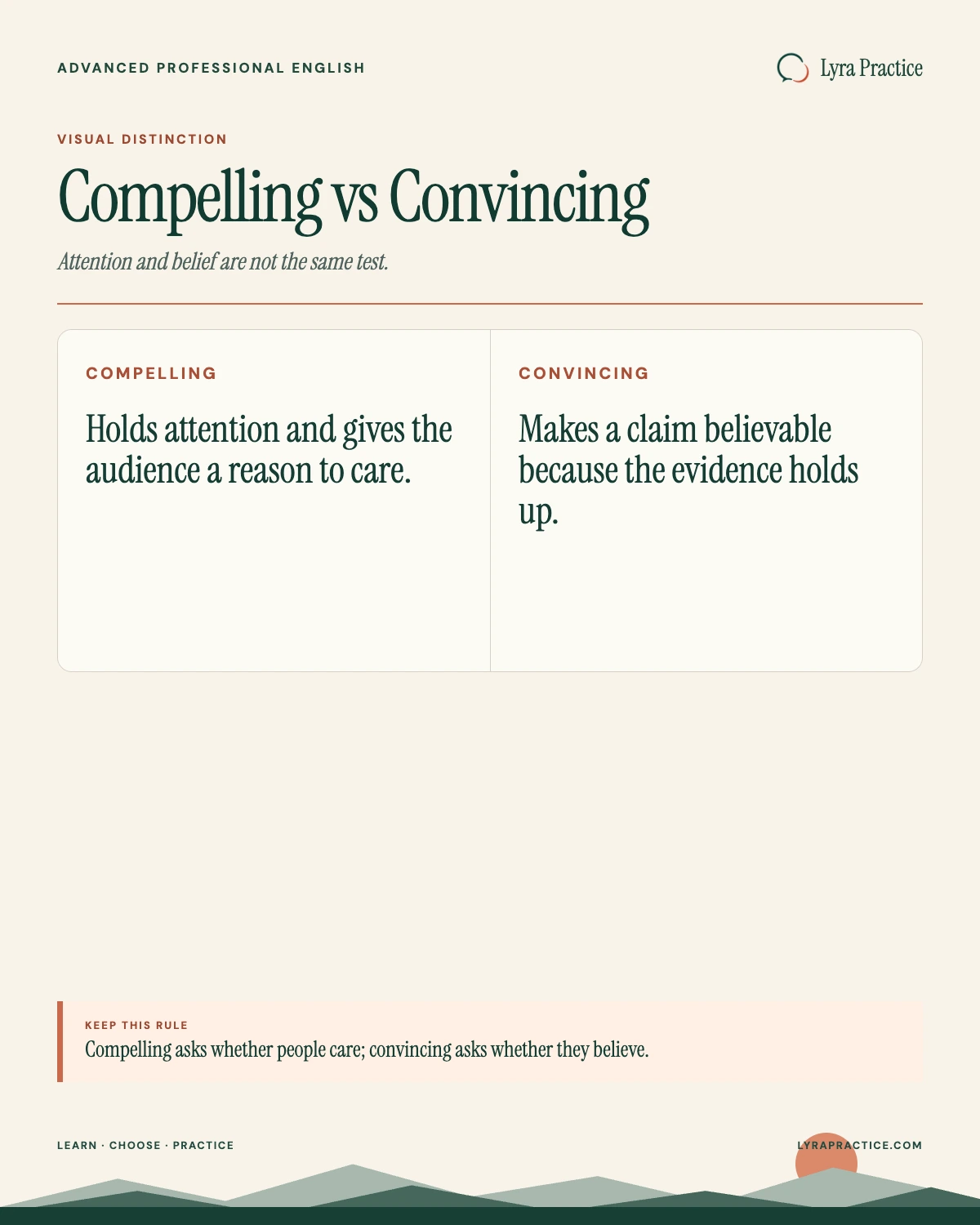
"Convincing" describes whether people believe a claim. "Compelling" describes the case's wider pull and how well it holds attention. A convincing case can be dry and therefore not compelling. A compelling but flawed case may not be fully convincing.
Try it yourself
Use "Compelling" yourself
The closest neighbors in the whole set
These words are the closest pair in this group, so their difference matters. Convincing asks one question: does the audience believe the claim? It focuses on whether the evidence holds up. Compelling asks whether the audience cares, pays attention, or feels moved to act. A detailed, sound analysis can be convincing on the facts but not compelling. People may lose interest before reaching the end. By contrast, a vivid story can hold real attention without proving anything.
"The analysis is convincing on its own terms, and the trend holds up under review. Yet the deck is not compelling. People outside the team can easily ignore a page of raw statistics."
"Press coverage of a launch can be compelling because it holds attention and creates interest. Yet it is not convincing proof that the campaign drove signups."
The mistake: using them as interchangeable praise
Do not swap these words when giving general praise. "This isn't compelling or convincing" gives vague feedback. Separate the ideas to make your feedback useful. "The story is compelling, but the evidence isn't convincing yet" tells the writer what to fix.
Practice scenarios
Practice using compelling in these situations.
- separating whether a case is believable from whether it holds attention
- giving feedback that names evidence gaps versus engagement gaps
- describing content that is compelling but not yet fully convincing
Try these useful practice phrases.
- "It's convincing, but not compelling yet."
- "The story is compelling, but the evidence isn't convincing yet."
- "This is compelling on its own terms, but not fully convincing."
Want to actually use "Compelling" naturally at work?
Understanding it is one thing. Practice its nuances, see how it works in real workplace situations, and use it yourself with feedback.
Start the "Compelling" learning path →Convincing asks whether the audience believes the case. Compelling asks whether they care about it.
The best cases earn both, but many real cases earn only one.