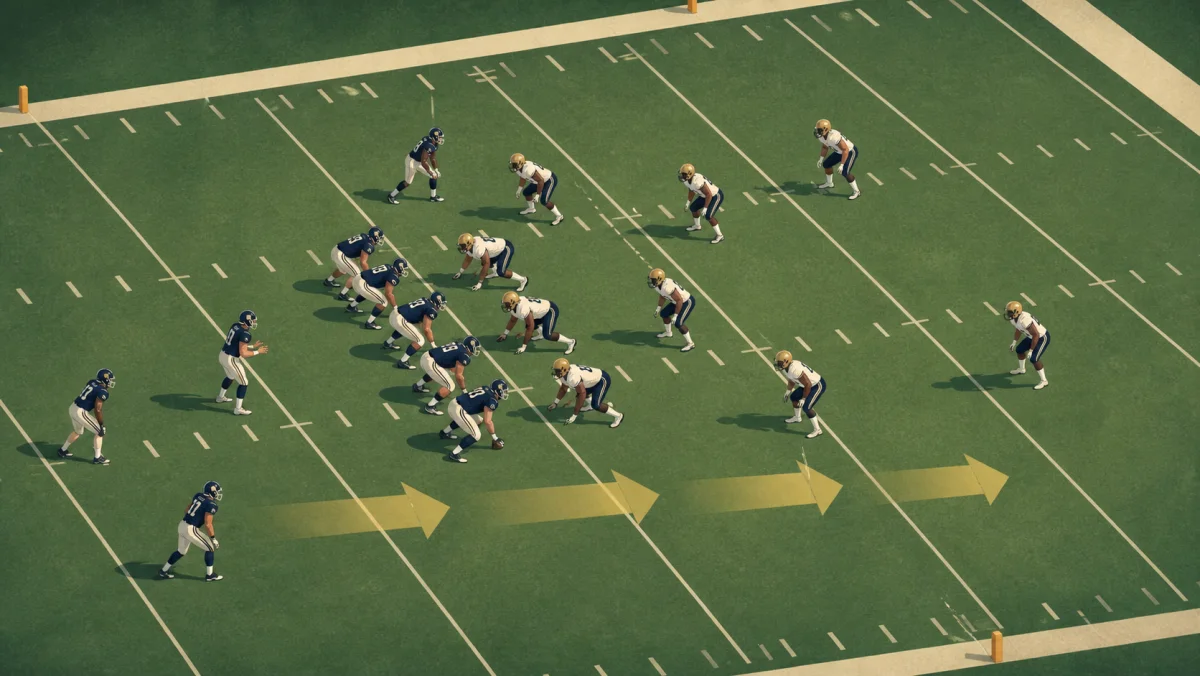
You do not need every penalty or formation to follow a casual American football conversation. Start with one idea: the team with the ball gets limited attempts to advance, while the other team tries to stop it.
Once that structure is clear, terms such as first down, move the chains, punt, and Hail Mary are easier to interpret. They also appear as metaphors outside sports.
The basic objective
Two teams compete for possession. The team with the ball is the offense; the other is the defense. The offense tries to advance and score in the opponent's end zone.
A touchdown is worth six points. The scoring team can then try a one-point kick or a two-point play. A field goal is worth three points. A safety usually gives the defense two points.
Games have four quarters. An NFL game has 60 minutes on the game clock. Clock stops, breaks, and reviews make the event much longer in real time.
Downs: the rule that unlocks the game
The offense normally gets four attempts, called downs, to gain ten yards. If it succeeds, it earns a first down and four more downs. Near the goal line, the needed distance can be shorter.
A broadcast might show “2nd & 7.” It is second down, and the offense needs seven more yards for a first down.
On fourth down, the offense commonly chooses among these options:
- try to gain the remaining distance
- attempt a field goal from a practical range
- punt downfield, giving up the ball while seeking better field position
If the offense tries and fails, the other team normally takes possession at the dead-ball spot. Rules and penalties can change that spot. Fourth down is therefore a common decision point.
Passing, running, and turnovers
A play begins with the snap, when the center passes the ball backward, usually to the quarterback. The offense may run or pass. It can throw one forward pass per play, from behind the line of scrimmage, to an eligible receiver.
A play can end with a tackle, score, incomplete pass, or player going out of bounds. Possession can change through a turnover, such as an interception or a recovered fumble. Other changes include punts and failed fourth downs.
That framework covers much casual commentary. Teams manage distance, downs, field position, time, and risk.
A lot to take in? It is.
But Rome wasn't built in a day. Build your American workplace English one expression and cultural reference at a time—with curated explanations and structured practice in Lyra Practice.
Start a session →What you might hear at work
American football supplies many workplace metaphors in the United States. Usage varies by speaker, workplace, and region. Context shows whether a term is literal.
"The Eagles converted on fourth down."
Literal sports talk: the team gained enough ground on fourth down to keep possession.
"We're facing fourth down with the contract."
Figurative workplace talk: the team sees a high-pressure attempt or decision ahead.
Other common expressions include:
- Move the chains: make enough progress to sustain an effort. On the field, the chain crew marks the line to gain.
- Get the ball over the goal line: complete the final part of a project or agreement.
- Punt: postpone or pass off a decision, often instead of acting now.
- Hail Mary: a desperate, low-probability attempt, often with little time left.
- Drop the ball: fail to do something you were responsible for.
- The playbook: a set of established strategies or procedures.
- Monday-morning quarterback: someone who judges a decision with the benefit of hindsight.
Some expressions now extend well beyond football. A colleague may say “I dropped the ball” to accept responsibility even when no one follows the NFL.
What you could say naturally
Use a metaphor when it adds meaning and suits your audience. These examples may sound natural in many US workplaces:
"I dropped the ball on the follow-up. I'll send it today."
"Let's move the chains by agreeing on the scope before Friday."
"We can punt that decision until we have the customer data."
"Sending the proposal without an introduction would be a Hail Mary."
Be careful with punt. At work, it can suggest “delay,” deferral, or avoiding responsibility. For clarity, state the next action and date: “Let's revisit this after the finance review on Thursday.”
Following casual football conversation
You can join in without pretending to be a fan. Try a low-pressure question if you want to engage:
"Was that a regular-season game or the playoffs?"
"What made that fourth-down decision unusual?"
"I don't follow football closely—who's having a strong season?"
The last sentence states your knowledge honestly and keeps the conversation open. You can also change the subject. Sports knowledge should not be treated as a condition of workplace belonging.
The Super Bowl is the NFL championship game and a major US media event. Some conversations focus on the halftime show or commercials. Interest differs widely, including within the United States.
For the hindsight metaphor, read what Monday-morning quarterback means. To compare the logic of another sport, see baseball rules for non-Americans.