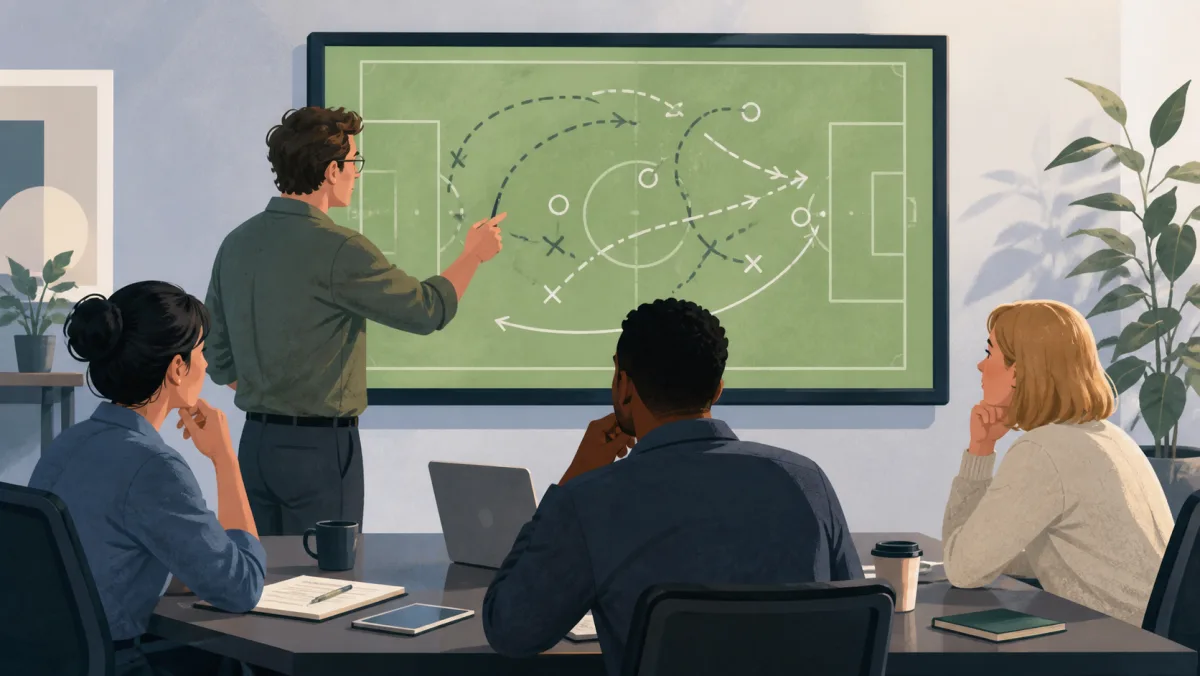
A Monday-morning quarterback criticizes a decision after the outcome is known. Hindsight makes the “right” choice look easier than it did before.
"It's easy to be a Monday-morning quarterback and say we should have delayed the launch."
The expression comes from American football. A quarterback makes fast choices during a game. Many games take place on Sunday. On Monday, spectators can judge those choices with the full result in hand.
Quick check
How well do you know "Monday Morning Quarterback"?
You know "Monday Morning Quarterback" well.
Keep going with the full learning path — more workplace contexts, related expressions, and practice using it yourself with feedback.
Continue with "Monday Morning Quarterback" →There's more to "Monday Morning Quarterback" than it seems.
You've got part of it, but the full learning path goes deeper into its nuances, workplace contexts, and when it sounds natural — then gives you practice using it yourself.
Learn "Monday Morning Quarterback" in depth →What the expression criticizes
Reviewing a past decision is not the problem. A useful retrospective also asks what went wrong.
The phrase criticizes hindsight that leads to unfair blame:
- treating an uncertain past decision as if the outcome had been obvious
- criticizing without acknowledging the pressure or information available at the time
- claiming superior judgment only after the risk has disappeared
- offering blame rather than a lesson that improves future decisions
"We should review the incident, but let's not Monday-morning-quarterback the team."
The review should be fair to people who had incomplete information.
Try it yourself
Use "Monday Morning Quarterback" yourself
Noun and verb forms
As a noun, the phrase names a person:
"Every project attracts a few Monday-morning quarterbacks after launch."
As a verb, it names the behavior:
"I don't want to Monday-morning-quarterback the decision."
You may also hear Monday-morning quarterbacking:
"The postmortem turned into Monday-morning quarterbacking."
Hyphenation varies. Hyphens help readers see the words as one unit.
Why Monday morning?
The time reference is part of the joke. Players made hard choices during the game. Confident criticism arrives after spectators know the result.
You do not need deep football knowledge. The key contrast is:
During the game: limited time, uncertainty, pressure, consequences.
Monday morning: complete outcome, no pressure, no responsibility for the original choice.
The same pattern appears in business, politics, emergencies, and personal choices.
Workplace examples
"We can all Monday-morning-quarterback the forecast now that the market data is available."
"Rather than blame the incident commander, document which signals would support a different decision next time."
"Saying the acquisition was obviously a mistake is Monday-morning quarterbacking. The risks looked different in 2023."
"This isn't Monday-morning quarterbacking—we raised the same concern before the release."
The last example rejects the label. A warning made before release is not based only on hindsight.
Is the phrase always fair?
No. People may use the label to avoid fair review of a poor decision. The phrase should not end the discussion.
A useful distinction is whether the critic can answer these questions:
- What information was available at the time?
- What reasonable alternative existed then?
- Was the concern documented before the outcome?
- What should change in the next decision?
Criticism that improves the process may be useful. The label fits better when someone only claims, “I would have known better.”
Related expressions
Hindsight is 20/20 means past events look clearer afterward. It names the main idea behind Monday-morning quarterbacking.
Second-guess means to question a decision during or after the process. It lacks the football image and does not always imply unfair hindsight.
Armchair quarterback describes a confident observer who did not take part. The criticism can happen before, during, or after the event.
The reference may be unclear if you do not follow American football. Its workplace meaning is simple: judging the play afterward is easier than calling it during the game.
For another phrase that challenges reactive business behavior, see keeping up with the Joneses meaning. For an institution used as shorthand for a frustrating process, see why the DMV is an American cultural reference.
A lot to take in? It is.
But Rome wasn't built in a day. Build your American workplace English one expression and cultural reference at a time—with curated explanations and structured practice in Lyra Practice.
Start a session →