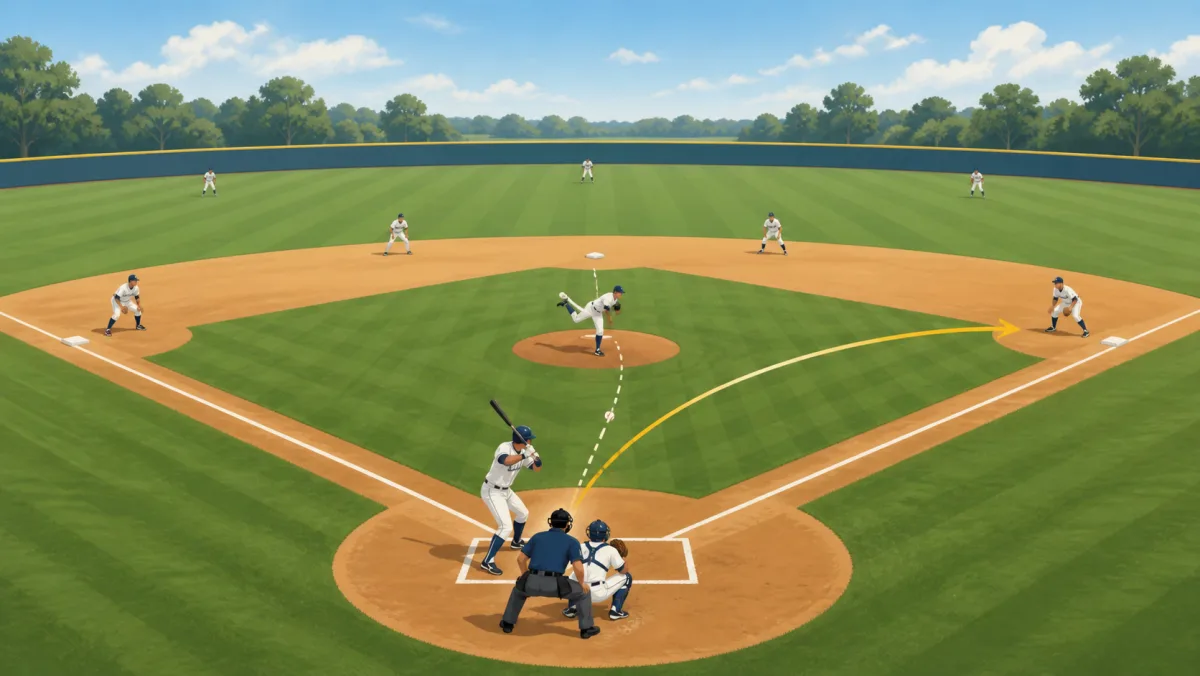
Baseball can seem complicated because each pitch creates multiple possibilities, but you do not need every rule at once. Start with this: one team moves runners around four bases to score, while the other team tries to make three outs.
This basic cycle explains several workplace expressions, including step up to the plate, touch base, ballpark figure, and out of left field.
The basic objective
In Major League Baseball, a regulation game normally has nine innings, and each inning has two halves. One team bats while the other plays defense; then they switch.
The pitcher throws the ball toward home plate, while the batter tries to hit it and reach first base. A runner scores a run by advancing safely through first, second, third, and home.
Three outs end the batting team's half-inning, and the teams then exchange roles. The team with more runs wins; a tie after regulation can lead to extra innings. Specific extra-inning rules depend on the competition and level of play.
Balls, strikes, and outs
The area over home plate is the strike zone, and a pitch through that zone can be called a strike. A missed swing also counts as a strike. Three strikes usually produce a strikeout, although some third strikes remain live plays.
A pitch outside the zone can be called a ball if the batter does not swing. Four balls normally send the batter to first base; this is a walk.
There are many ways to make an out: a fielder can catch a batted ball before it lands or tag a runner off base. On a force play, the ball can reach the base first.
You may hear three up, three down when three batters come to the plate and all make outs. No other batter appears in that half-inning.
Hits, home runs, and loaded bases
A hit may take the batter to first, second, or third base; a home run often clears the outfield fence in fair territory. The batter and any runners on base can then score.
The bases are loaded when runners occupy first, second, and third. A home run then scores four runs. It is called a grand slam because the three runners and batter score.
MLB uses timers between pitches and batters. Yet a game is not won by leading when a clock expires. Its main structure is innings and outs. Other leagues may use different rules.
A lot to take in? It is.
But Rome wasn't built in a day. Build your American workplace English one expression and cultural reference at a time—with curated explanations and structured practice in Lyra Practice.
Start a session →What you might hear at work
Baseball has contributed numerous expressions to American English. People may use them professionally without discussing a game.
"She hit a home run in the ninth inning."
Literal sports meaning: she hit a home run late in a game.
"The product team hit a home run with the new onboarding flow."
Figurative workplace meaning: the team achieved a strong result.
Common workplace expressions include:
- Step up to the plate: accept responsibility or take action in a demanding situation.
- Touch base: make brief contact or exchange an update.
- Ballpark figure: a rough numerical estimate, not an exact calculation.
- In the ballpark: reasonably close to the right amount or expectation.
- Throw a curveball: introduce an unexpected complication, question, or change.
- Out of left field: surprising or seemingly unrelated to what came before.
- Cover all the bases: account for all important parts of a task.
- Hit it out of the park: perform extremely well.
- Strike out: fail in an attempt.
You may also hear batting a thousand. It means someone has succeeded every time so far. A perfect baseball batting average is written 1.000. At work, the phrase is usually playful, not a precise measure.
What you could say naturally
These expressions can be useful, but some may sound like clichés. Use them when they suit the audience and add clarity:
"Can we touch base after the customer interview?"
"I only need a ballpark figure for next quarter's budget."
"The legal review threw us a curveball, so the launch date may change."
"Let's cover all the bases before we send the announcement."
Touch base is common, but it can be vague. “Let's touch base next week” does not state the purpose or format. If those details matter, use a clearer version:
"Let's have a 15-minute call Tuesday to choose the launch date."
Consider tone before saying a person struck out. The phrase may sound harsher than saying an attempt did not work.
Following casual baseball conversation
Major League Baseball, or MLB, has 30 teams. They belong to the American League or National League. The league champions meet in the World Series. MLB clubs are based in the United States and Canada. This is not a national-team tournament.
If coworkers discuss a game, you can ask simple questions:
"Was it a close game?"
"Was that part of the regular season or the playoffs?"
"I know the basics, but not the teams—who are you following?"
Baseball can be part of local or family culture, but not everyone follows it. Ask with curiosity rather than making assumptions about Americans.
For another sport that shaped business vocabulary, see American football rules for non-Americans. For other uses of par and course, read golf rules and culture for non-Americans.