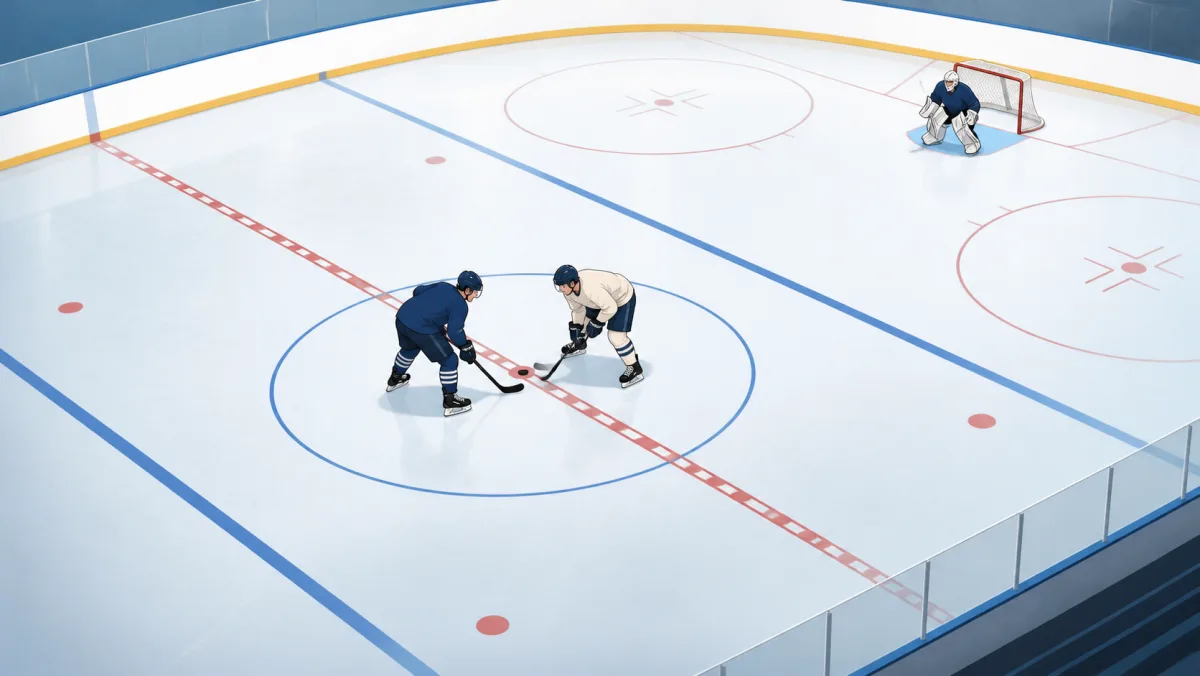
Ice hockey moves fast. Players can change while play continues, and the puck can be hard to follow. The basic aim is simple: each team uses sticks to send the puck into the other team's net.
At work, you may hear power play, hat trick, face-off, and drop the gloves. You do not need to know every rule to understand these phrases.
The basic objective
In standard play, each team has six players on the ice. They are five skaters and one goaltender, or goalie. Teams often change skaters during play.
An NHL game has three 20-minute periods. The clock stops for breaks in play, so a game lasts much longer than one hour. Each goal is worth one point in the score. Rules for a tie vary by league and competition stage.
A face-off starts or restarts play. An official drops the puck between two opponents. Players can carry, pass, or shoot the puck. Rules on body contact vary by league, age, and level.
The lines on the ice
The rink has a center red line and two blue lines. The blue lines mark the attacking zones at each end.
Two rules commonly confuse new viewers:
Offside: In NHL rules, the puck usually must enter the attacking zone before every attacker. A player is onside if either skate still touches or remains above the blue line. A player with control of the puck may cross ahead of it. Delayed offside rules can also let play continue.
Icing: A team may not simply shoot the puck from behind the center line past the other goal line. In the NHL, officials use a race-based judgment before they stop play. The next face-off then occurs in the offending team's end. Several exceptions apply, including one for a short-handed team.
For a beginner, the purpose matters most. Offside controls how attackers enter the zone. Icing limits easy shots down the full length of the rink.
Penalties and the power play
Officials can penalize tripping, holding, hooking, slashing, interference, and high-sticking. A standard minor penalty lasts two minutes. The player goes to the penalty box, and the team is often short-handed.
The other team then has a power play, with more skaters on the ice. A power-play goal usually ends one standard minor penalty. Other penalty types follow different rules.
If the short-handed team allows no goal before time expires, it has killed the penalty.
A lot to take in? It is.
But Rome wasn't built in a day. Build your American workplace English one expression and cultural reference at a time—with curated explanations and structured practice in Lyra Practice.
Start a session →What you might hear at work
Hockey talk is common in Canada and in several northern US regions. It also appears in other countries and areas where the sport has strong support. Some hockey phrases have wider uses.
"Boston scored twice on the power play."
Literal sports talk: Boston scored while it had more skaters because of an opponent's penalty.
"The proposed reorganization looks like a power play by the regional director."
Figurative workplace talk: the director seems to be seeking more control. Outside hockey, power play often has a critical tone. It can suggest forceful office politics.
Other expressions include:
- Hat trick: three notable successes by one person. In hockey, one player scores three goals in one game.
- Face-off: a direct contest, debate, or clash between two sides.
- Drop the gloves: start an open fight. In some men's professional leagues, players drop their gloves before fighting. Fighting still brings penalties.
- Take one for the team: accept a cost to help the group. This is a broad sports phrase, not only a hockey term.
- On thin ice: in a risky position. This older phrase did not come from organized hockey.
- Pass the puck: transfer responsibility. It is less common than pass the buck and may be a hockey joke.
Pass the buck is the standard phrase for shifting blame or responsibility. Pass the puck may be wordplay or a literal sports statement.
What you could say naturally
"Maya completed a hat trick: she closed three renewals this week."
"The two vendors will face off in the final evaluation."
"We're on thin ice if we launch without the privacy review."
Use drop the gloves cautiously. It suggests open conflict and can sound aggressive:
"Legal and sales dropped the gloves over the contract language."
Friends at work may use it as a joke. In formal or tense settings, “disagreed directly” is clearer and calmer.
Likewise, take one for the team can describe a small favor. Do not use it to pressure someone into unfair work or personal sacrifice.
Following casual hockey conversation
The NHL is the leading men's professional league in Canada and the United States. Its champion wins the Stanley Cup. The postseason is called the Stanley Cup Playoffs.
You can join a conversation without knowing teams or statistics:
"Was the game close?"
"Did it go to overtime?"
"I understand the basics, but icing still confuses me—what happened on that play?"
Interest in hockey varies by country and region. Ask whether a colleague follows the sport. Do not assume that they support the nearest team.
For workplace metaphors from another fast, strategic game, see American football rules for non-Americans. For expressions rooted in individual competition, see golf rules and culture for non-Americans.