
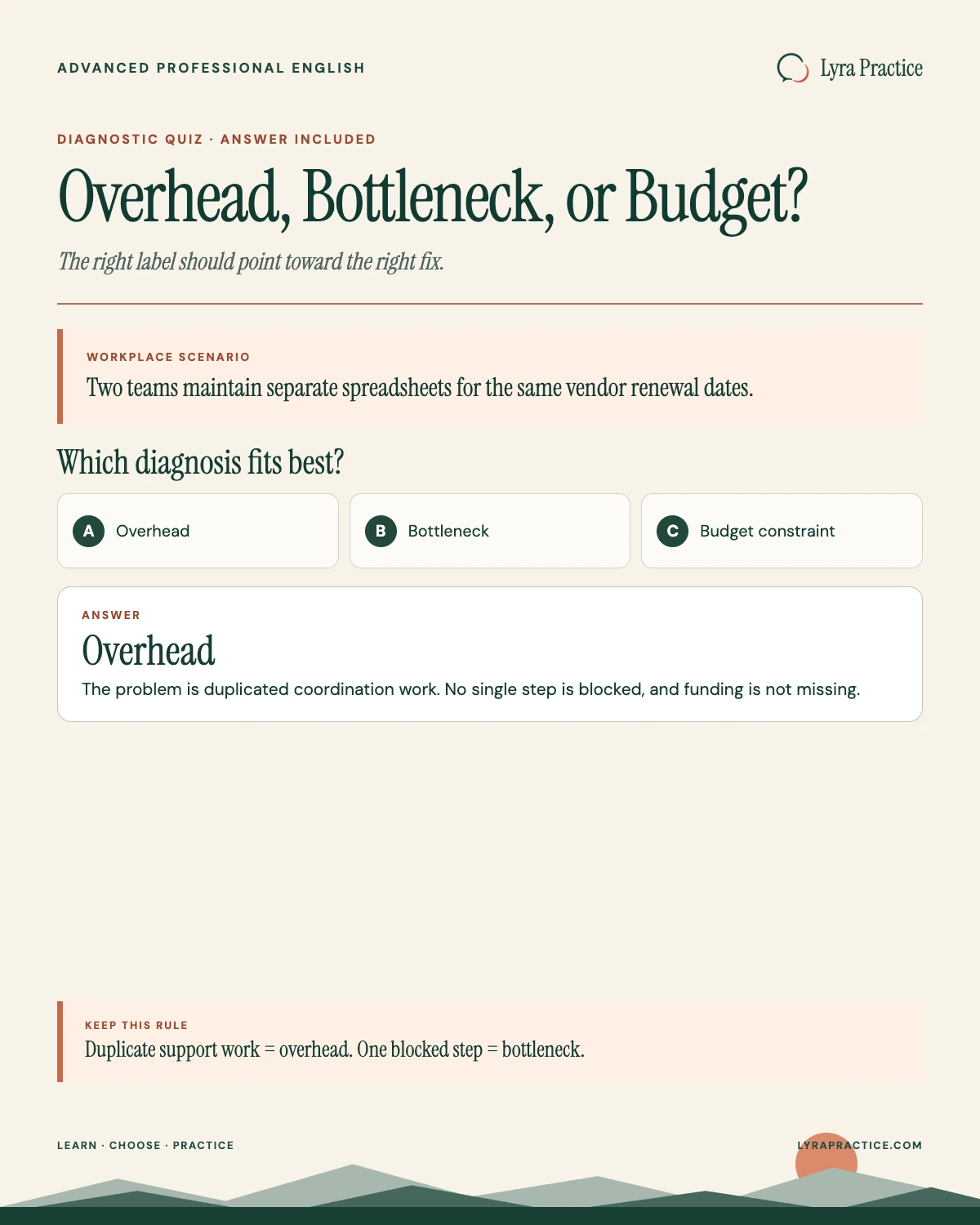
Overhead is a common business word, but many non-native professionals use it too broadly. They use it for "extra cost," "extra work," or "extra anything."
Overhead means indirect costs or support work that keep things running, apart from the main work or output. The word has three related business meanings. Your next point depends on which meaning you use.
Quick check
What does overhead mean at work
You know "Overhead" well.
Keep going with the full learning path — more workplace contexts, related expressions, and practice using it yourself with feedback.
Continue with "Overhead" →There's more to "Overhead" than it seems.
You've got part of it, but the full learning path goes deeper into its nuances, workplace contexts, and when it sounds natural — then gives you practice using it yourself.
Learn "Overhead" in depth →Three meanings, one idea
The first meaning is financial: overhead is an indirect operating cost. Examples include rent, shared software, and office salaries. These costs keep a business running without linking to one unit sold or client served.
"Rent, shared software licenses, and administrative salaries are part of a company's overhead -- they keep the business running but aren't tied to any single unit sold."
The second meaning is about process: overhead is coordination around the real output. It can include approvals, meetings, handoffs, and reports.
"When a project lead says extra sign-off steps 'add overhead,' they mean the approvals and handoffs around the work, not the core deliverable itself."
The third meaning is resource load: ongoing management or support work needed to run or grow something.
"Supporting three custom client workflows creates real management overhead for an operations team, even though nothing about the underlying product changed."
One idea links all three meanings: overhead surrounds the main work but is not the work itself. The actual product, service, or output is not overhead.
Try it yourself
Write the workplace message
Where the word stops applying
That idea gives the word a clear limit: overhead does not mean every cost, delay, or problem. A canceled order is lost business, not normally overhead. A hard software bug is a problem, not normally overhead. A stuck shipment is a logistics delay, not normally overhead. On their own, these are not ongoing indirect costs or coordination work.
Overhead also has a separate, literal meaning, such as a plane's overhead bin or office lighting. A drone can also fly overhead. Knowing this meaning can prevent confusion while reading. Here, the word refers to something above you, not to cost or process.
The common mistake
The main mistake is using "overhead" for any annoying cost. Precise use makes the word helpful in reports and planning talks, while loose use makes it less helpful.
Practice scenarios
Practice using overhead in these situations.
- naming the indirect cost behind a pricing or budget conversation
- explaining that extra approval steps around a deliverable are overhead, not the deliverable itself
- recognizing when a cost, delay, or problem is being mislabeled as overhead
Try these useful phrases.
- "[X] is part of our overhead -- it keeps the business running but isn't tied to any single [unit/client]."
- "The extra [steps] add overhead around the work, not to the work itself."
- "That's not overhead -- it's a [one-time cost / delay / problem], and it needs a different fix."
Want to actually use "Overhead" naturally at work?
Understanding it is one thing. Practice its nuances, see how it works in real workplace situations, and use it yourself with feedback.
Start the "Overhead" learning path →Overhead is what surrounds the work, not the work.
Learn its limits, and other overhead sentences become easier to write.