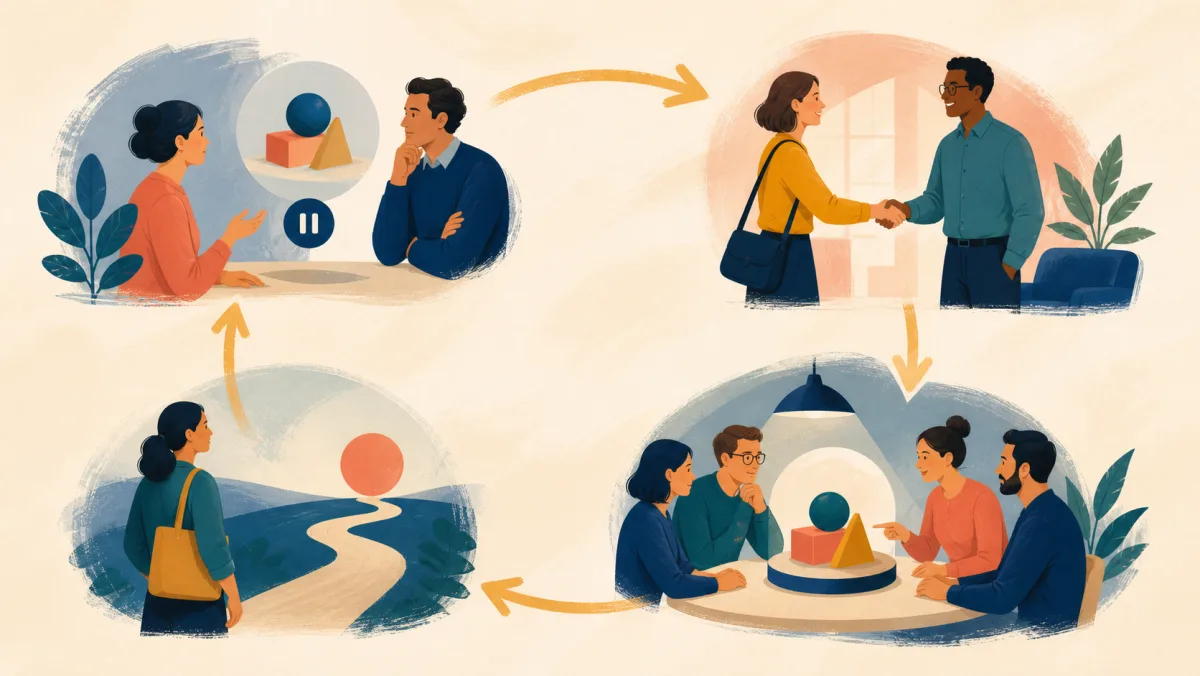
At work, circle back usually means return to a topic or person later. It is common in meetings, email, and chat.
The phrase often marks a planned follow-up after a pause or another step. It may suggest that a matter remains open. However, context determines whether it is a firm commitment or a vague delay.
"Let's circle back on the vendor contract once Legal has reviewed the indemnity clause."
"I'll circle back with the design team after the user-testing results come in."
"We circled back to the staffing question at the end of the meeting, once budget was confirmed."
Quick check
What does the lead promise?
You know "Circle Back" well.
Keep going with the full learning path — more workplace contexts, related expressions, and practice using it yourself with feedback.
Continue with "Circle Back" →There's more to "Circle Back" than it seems.
You've got part of it, but the full learning path goes deeper into its nuances, workplace contexts, and when it sounds natural — then gives you practice using it yourself.
Learn "Circle Back" in depth →What makes it a return, not a first contact
The phrase links an earlier point with later attention. The gap may last minutes, days, or months. It most clearly describes a return to something already raised. Some speakers also use it loosely for follow-up or renewed contact.
What circling back doesn't mean
Circling back does not itself mean a matter is solved or approved. Those results may come from the later talk. "I'll circle back on this" only signals later attention unless the speaker adds a result.
The words also have literal uses. "The runner circled back to the starting line" describes physical movement. The verb circle can mean move around something or draw a ring around it. Context separates these uses from workplace follow-up.
Try it yourself
Describe a return without promising an outcome
Why the distinction is worth holding onto
The phrase names a return, not a completed result. "I circled back" means contact or discussion happened again. It does not prove that the issue was resolved. Add the outcome when readers need the current status.
Why the phrase is so common in the first place
Not every issue can be decided when it first appears. A team may need approval, data, or time to think. Circle back offers a short way to mark later attention. Add a date or trigger when follow-through matters.
A word worth using precisely
Because the phrase is common, it can become vague filler. Make it useful by naming the topic, person, date, or next trigger. A clear follow-up matters more than the idiom itself.
Practice scenarios
Practice using circle back in situations like:
- deciding whether something counts as a genuine return or a first point of contact
- explaining to a colleague what circling back does and doesn't commit you to
- reading a status update and checking whether 'circled back' actually means resolved
Useful practice phrases:
- "Let's circle back on this once Legal has reviewed it."
- "I'll circle back with the team after the results come in."
- "We circled back to that question once budget was confirmed."
Want to actually use "Circle Back" naturally at work?
Understanding it is one thing. Practice its nuances, see how it works in real workplace situations, and use it yourself with feedback.
Start the "Circle Back" learning path →"Circle back" points to later attention, not a guaranteed outcome.
Use it for a return or follow-up, then state the result separately.