
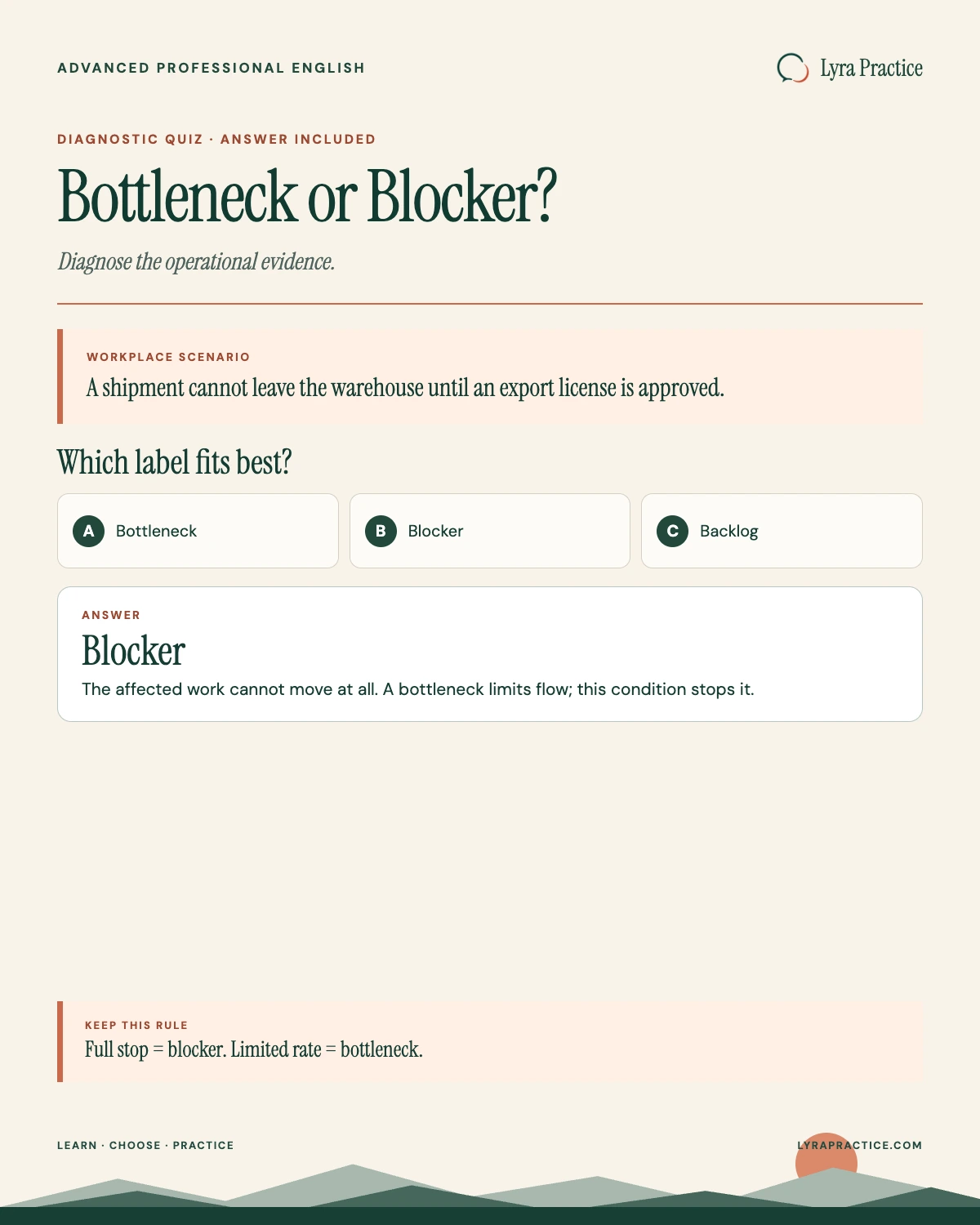
At work, a "bottleneck" is a point that limits a process's flow or output. Work may arrive faster than that point can handle it. As a result, items can wait there.
The word is more precise than "something is slow." It names a limiting point, not every problem or delay.
A process can also have more than one constraint. The main bottleneck may change after the team fixes one step.
Quick check
What does bottleneck mean at Rowan?
You know "Bottleneck" well.
Keep going with the full learning path — more workplace contexts, related expressions, and practice using it yourself with feedback.
Continue with "Bottleneck" →There's more to "Bottleneck" than it seems.
You've got part of it, but the full learning path goes deeper into its nuances, workplace contexts, and when it sounds natural — then gives you practice using it yourself.
Learn "Bottleneck" in depth →Where the word comes from
Picture a bottle with a narrow neck. The neck limits how quickly liquid can leave. That image gives us the workplace meaning. One part of a process limits how much the whole process can move.
"Legal review is slow."
versus
"Legal review is the bottleneck in our approval process."
The first sentence reports slow work. The second makes a stronger claim: legal review limits the wider process. That claim should rest on evidence such as wait times, queues, or capacity.
Try it yourself
Interpret the queue at Marlin Property
Why precision is the whole point
Once a team finds a bottleneck, it can examine that step. The response might involve changing priorities, adding capacity, or redesigning the work. The right action depends on the cause. Automation is one option, but it is not always the answer.
"Naming the bottleneck is what lets a team decide where to add capacity, automate, or redesign — instead of just reporting that things feel slow."
You may also see "bottleneck" in traffic, manufacturing, or computing. In each case, something limits flow or performance. At work, the same idea can apply to approvals, staffing, equipment, or decisions.
Common mistakes
Mistake: using bottleneck as a stronger-sounding synonym for "problem."
Ask what limits the process and what evidence shows that limit. A slow step is not always the bottleneck. It may have spare capacity, while another step creates the queue. Also avoid assuming there can be only one constraint in every system.
Practice scenarios
Practice using "bottleneck" in situations like:
- naming the step that currently limits a process
- explaining the evidence behind a bottleneck claim
- checking whether a delay is a bottleneck or a separate problem
Useful practice phrases:
- "[Step] is slow" reports pace. "[Step] is the bottleneck in [process]" identifies a limit.
- Naming the bottleneck is what lets a team decide where to add capacity, automate, or redesign.
- If you can't point to a place limiting the flow, you haven't identified a bottleneck yet.
Want to actually use "Bottleneck" naturally at work?
Understanding it is one thing. Practice its nuances, see how it works in real workplace situations, and use it yourself with feedback.
Start the "Bottleneck" learning path →A bottleneck is not simply a bigger word for "problem."
It points to a current limit in the flow. Name the evidence, then decide what action fits.