
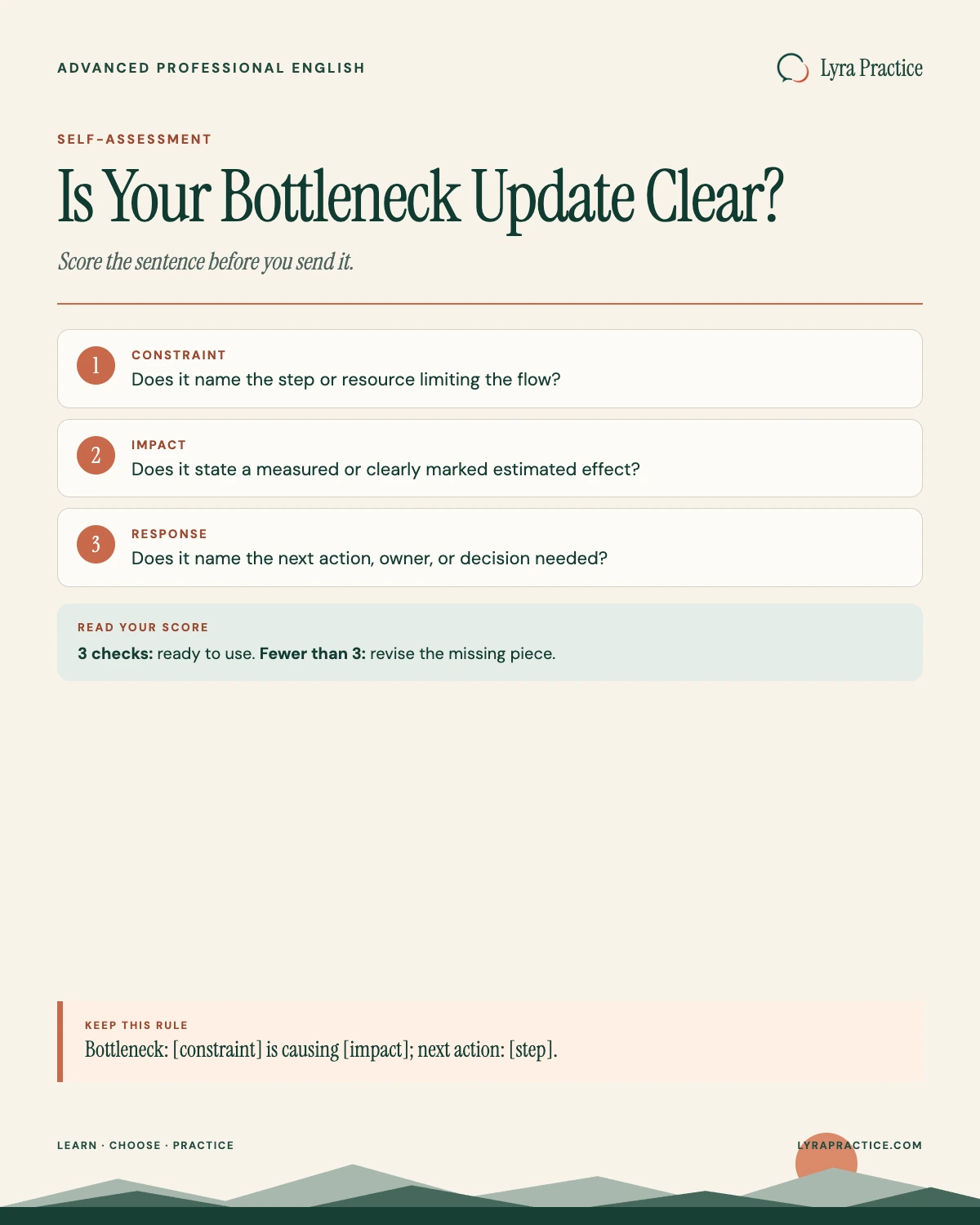
Naming a bottleneck is only the first step. A useful update explains the limit, its impact, and what happens next. It should also make clear whether you are sharing facts, estimates, or a request for a decision.
A simple structure combines three things in one line: the specific constraint, its business impact, and a next action.
"Bottleneck: [constraint] is causing [impact]; next action: [step]."
Quick check
Vague alarm or actionable status?
You know "Bottleneck" well.
Keep going with the full learning path — more workplace contexts, related expressions, and practice using it yourself with feedback.
Continue with "Bottleneck" →There's more to "Bottleneck" than it seems.
You've got part of it, but the full learning path goes deeper into its nuances, workplace contexts, and when it sounds natural — then gives you practice using it yourself.
Learn "Bottleneck" in depth →Why this structure works
This gives leaders a short summary of the constraint and the proposed response. They may still need evidence, options, costs, or details about who can approve the action.
"Bottleneck: legal review is causing a 2-week delay on every enterprise deal; next action: requesting a dedicated reviewer for Q3 deals."
"Bottleneck: onboarding capacity is causing 30% of new signups to churn before activation; next action: hiring two onboarding specialists."
These are sample lines, so their numbers must be replaced with verified facts or marked estimates. A short update does not need every meeting or handoff. It does need enough context to support its claim and request.
A related pattern can help when a bottleneck is new rather than ongoing:
"The single-reviewer approval step has become the bottleneck because pull requests are now waiting 4 days on average, up from same-day."
This version gives a measure: the wait changed from same-day to four days. Check the source and time period before using such a claim. A longer wait may show a constraint, but the team may need more data to prove its cause.
Try it yourself
Draft Monday’s Beacon Logistics update
Common mistakes
Mistake: reporting only that something is slow.
Without the impact and next action, the update may not show what help is needed. "Legal review is slow" is vague. "Legal review is causing a 2-week delay; here's what I'm proposing" gives a claim and proposal. Leaders can then test the evidence and decide whether they have authority to act.
Escalating a stalled approval without blaming the approver
The same structure gets harder to apply cleanly when the message is going directly to the person who owns the limiting step. Escalating a decision bottleneck is especially sensitive for exactly that reason.
"Risky: 'Procurement is holding everything up again.'"
That line blames a team without giving useful facts. It may make the owner defensive and may not help the work move.
"Safer: 'Procurement approval is the bottleneck on three deals this week — is there anything I can do to help move it, or should we flag it to your lead?'"
"Also safer: 'I know contracts review is buried right now — is there anything I can do to help move the Meridian deal, or should I flag it to your director?'"
The safer versions focus on the approval step and ask what route to use. They cannot guarantee faster action, but they make the request clear without assigning blame. Follow the agreed escalation process when possible. For urgent issues or reports with a required route, use that route even if the owner objects.
Explaining a bottleneck to a client without sounding like an excuse
External updates need care. A clear update can still sound as if it blames the client, a vendor, or your team. Use cause, impact, and response, but only state causes and numbers you can support.
"'Customs clearance is currently the bottleneck for your shipment — it's adding roughly 5 business days, and we've requested expedited processing to reduce that.'"
"'The delay is coming from a single compliance review step — it's adding about 3 business days, and we've assigned a second reviewer to clear it faster.'"
Sometimes softer wording may fit the audience better than the word "bottleneck" itself:
"Client-safe: 'a supply constraint is affecting delivery timing' can preserve the same logic as 'bottleneck' with a softer register when that reads better for the audience."
Mistake: hiding behind a vague excuse, or quietly blaming the client's own team. Stage, impact, and response make the update clearer, but they do not prove fault or guarantee success. Be fair about uncertainty, ownership, and any action the client needs to take.
Practice scenarios
Practice describing a bottleneck clearly in situations like:
- writing a one-line constraint-impact-action update for leadership
- escalating a stalled approval to its owner without sounding accusatory
- explaining a client-facing delay with cause, impact, and mitigation
Useful practice phrases:
- "Bottleneck: [constraint] is causing [impact]; next action: [step]."
- "[Step] has become the bottleneck because [evidence]."
- "[Stage] is currently the bottleneck for [outcome] — it's adding [impact], and we've [mitigation]."
Want to actually use "Bottleneck" naturally at work?
Understanding it is one thing. Practice its nuances, see how it works in real workplace situations, and use it yourself with feedback.
Start the "Bottleneck" learning path →A bottleneck may need action from someone with the right authority.
Constraint, impact, and next action form a useful summary. Add evidence or a clear decision request when needed.