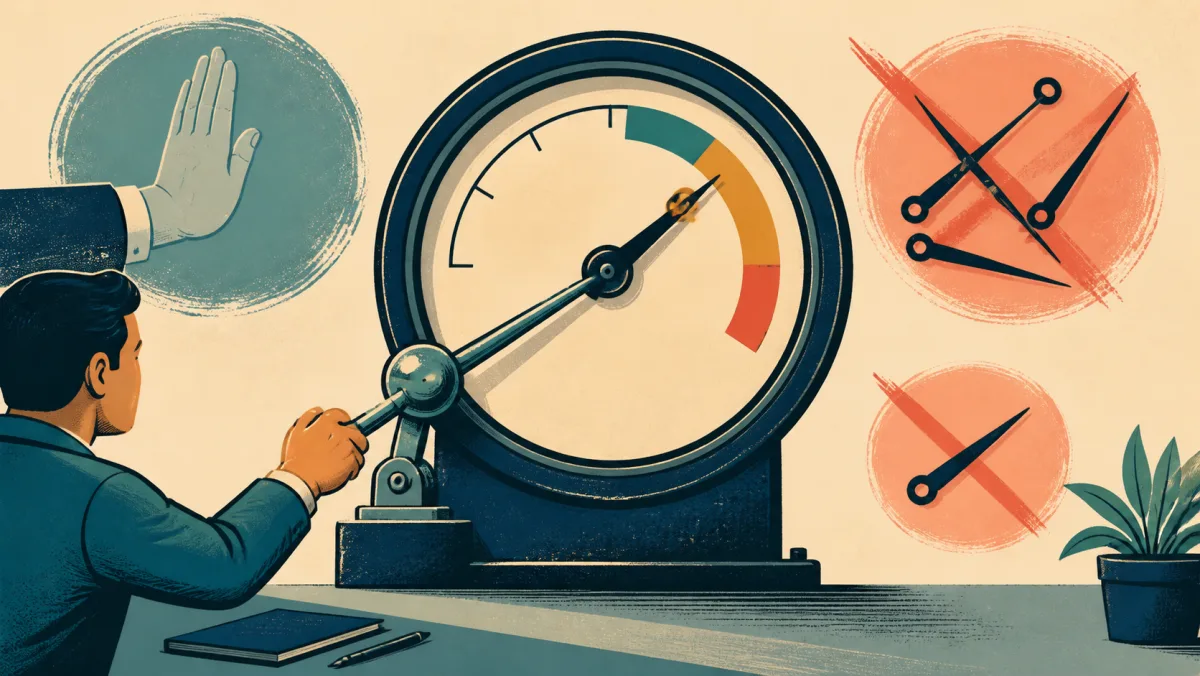
Move the needle may look like an ordinary verb-object combination, so small changes can seem acceptable. In professional English, though, the idiom has a conventional form. A different verb or article may distract the reader, even when the intended meaning remains clear.
Quick check
Repair the fixed idiom
You know "Move The Needle" well.
Keep going with the full learning path — more workplace contexts, related expressions, and practice using it yourself with feedback.
Continue with "Move The Needle" →There's more to "Move The Needle" than it seems.
You've got part of it, but the full learning path goes deeper into its nuances, workplace contexts, and when it sounds natural — then gives you practice using it yourself.
Learn "Move The Needle" in depth →The direct object is fixed
The object is always singular, always definite: the needle. Not "a needle." Not "needles."
Right: "This redesign could move the needle on activation." Wrong: "This redesign could move a needle on activation."
The definite article is part of the conventional phrase, just as "kick the bucket" does not become "kick a bucket." In this business idiom, use "move a needle" or "move needles" only when describing physical needles.
The verb is fixed too
The verb is always move. Not "push." Not "turn." Not "change."
Right: "The pricing test could move the needle on conversion." Wrong: "The pricing test could push the needle on conversion."
"Push," "turn," and "change" can all describe a physical "needle." They are not conventional substitutes in this idiom. Use move when you mean to create a meaningful change in a result or metric.
Try it yourself
Fix Ana’s line before the town hall
Why the fixed form matters more than it seems to
These errors are minor, and most listeners will still understand the message. Yet a changed article or verb can make the phrase sound unusual. Treat the complete idiom as one lexical unit instead of building it word by word. Repeated practice can make the "standard form" easier to retrieve under pressure.
Significantly move the needle, not very
The phrase also requires an appropriate modifier. "Very" cannot modify the verb move on its own. It can modify an adjective, as in very likely to move the needle, but "very move the needle" is not grammatical.
Natural: "This change could significantly move the needle on retention." Wrong: "This change could very move the needle on retention."
Use "really," "meaningfully," "materially," or "significantly" when the strength matches your evidence. Each can modify this verb phrase and, unlike "very," can appear before move.
Practice scenarios
Practice producing the fixed form with less effort in situations like:
- describing a change's impact in a status update, verb and article both correct
- intensifying a claim naturally with "significantly" instead of reaching for "very"
- catching yourself before substituting "push" or "turn" for "move"
- reviewing a colleague's draft that has the object or verb slightly wrong
- writing quickly under time pressure, where fixed-form slips are most likely
Useful practice phrases:
- "This could move the needle on..."
- "This could significantly move the needle on..."
- "Not 'push' or 'turn' the needle — just 'move' it."
- "It's always 'the needle,' never 'a needle.'"
Want to actually use "Move The Needle" naturally at work?
Understanding it is one thing. Practice its nuances, see how it works in real workplace situations, and use it yourself with feedback.
Start the "Move The Needle" learning path →Conventional phrases become easier to produce when learned as complete units.
Here, a small grammatical adjustment makes professional wording more natural.