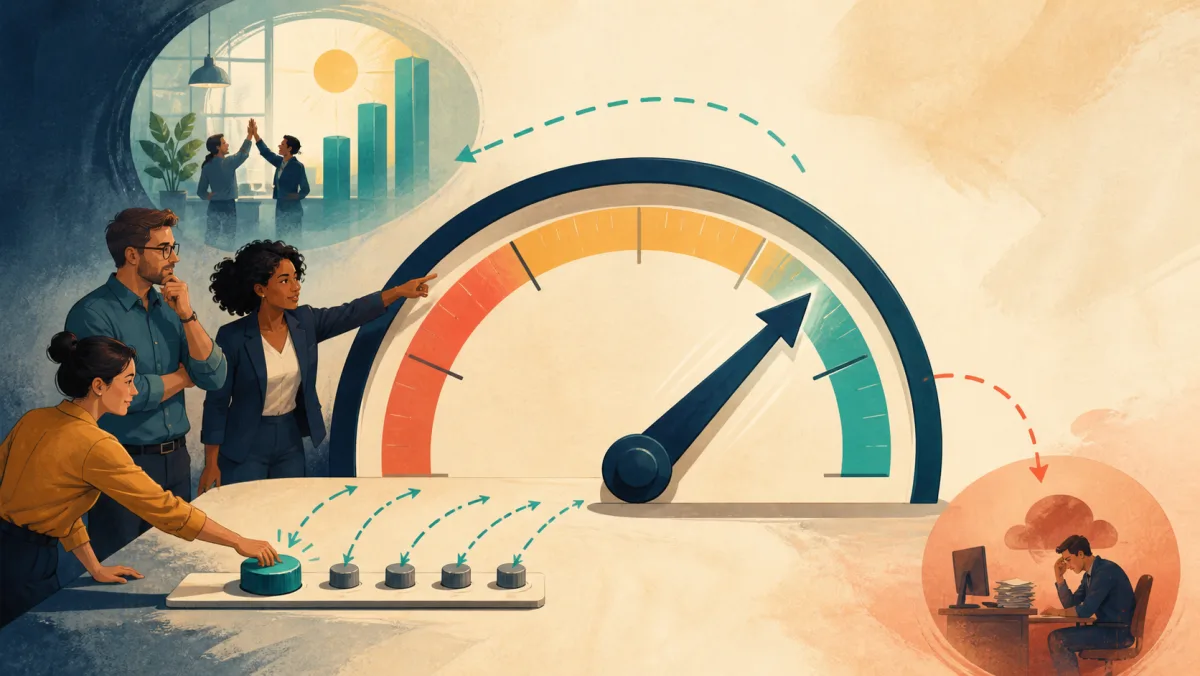
Move the needle means to cause a meaningful change in an important result. The phrase appears in updates, planning talks, and client advice. Your verb and level of detail should match the evidence. These ten examples show how.
Quick check
Does the result justify the idiom?
You know "Move The Needle" well.
Keep going with the full learning path — more workplace contexts, related expressions, and practice using it yourself with feedback.
Continue with "Move The Needle" →There's more to "Move The Needle" than it seems.
You've got part of it, but the full learning path goes deeper into its nuances, workplace contexts, and when it sounds natural — then gives you practice using it yourself.
Learn "Move The Needle" in depth →A proven, realized result
A strong result claim gives the numbers before and after the change. It should also have evidence that links the action to the result.
"In the controlled test, the redesigned checkout moved the needle on conversion, from 2.1% to 2.8% over six weeks."
Before work ships -- a prospective, evidence-matched claim
You can use the phrase before results exist, but the verb must match the evidence. Could marks a possibility. Is likely to needs stronger support, such as a sound test or a close past result.
"Based on the pilot, the pricing test is likely to move the needle on conversion when the new checkout ships."
When the outcome gets worse, not better
The phrase often suggests improvement, but it can also mark a meaningful decline. Add in the wrong direction and name the worse result.
"The pricing change moved the needle in the wrong direction: the renewal rate fell by four percentage points."
Try it yourself
Write one clean sentence for Mira’s update
A small but real effect -- not the same as "won't"
Won't, doesn't, and barely make different claims. Barely means there is a small effect. Doesn't reports no meaningful effect. Won't predicts that no meaningful effect will occur.
"The new banner ad barely moved the needle on sign-ups: the tested lift was small but measurable."
"Based on the test, this copy change alone won't move the needle on churn; we need to fix onboarding first."
Naming the beneficiary as well as the metric
Use on before the metric. You can then use for before the group that benefits.
"The fix moved the needle on backlog for enterprise customers, cutting open tickets from 240 to 170."
A precise claim, not a hyped one
A precise claim names the metric and the expected size of change. Without that detail, the phrase can sound like a slogan.
"Instead of promising it 'will move the needle,' the proposal gave a forecast: a five-percentage-point lift in retention."
A mixed result, reported honestly
One project can help one metric but not another. Report each result instead of saying only that the project worked.
"The campaign moved the needle on brand awareness, but the test found no clear change in qualified pipeline."
A hedged client recommendation
For a recommendation, explain how the action may help and use a careful modal such as could. This avoids a promise you cannot support.
"This investment could move the needle on renewals by finding adoption gaps earlier, though we cannot guarantee the result."
Tactful, evidence-seeking pushback
A skeptical reply can sound blunt. Recognize the idea, state your doubt, and ask for evidence. This keeps the discussion open.
"It's a solid idea, but I'm not sure it will move the needle on retention -- do we have any data suggesting otherwise?"
Practice scenarios
Practice using move the needle in situations like:
- reporting a metric that changed, with the actual before-and-after numbers
- splitting a mixed result by metric instead of collapsing it into one blanket verdict
- delivering a skeptical impact judgment about a colleague's proposal without shutting the conversation down
Useful practice phrases:
- "[Change] moved the needle on [metric], from [X] to [Y]."
- "[Change] moved the needle on [metric A], but not yet on [metric B]."
- "I'm not sure this will move the needle on [metric] -- what evidence do we have?"
Want to actually use "Move The Needle" naturally at work?
Understanding it is one thing. Practice its nuances, see how it works in real workplace situations, and use it yourself with feedback.
Start the "Move The Needle" learning path →Across these examples, the metric, direction, and level of confidence all change. The evidence behind the claim changes too.
Careful calibration matters more than the idiom. Match the wording to the evidence, and the claim will sound precise rather than hollow.