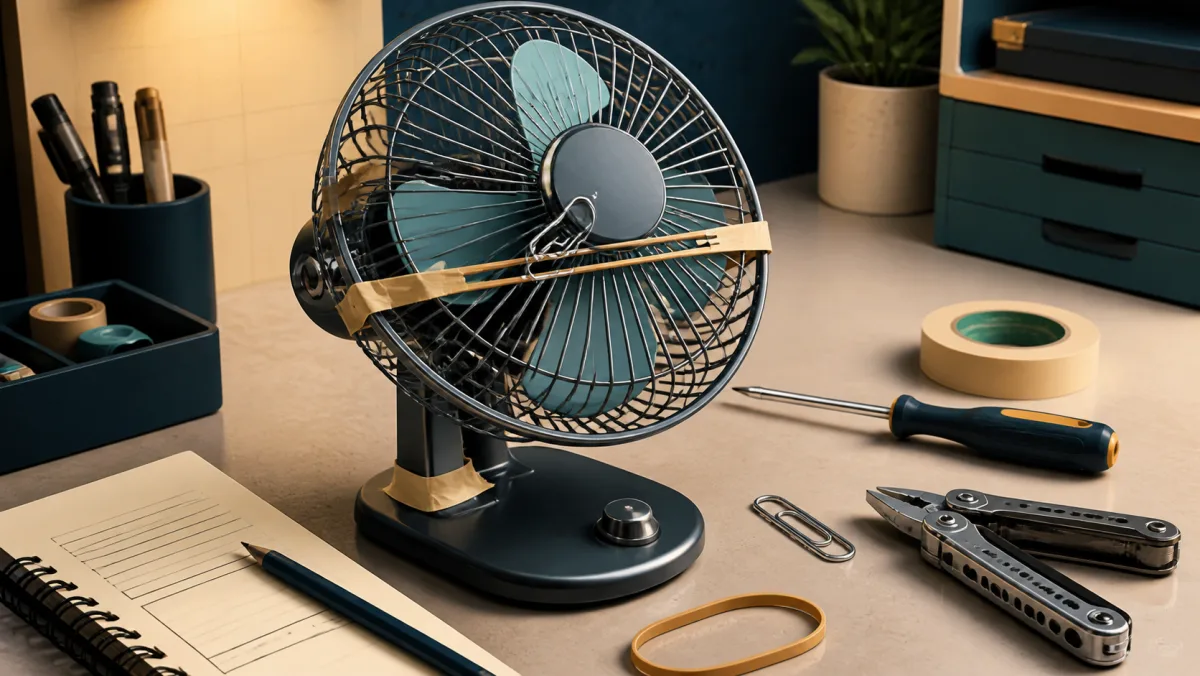
To MacGyver something means to make or repair it with items at hand. The word suggests a clever, improvised solution. The result may work, but the word does not promise quality.
"The tripod broke, so we MacGyvered a stand out of books and tape."
The verb comes from the original American TV series MacGyver. Its hero, Angus MacGyver, solves urgent problems with common objects and scientific skill. A later series reimagined the same character.
MacGyver is pronounced muh-GUY-vur, with the stress on guy.
Quick check
How well do you know "Macgyver"?
You know "Macgyver" well.
Keep going with the full learning path — more workplace contexts, related expressions, and practice using it yourself with feedback.
Continue with "Macgyver" →There's more to "Macgyver" than it seems.
You've got part of it, but the full learning path goes deeper into its nuances, workplace contexts, and when it sounds natural — then gives you practice using it yourself.
Learn "Macgyver" in depth →The central idea behind MacGyver
A typical use has three parts:
- There is an immediate practical problem.
- The proper tools or materials are unavailable.
- Someone invents a workable solution from what is nearby.
The word points to clever use of limited supplies. An ordinary repair usually does not fit the verb.
"Facilities replaced the damaged cable."
This is an ordinary repair.
"We MacGyvered a temporary cable shield from a plastic folder."
This sounds clever, makeshift, and short-term.
Try it yourself
Use "Macgyver" yourself
How to use MacGyver as a verb
In informal use, MacGyver behaves like a regular English verb:
- present: “We can MacGyver a solution.”
- past: “She MacGyvered a replacement handle.”
- continuous: “They're MacGyvering a temporary setup.”
It is usually transitive, so it takes an object:
"Can we MacGyver a demo before the client arrives?"
Speakers also use MacGyver together for a solution made from several pieces:
"They MacGyvered together a functional recording booth with blankets and spare panels."
The word comes from a character's name, so writers often use a capital M. Lowercase forms also appear in informal writing.
Is MacGyvering positive or negative?
It can sound positive, mixed, or negative.
Positive:
"Our engineer MacGyvered a fix that kept the event running."
This praises quick thinking under pressure.
Mixed:
"We MacGyvered a workaround for today, but it isn't a maintainable solution."
This values the quick fix but also names its limits.
Negative:
"The whole system has been MacGyvered together with scripts nobody owns."
This criticizes a fragile setup that lacks clear ownership.
The word does not guarantee quality, long life, or safety. It describes a clever solution made with limited supplies.
MacGyver vs hack, workaround, and jury-rig
A workaround avoids or bypasses a problem. It may not involve building anything.
A hack can mean a clever shortcut or makeshift change. In technology, it can also mean unauthorized computer access. Context matters.
To jury-rig something means to build it quickly from items at hand. This is close to MacGyver. However, the name highlights clever problem-solving and the TV character.
"We used a workaround by exporting the data manually."
"We jury-rigged a cover from cardboard."
"Sam MacGyvered a sensor mount from two clips and an old phone case."
The final sentence presents Sam as a clever problem-solver.
Tone and professional use
The verb is informal and appears in workplace talk. It works best when listeners know the TV reference. Do not assume every global audience will know it.
Avoid it when safety, compliance, or engineering quality needs exact wording. “We MacGyvered the electrical connection” may sound alarming rather than impressive.
A clear work sentence names the limit:
"We MacGyvered a temporary fix for the presentation; the permanent replacement arrives tomorrow."
The core image is a capable person solving a problem with common items. Still, use plain language when readers may not know the show.
For another film title that became a metaphor, see what a Groundhog Day reference means. For a cartoon comparison involving elaborate inventions that fail, see Wile E. Coyote and the Road Runner.
A lot to take in? It is.
But Rome wasn't built in a day. Build your American workplace English one expression and cultural reference at a time—with curated explanations and structured practice in Lyra Practice.
Start a session →